The US dollar broke through the 162 level against the Japanese yen, reaching a 40-year high, and the bullish momentum may continue in the short term.
2026-06-30 10:57:23
The US dollar strengthened significantly against the Japanese yen during Asian trading hours, briefly breaking through the key psychological level of 162.00 to reach a 40-year high. However, the upward momentum slowed noticeably after hitting this high, mainly due to concerns about potential intervention in the Japanese foreign exchange market, which led to a cautious market sentiment at these high levels.
In Japan, Finance Minister Katsunobu Kato and U.S. Treasury Secretary Bessenter have reached a consensus on the exchange rate issue, stating that they will take appropriate measures to stabilize the market if necessary. Meanwhile, Chief Cabinet Secretary Minoru Kihara reiterated that the government will intervene appropriately if excessive volatility occurs in the foreign exchange market. These statements have, to some extent, limited the space for speculative long positions in the yen, causing the exchange rate to consolidate at high levels.
Nevertheless, the Bank of Japan's gradually hawkish policy stance continues to provide some fundamental support for the yen. The summary of the Bank of Japan's June meeting showed that some policymakers began to focus on upside risks to inflation and discussed the possibility of raising interest rates more quickly to a level closer to neutral. Furthermore, strengthening signs of rising domestic inflation in Japan are also reinforcing market expectations for monetary policy normalization. However, because Japanese interest rates remain significantly lower than those in the United States, the interest rate differential remains wide, keeping yen carry trades active and limiting the yen's upside potential.
Meanwhile, factors in the US continue to support the dollar. Market expectations that the Federal Reserve will maintain high interest rates or even raise them further are still building, and the dollar's stabilization after its previous pullback from a 13-month high has kept the dollar index resilient, providing additional impetus for USD/JPY. Geopolitically, uncertainty surrounding US-Iran relations continues to weigh on market sentiment. The US has indicated that Iran may request talks in Qatar, while Iran denies any near-term negotiation arrangements. This information asymmetry further enhances market caution towards risk assets and indirectly supports demand for the dollar as a safe haven.
Overall, the USD/JPY pair is currently in a highly volatile phase, characterized by a mix of policy expectations and intervention risks. On one hand, the widening interest rate differential between the US and Japan supports the pair's strength; on the other hand, expectations of official Japanese intervention have created a significant psychological resistance level above 162, limiting further upside potential.
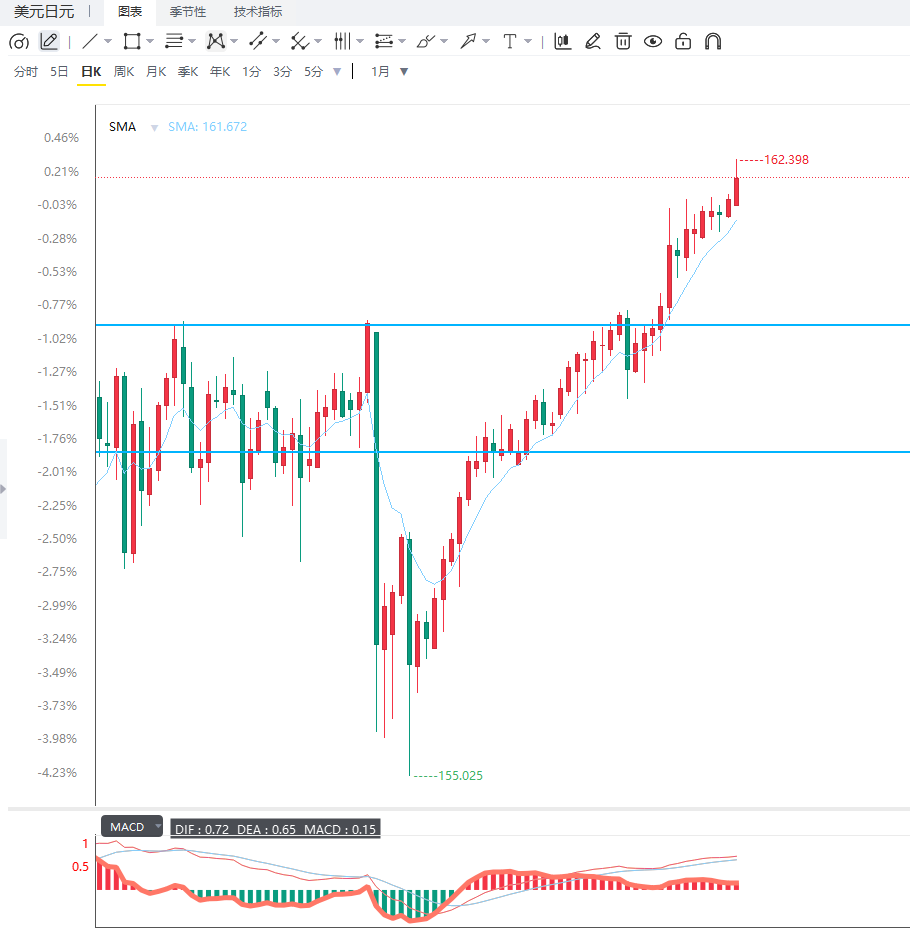
From a daily chart perspective, USD/JPY maintains an extremely strong upward trend. After breaking through the previous high, the price entered a high-level extension phase following the accelerated surge. While the trend structure hasn't shown clear reversal signals, the momentum is beginning to show signs of slowing. The key support level is currently in the 160.50–161.00 area, which is a reference range for previous breakouts and trend retracements. Potential resistance is concentrated in the 162.50–163.20 range; a decisive break above this area could open up further upside potential.
From a 4-hour chart perspective, the short-term structure shows a high-level consolidation with a slightly bullish bias. The moving average system remains in a bullish alignment, but the price has repeatedly encountered resistance near the 162 level, indicating that short-term selling pressure and expectations of intervention are simultaneously increasing. If the exchange rate continues to hold above 161.50, it still has the momentum to test the area above 162.50; however, if intervention signals appear or the US dollar weakens, it may trigger a rapid pullback to the 160.50 or even lower support area.
Editor's Summary:
In summary, the current USD/JPY exchange rate movement is essentially a typical high-level game structure driven by both the USD/JPY interest rate differential and expectations of Japanese intervention. The US dollar remains strong, supported by high interest rate expectations, while the Japanese yen, despite signs of a hawkish policy shift, is still limited by the actual interest rate differential, maintaining an extremely strong exchange rate. The core short-term market risk lies in whether the Japanese authorities will implement foreign exchange intervention; if such a policy is implemented, it could trigger rapid volatility and a pullback. Before that, the exchange rate may maintain a high-level, slightly bullish structure, but will continue to face significant psychological and policy-driven resistance above the 162 level.
In Japan, Finance Minister Katsunobu Kato and U.S. Treasury Secretary Bessenter have reached a consensus on the exchange rate issue, stating that they will take appropriate measures to stabilize the market if necessary. Meanwhile, Chief Cabinet Secretary Minoru Kihara reiterated that the government will intervene appropriately if excessive volatility occurs in the foreign exchange market. These statements have, to some extent, limited the space for speculative long positions in the yen, causing the exchange rate to consolidate at high levels.
Nevertheless, the Bank of Japan's gradually hawkish policy stance continues to provide some fundamental support for the yen. The summary of the Bank of Japan's June meeting showed that some policymakers began to focus on upside risks to inflation and discussed the possibility of raising interest rates more quickly to a level closer to neutral. Furthermore, strengthening signs of rising domestic inflation in Japan are also reinforcing market expectations for monetary policy normalization. However, because Japanese interest rates remain significantly lower than those in the United States, the interest rate differential remains wide, keeping yen carry trades active and limiting the yen's upside potential.
Meanwhile, factors in the US continue to support the dollar. Market expectations that the Federal Reserve will maintain high interest rates or even raise them further are still building, and the dollar's stabilization after its previous pullback from a 13-month high has kept the dollar index resilient, providing additional impetus for USD/JPY. Geopolitically, uncertainty surrounding US-Iran relations continues to weigh on market sentiment. The US has indicated that Iran may request talks in Qatar, while Iran denies any near-term negotiation arrangements. This information asymmetry further enhances market caution towards risk assets and indirectly supports demand for the dollar as a safe haven.
Overall, the USD/JPY pair is currently in a highly volatile phase, characterized by a mix of policy expectations and intervention risks. On one hand, the widening interest rate differential between the US and Japan supports the pair's strength; on the other hand, expectations of official Japanese intervention have created a significant psychological resistance level above 162, limiting further upside potential.
From a daily chart perspective, USD/JPY maintains an extremely strong upward trend. After breaking through the previous high, the price entered a high-level extension phase following the accelerated surge. While the trend structure hasn't shown clear reversal signals, the momentum is beginning to show signs of slowing. The key support level is currently in the 160.50–161.00 area, which is a reference range for previous breakouts and trend retracements. Potential resistance is concentrated in the 162.50–163.20 range; a decisive break above this area could open up further upside potential.
From a 4-hour chart perspective, the short-term structure shows a high-level consolidation with a slightly bullish bias. The moving average system remains in a bullish alignment, but the price has repeatedly encountered resistance near the 162 level, indicating that short-term selling pressure and expectations of intervention are simultaneously increasing. If the exchange rate continues to hold above 161.50, it still has the momentum to test the area above 162.50; however, if intervention signals appear or the US dollar weakens, it may trigger a rapid pullback to the 160.50 or even lower support area.
Editor's Summary:
In summary, the current USD/JPY exchange rate movement is essentially a typical high-level game structure driven by both the USD/JPY interest rate differential and expectations of Japanese intervention. The US dollar remains strong, supported by high interest rate expectations, while the Japanese yen, despite signs of a hawkish policy shift, is still limited by the actual interest rate differential, maintaining an extremely strong exchange rate. The core short-term market risk lies in whether the Japanese authorities will implement foreign exchange intervention; if such a policy is implemented, it could trigger rapid volatility and a pullback. Before that, the exchange rate may maintain a high-level, slightly bullish structure, but will continue to face significant psychological and policy-driven resistance above the 162 level.
- Risk Warning and Disclaimer
- The market involves risk, and trading may not be suitable for all investors. This article is for reference only and does not constitute personal investment advice, nor does it take into account certain users’ specific investment objectives, financial situation, or other needs. Any investment decisions made based on this information are at your own risk.