A supply gap of one billion barrels has emerged, triggering a global oil storage replenishment surge that could push up oil prices.
2026-06-30 11:16:53
The geopolitical conflict in the Middle East has caused a cumulative loss of more than one billion barrels of global crude oil supply. Thanks to ample crude oil reserves before the war, major Asian countries have reduced imports and released inventory, successfully preventing a sharp rise in oil prices.
Currently, countries around the world are simultaneously launching reserve construction and inventory replenishment plans. The International Energy Agency previously released a large amount of emergency crude oil, and subsequent replenishment demand will support crude oil demand in the long term. Many Asian countries have realized that new energy sources cannot replace crude oil in the short term, and are building reserves in accordance with the model of major Asian countries, but the huge capital threshold has become the main obstacle. Once the situation in the Middle East eases, concentrated replenishment will drive a recovery in crude oil demand, changing the supply and demand pattern of the oil market in the medium to long term.
In March of this year, the escalation of the conflict between the US and Iran disrupted shipping in the Strait of Hormuz, leading to a significant contraction in global crude oil supply, with the cumulative shortfall exceeding one billion barrels. The International Energy Agency subsequently announced the release of 400 million barrels from the Joint Contingency Reserve, a scale far exceeding the 182 million barrels released during the Russia-Ukraine conflict in 2022. Combined with additional releases from the US Strategic Petroleum Reserve, this provided short-term relief from the supply shortage.

Before the crisis, this major Asian country had long purchased crude oil from various countries at low prices, building the world's largest oil reserves. After the conflict broke out, the country proactively reduced crude oil imports and used its reserves to offset the price pressure caused by the supply contraction, preventing oil prices from soaring to triple digits and becoming a core pillar for stabilizing the international oil market.
This shipping lane blockade has fully exposed the vulnerability of countries with weak reserves to risks, leading to a consensus within the industry that even as the global energy transition continues to accelerate, crude oil remains the core energy source for the global economy.
In the early stages of the conflict, the market generally expected that energy-importing countries would make every effort to develop wind power and solar power to reduce their dependence on Middle Eastern crude oil. Asian countries did indeed increase their investment in renewable energy. However, governments of all countries have acknowledged that new energy sources do not have the ability to replace fossil fuels in the short term. Therefore, they launched strategic crude oil reserve plans, and the model of Asian major countries setting up reserves in advance has been imitated by many countries.
Previously, the International Energy Agency released large quantities of reserves, and countries depleted their own inventories. Once the conflict eases, a large-scale replenishment will inevitably begin, continuously driving up the demand for crude oil purchases. In addition to replenishing existing reserves, many countries with insufficient reserves plan to build new storage facilities.
Taking India as an example, its existing crude oil reserves can only last for eight days, which is seriously insufficient to meet safety standards. The government has requested state-owned oil companies to add 13 million barrels of reserves, but this amount is a drop in the bucket to cope with a large-scale supply crisis. Improving the reserve system requires hundreds of billions of dollars. Not only India, but all major crude oil importing countries in the world have a need to expand their reserves. Major Asian countries and members of the International Energy Agency will also need to gradually replenish their depleted inventories.
The market consensus is that once there are signs of substantial easing in the Middle East crisis, global restocking will drive a rapid increase in crude oil demand. The International Energy Agency, which consistently adheres to the peak demand theory for crude oil, estimates in its latest monthly report that, due to the impact of geopolitical conflicts, global daily crude oil demand will decrease by 1.1 million barrels this year, but will rebound by 2 million barrels per day in 2027.
The expectation of a recovery in demand may cause short-term fluctuations in oil prices, but the medium- to long-term increase in demand will continue to change the operating logic of the oil market.
The Middle East conflict has created a significant crude oil supply gap, temporarily suppressing oil prices through national emergency reserves. However, subsequent global replenishment and new reserve construction will generate sustained demand for crude oil. Many countries are adopting the reserve models of major Asian countries, but high capital costs limit the speed of reserve expansion. Once the geopolitical situation truly eases, crude oil demand will recover significantly, becoming a core variable influencing international oil price trends over the next two years.
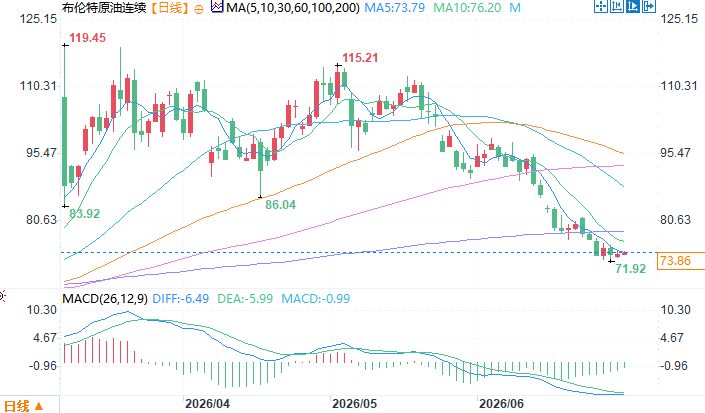
Brent crude oil daily chart source: EasyForex
At 11:15 AM Beijing time on June 30, Brent crude oil futures were trading at $73.82 per barrel.
Currently, countries around the world are simultaneously launching reserve construction and inventory replenishment plans. The International Energy Agency previously released a large amount of emergency crude oil, and subsequent replenishment demand will support crude oil demand in the long term. Many Asian countries have realized that new energy sources cannot replace crude oil in the short term, and are building reserves in accordance with the model of major Asian countries, but the huge capital threshold has become the main obstacle. Once the situation in the Middle East eases, concentrated replenishment will drive a recovery in crude oil demand, changing the supply and demand pattern of the oil market in the medium to long term.
Geopolitical shocks have created a huge supply gap, but reserves held by major Asian countries have stabilized global oil prices.
In March of this year, the escalation of the conflict between the US and Iran disrupted shipping in the Strait of Hormuz, leading to a significant contraction in global crude oil supply, with the cumulative shortfall exceeding one billion barrels. The International Energy Agency subsequently announced the release of 400 million barrels from the Joint Contingency Reserve, a scale far exceeding the 182 million barrels released during the Russia-Ukraine conflict in 2022. Combined with additional releases from the US Strategic Petroleum Reserve, this provided short-term relief from the supply shortage.
Before the crisis, this major Asian country had long purchased crude oil from various countries at low prices, building the world's largest oil reserves. After the conflict broke out, the country proactively reduced crude oil imports and used its reserves to offset the price pressure caused by the supply contraction, preventing oil prices from soaring to triple digits and becoming a core pillar for stabilizing the international oil market.
A global consensus has been reached on oil storage; new energy sources cannot completely replace crude oil.
This shipping lane blockade has fully exposed the vulnerability of countries with weak reserves to risks, leading to a consensus within the industry that even as the global energy transition continues to accelerate, crude oil remains the core energy source for the global economy.
In the early stages of the conflict, the market generally expected that energy-importing countries would make every effort to develop wind power and solar power to reduce their dependence on Middle Eastern crude oil. Asian countries did indeed increase their investment in renewable energy. However, governments of all countries have acknowledged that new energy sources do not have the ability to replace fossil fuels in the short term. Therefore, they launched strategic crude oil reserve plans, and the model of Asian major countries setting up reserves in advance has been imitated by many countries.
The concentrated release of demand for replenishing and building new reserves in various countries highlights the constraints on funding.
Previously, the International Energy Agency released large quantities of reserves, and countries depleted their own inventories. Once the conflict eases, a large-scale replenishment will inevitably begin, continuously driving up the demand for crude oil purchases. In addition to replenishing existing reserves, many countries with insufficient reserves plan to build new storage facilities.
Taking India as an example, its existing crude oil reserves can only last for eight days, which is seriously insufficient to meet safety standards. The government has requested state-owned oil companies to add 13 million barrels of reserves, but this amount is a drop in the bucket to cope with a large-scale supply crisis. Improving the reserve system requires hundreds of billions of dollars. Not only India, but all major crude oil importing countries in the world have a need to expand their reserves. Major Asian countries and members of the International Energy Agency will also need to gradually replenish their depleted inventories.
With expectations of a recovery in crude oil demand, oil prices are likely to fluctuate in the short term.
The market consensus is that once there are signs of substantial easing in the Middle East crisis, global restocking will drive a rapid increase in crude oil demand. The International Energy Agency, which consistently adheres to the peak demand theory for crude oil, estimates in its latest monthly report that, due to the impact of geopolitical conflicts, global daily crude oil demand will decrease by 1.1 million barrels this year, but will rebound by 2 million barrels per day in 2027.
The expectation of a recovery in demand may cause short-term fluctuations in oil prices, but the medium- to long-term increase in demand will continue to change the operating logic of the oil market.
Summarize
The Middle East conflict has created a significant crude oil supply gap, temporarily suppressing oil prices through national emergency reserves. However, subsequent global replenishment and new reserve construction will generate sustained demand for crude oil. Many countries are adopting the reserve models of major Asian countries, but high capital costs limit the speed of reserve expansion. Once the geopolitical situation truly eases, crude oil demand will recover significantly, becoming a core variable influencing international oil price trends over the next two years.
Brent crude oil daily chart source: EasyForex
At 11:15 AM Beijing time on June 30, Brent crude oil futures were trading at $73.82 per barrel.
- Risk Warning and Disclaimer
- The market involves risk, and trading may not be suitable for all investors. This article is for reference only and does not constitute personal investment advice, nor does it take into account certain users’ specific investment objectives, financial situation, or other needs. Any investment decisions made based on this information are at your own risk.