Lagarde defends June rate hike as no "insurance," warns inflation could remain high until 2028.
2026-06-30 16:12:49
On Tuesday (June 30), the euro traded lower against the dollar during the European session, currently down about 0.3% and trading below 1.1400.
European Central Bank President Christine Lagarde on Monday strongly defended her June 11 rate hike decision, saying it was a necessary measure to combat real inflationary pressures, rather than an "insurance rate hike" as some have described it.
She warned that without interest rate hikes, inflation could remain above the 2% target until 2028. Lagarde also stated that the central bank no longer needs to implement extremely large interest rate hikes as it did during the energy crisis, but can instead make "measurable adjustments" more leisurely at each meeting.
Amidst a complex backdrop of volatile oil prices due to geopolitical conflicts and an unexpectedly resilient European economy, the European Central Bank is attempting to find a precise balance between "overreacting" and "underreacting."

"Some people have described our rate hike earlier this month as an 'insurance hike.' I'm sorry to disappoint them—that's inaccurate," Lagarde said at the ECB's annual monetary policy conference in Sintra on Monday. "We were facing the prospect of both headline and core inflation rising at that time."
She further pointed out that without the 25 basis point rate hike on June 11 (raising the benchmark interest rate to 2.25%), inflation might have lingered above the 2% target until 2028. This was the first rate adjustment by the European Central Bank in a year, and even after the rate hike, inflation is not expected to return to the 2% target level until the last quarter of 2027. The Eurozone's annualized inflation rate in May was 3.2%.
Looking back at history, Lagarde said that after Russia cut off natural gas supplies, the European Central Bank responded with "the fastest tightening cycle in history," using unprecedented interest rate hikes to successfully curb double-digit inflation.
However, she made it clear that the same level of force was no longer necessary at this stage: "We can make measurable adjustments to interest rates based on the shocks we face." This statement marks the European Central Bank's formal shift from crisis management mode to a more deliberate policy calibration phase.
Lagarde revealed that central bank forecasters are now using both "mild" and "severe" scenarios to assess the potential trajectory of geopolitical events, ensuring that central banks neither overreact nor underreact. This methodological upgrade reflects the fact that traditional linear forecasting is no longer sufficient to meet policy-making needs in the current highly uncertain global environment.
She specifically pointed out that while oil prices fluctuated wildly during the Iran war, the European economy performed better than many had pessimistically anticipated after President Trump imposed new tariffs on European imports. This discrepancy between "severe external shocks and unexpected internal resilience" further reinforces the rationale for the European Central Bank's strategy of "assessing at each meeting and making small, gradual adjustments."
The European Central Bank's remaining two interest rate decision meetings this year are scheduled for July 22-23 and September 9-10.
According to the daily chart, the Euro/USD pair is in a clear medium-term downtrend, with the price declining steadily from the April high of 1.1848, recently testing a low of 1.1324 before a slight rebound. The moving average system is completely bearish, with the MA20 (1.1493), MA50, MA100, and MA200 forming strong resistance from above. The current price remains below all of these moving averages, indicating that the medium-term downtrend structure has not changed.
In terms of indicators, the MACD remains in the bearish zone below the zero line, with DIFF at -0.0064 lower than DEA at -0.0057, and the green bars continuing to run. The bearish momentum has only slightly converged, and there is no bottom reversal signal. The RSI value is 36.31, which is in the weak range of 30-50. It has not entered a deep oversold state, and the downward momentum has not been fully released. The short-term rebound strength is limited.
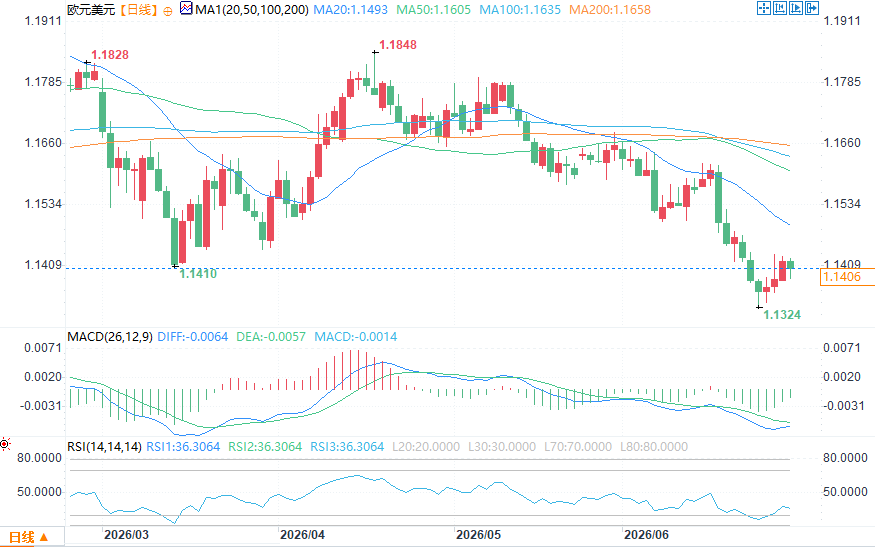
(Euro/USD daily chart, source: FX678)
At 16:12 Beijing time on June 30, the euro was trading at 1.1392/93 against the US dollar.
European Central Bank President Christine Lagarde on Monday strongly defended her June 11 rate hike decision, saying it was a necessary measure to combat real inflationary pressures, rather than an "insurance rate hike" as some have described it.
She warned that without interest rate hikes, inflation could remain above the 2% target until 2028. Lagarde also stated that the central bank no longer needs to implement extremely large interest rate hikes as it did during the energy crisis, but can instead make "measurable adjustments" more leisurely at each meeting.
Amidst a complex backdrop of volatile oil prices due to geopolitical conflicts and an unexpectedly resilient European economy, the European Central Bank is attempting to find a precise balance between "overreacting" and "underreacting."
Defending interest rate hikes: Not a "safe" measure, but a necessary one.
"Some people have described our rate hike earlier this month as an 'insurance hike.' I'm sorry to disappoint them—that's inaccurate," Lagarde said at the ECB's annual monetary policy conference in Sintra on Monday. "We were facing the prospect of both headline and core inflation rising at that time."
She further pointed out that without the 25 basis point rate hike on June 11 (raising the benchmark interest rate to 2.25%), inflation might have lingered above the 2% target until 2028. This was the first rate adjustment by the European Central Bank in a year, and even after the rate hike, inflation is not expected to return to the 2% target level until the last quarter of 2027. The Eurozone's annualized inflation rate in May was 3.2%.
Saying goodbye to radical measures: From "rapid tightening" to "measurable adjustments"
Looking back at history, Lagarde said that after Russia cut off natural gas supplies, the European Central Bank responded with "the fastest tightening cycle in history," using unprecedented interest rate hikes to successfully curb double-digit inflation.
However, she made it clear that the same level of force was no longer necessary at this stage: "We can make measurable adjustments to interest rates based on the shocks we face." This statement marks the European Central Bank's formal shift from crisis management mode to a more deliberate policy calibration phase.
Scenario Response: Finding Precise Balance Amid Dramatic Fluctuations
Lagarde revealed that central bank forecasters are now using both "mild" and "severe" scenarios to assess the potential trajectory of geopolitical events, ensuring that central banks neither overreact nor underreact. This methodological upgrade reflects the fact that traditional linear forecasting is no longer sufficient to meet policy-making needs in the current highly uncertain global environment.
She specifically pointed out that while oil prices fluctuated wildly during the Iran war, the European economy performed better than many had pessimistically anticipated after President Trump imposed new tariffs on European imports. This discrepancy between "severe external shocks and unexpected internal resilience" further reinforces the rationale for the European Central Bank's strategy of "assessing at each meeting and making small, gradual adjustments."
The European Central Bank's remaining two interest rate decision meetings this year are scheduled for July 22-23 and September 9-10.
Technical Analysis
According to the daily chart, the Euro/USD pair is in a clear medium-term downtrend, with the price declining steadily from the April high of 1.1848, recently testing a low of 1.1324 before a slight rebound. The moving average system is completely bearish, with the MA20 (1.1493), MA50, MA100, and MA200 forming strong resistance from above. The current price remains below all of these moving averages, indicating that the medium-term downtrend structure has not changed.
In terms of indicators, the MACD remains in the bearish zone below the zero line, with DIFF at -0.0064 lower than DEA at -0.0057, and the green bars continuing to run. The bearish momentum has only slightly converged, and there is no bottom reversal signal. The RSI value is 36.31, which is in the weak range of 30-50. It has not entered a deep oversold state, and the downward momentum has not been fully released. The short-term rebound strength is limited.
(Euro/USD daily chart, source: FX678)
At 16:12 Beijing time on June 30, the euro was trading at 1.1392/93 against the US dollar.
- Risk Warning and Disclaimer
- The market involves risk, and trading may not be suitable for all investors. This article is for reference only and does not constitute personal investment advice, nor does it take into account certain users’ specific investment objectives, financial situation, or other needs. Any investment decisions made based on this information are at your own risk.