Rising expectations of yen intervention weighed on cross-currency pairs, with EUR/JPY maintaining a narrow range.
2026-06-30 16:36:48
The euro weakened against the yen in early European trading, dipping to around 184.85 , continuing its short-term correction. This decline was primarily driven by a recent yen rebound. With the Japanese government continuing to signal potential intervention, market sentiment regarding the risk of shorting the yen at higher levels has increased, putting pressure on cross-currency pairs.

In Japan, Finance Minister Katsunobu Kato reiterated that the government is prepared to take appropriate action at any time, and Chief Cabinet Secretary Minoru Kihara stated that the government will promote the construction of an economic system more resilient to foreign exchange fluctuations, while also being prepared to intervene in the foreign exchange market if necessary. These statements strengthened market expectations regarding the bottom line of yen policy, thus suppressing speculative short-selling sentiment.
Some institutions even believe that it's "only a matter of time" for the Japanese Ministry of Finance to intervene in the market again, further increasing market caution. Against this backdrop, the yen experienced a temporary recovery, pushing the EUR/JPY exchange rate down from its highs.
On the other hand, the European Central Bank's policy path also constrains the euro. Although Lagarde emphasized the improved resilience of the Eurozone economy, with falling energy prices, market expectations for further interest rate hikes have cooled significantly. Some institutions even believe that the current tightening cycle is nearing its end, with only one more rate hike remaining. This has narrowed the euro's interest rate advantage and weakened its support for the exchange rate.
Meanwhile, the market is focused on the upcoming retail sales and inflation data from Germany, which will provide new clues about the Eurozone's economic momentum and may affect short-term euro sentiment.
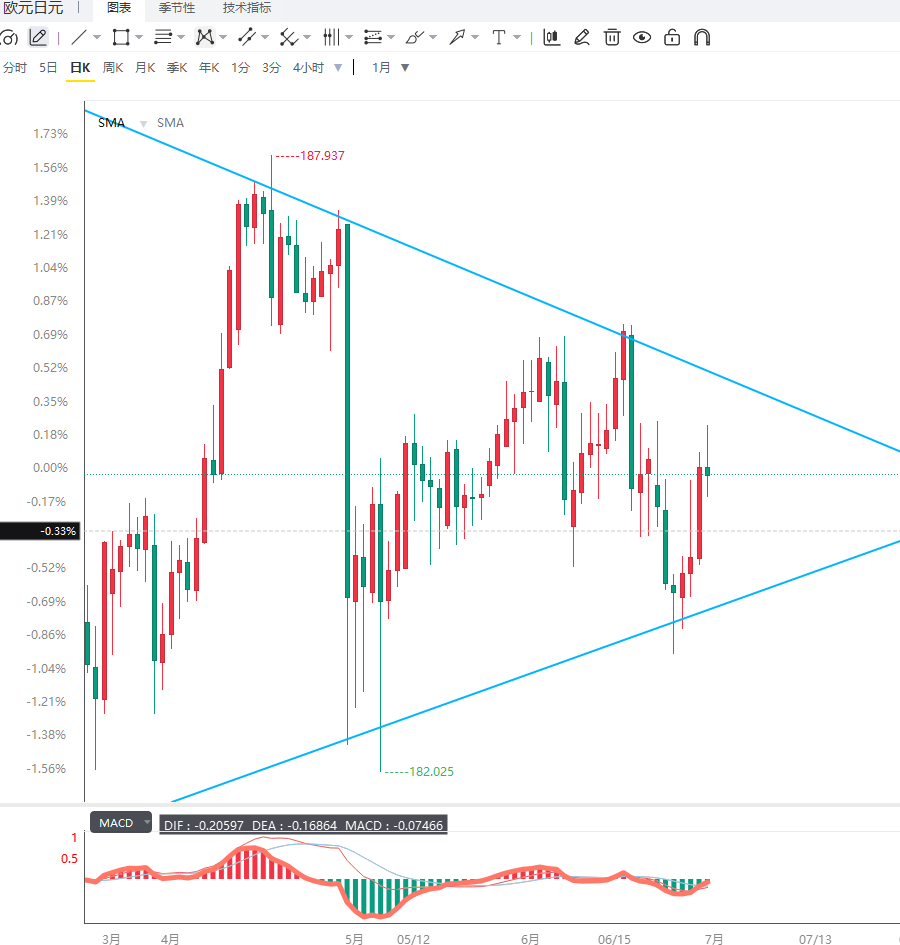
From a daily chart perspective, EUR/JPY remains in a high-level consolidation pattern. The previous strong upward trend has slowed, but a clear reversal structure has not yet formed. Currently, the exchange rate is trading below the 185 level, indicating that short-term upward momentum is stalled. Key support lies in the 183.80–184.00 area, a previous area of dense trading. Resistance is concentrated in the 185.80–186.50 range. If the price cannot regain a foothold above 185, the short-term trend will likely remain one of consolidation and pullback.
From a 4-hour chart perspective, the exchange rate has experienced a significant technical pullback after a continuous surge. The short-term moving average system has begun to flatten and slightly turn upwards, indicating weakening bullish momentum. The RSI indicator has fallen from the overbought zone to the neutral zone, suggesting the market has entered a correction phase. If the exchange rate continues to trade below 185, it may further test the 184 support level; if it breaks through 185.80 again, it is expected to resume its upward trend and challenge higher levels.
Editor's Summary:
In summary, the current EUR/JPY trend is driven by a combination of "strengthened expectations of yen intervention" and "narrowing euro interest rate differentials." The short-term pullback from its highs is a result of the convergence of technical factors and policy expectations. Continued signals of intervention from the Japanese government have significantly increased market vigilance, while the marginal weakening of the European Central Bank's policy has limited the euro's upside potential. Without new fundamental drivers, cross-currency pairs are expected to maintain a high-level consolidation structure. The market should pay close attention to the direction of Japanese currency market intervention and the short-term impact of German economic data on the euro.
In Japan, Finance Minister Katsunobu Kato reiterated that the government is prepared to take appropriate action at any time, and Chief Cabinet Secretary Minoru Kihara stated that the government will promote the construction of an economic system more resilient to foreign exchange fluctuations, while also being prepared to intervene in the foreign exchange market if necessary. These statements strengthened market expectations regarding the bottom line of yen policy, thus suppressing speculative short-selling sentiment.
Some institutions even believe that it's "only a matter of time" for the Japanese Ministry of Finance to intervene in the market again, further increasing market caution. Against this backdrop, the yen experienced a temporary recovery, pushing the EUR/JPY exchange rate down from its highs.
On the other hand, the European Central Bank's policy path also constrains the euro. Although Lagarde emphasized the improved resilience of the Eurozone economy, with falling energy prices, market expectations for further interest rate hikes have cooled significantly. Some institutions even believe that the current tightening cycle is nearing its end, with only one more rate hike remaining. This has narrowed the euro's interest rate advantage and weakened its support for the exchange rate.
Meanwhile, the market is focused on the upcoming retail sales and inflation data from Germany, which will provide new clues about the Eurozone's economic momentum and may affect short-term euro sentiment.
From a daily chart perspective, EUR/JPY remains in a high-level consolidation pattern. The previous strong upward trend has slowed, but a clear reversal structure has not yet formed. Currently, the exchange rate is trading below the 185 level, indicating that short-term upward momentum is stalled. Key support lies in the 183.80–184.00 area, a previous area of dense trading. Resistance is concentrated in the 185.80–186.50 range. If the price cannot regain a foothold above 185, the short-term trend will likely remain one of consolidation and pullback.
From a 4-hour chart perspective, the exchange rate has experienced a significant technical pullback after a continuous surge. The short-term moving average system has begun to flatten and slightly turn upwards, indicating weakening bullish momentum. The RSI indicator has fallen from the overbought zone to the neutral zone, suggesting the market has entered a correction phase. If the exchange rate continues to trade below 185, it may further test the 184 support level; if it breaks through 185.80 again, it is expected to resume its upward trend and challenge higher levels.
Editor's Summary:
In summary, the current EUR/JPY trend is driven by a combination of "strengthened expectations of yen intervention" and "narrowing euro interest rate differentials." The short-term pullback from its highs is a result of the convergence of technical factors and policy expectations. Continued signals of intervention from the Japanese government have significantly increased market vigilance, while the marginal weakening of the European Central Bank's policy has limited the euro's upside potential. Without new fundamental drivers, cross-currency pairs are expected to maintain a high-level consolidation structure. The market should pay close attention to the direction of Japanese currency market intervention and the short-term impact of German economic data on the euro.
- Risk Warning and Disclaimer
- The market involves risk, and trading may not be suitable for all investors. This article is for reference only and does not constitute personal investment advice, nor does it take into account certain users’ specific investment objectives, financial situation, or other needs. Any investment decisions made based on this information are at your own risk.