Will Warsh's speech and the non-farm payroll data drive a new trend in gold prices?
2026-07-01 01:40:10
On Tuesday (June 30), spot gold was quoted at $4022.01, up $5.05, or 0.13%, from the previous trading day. Gold prices dipped to $3942.10 during the day before rising to a daily high of $4037.67, a single-day fluctuation of $95. This rebound from the lows has sparked heated discussion in the market. The key question is whether this rebound is sustainable.
This rebound in gold prices is a result of bargain hunting following gold's worst quarterly performance in nearly 13 years. For the past few weeks, traders have been selling on rallies. The aggressive buy-on-dips strategy that drove gold prices higher in the first half of the year has disappeared; now, even a slight rebound in gold prices triggers quick profit-taking. Analysts point out that most traders will only consider a valid bottom reached when gold prices regain and hold above the $4,100 level, a condition that has not yet been met. Two key events in the next 48 hours will determine whether gold prices will surge and hold above $4,100 or weaken again.
Spot Gold Daily Chart Technical Analysis
Spot gold rebounded after hitting a low of $3942.10 in early trading on Tuesday. This rebound has raised questions among traders: is this the start of a new upward trend, or is the bulls merely defending the key support level of $3886.46, a level that has held for several months? Whether gold prices can continue their upward momentum will provide the answer. The upside potential and duration of this rebound will directly define the short-term price pattern for gold.
Gold is currently trading in a short-term range between $4382.62 and $3942.10. Based on market projections, short covering may push gold prices up to the $4162.36-$4214.34 resistance zone. The outcome of the battle between bulls and bears within this range will determine gold's short-term direction.
If gold prices encounter resistance and fall back within the $4162.36-$4214.34 range, or fail to break higher, it indicates that bears still dominate the market. Once strong downward momentum forms, bears will retest the multi-month support level of $3886.46. This level is extremely important; if it is decisively broken, spot gold will begin a deep decline, with no significant support levels until it reaches the next long-term support level of $3087.70.
Once the price breaks below $3886.46, gold will either experience a precipitous drop or enter a slow, gradual decline.
The two potential triggers for the recent sharp drop in gold prices are: first, hawkish comments from Federal Reserve Chairman Warsh on Wednesday; and second, strong US non-farm payroll data released on Thursday, which further weighed on gold prices.
From a bullish perspective, traders need to closely monitor the pullback resistance zone of $4162.36-$4214.30. If gold prices encounter resistance at this level, a new round of short orders will likely enter the market. If gold prices successfully break through this range, they will subsequently challenge the 50-day moving average at $4438.68 and the 200-day moving average at $4477.67.
The continued pressure from the US dollar and US Treasury yields limited the upside potential for gold.
The US dollar index has risen for the second consecutive month. Data from the CME Group's FedWatch Tool shows that the market expects a 64% probability of a Fed rate hike in September, with traders anticipating further monetary tightening by the Fed before the end of the year. This expectation has consistently suppressed gold prices. As long as the market believes the Fed will continue to raise rates, the dollar will maintain strong buying interest, and gold prices will continue to be under pressure.
Currently, the yield on 10-year US Treasury bonds is hovering around 4.39%, while the yield on 2-year US Treasury bonds is stable at around 4.13%. While US Treasury yields did not fluctuate significantly on Tuesday, even if they remain unchanged, it is enough to continue to suppress gold prices. Gold itself does not generate interest income; in recent months, the interest rate advantage of US Treasury bonds has been the core reason for funds abandoning gold and flowing into dollar assets. Tuesday's rebound in gold prices did not change this underlying logic.
Warsh's speech at the Sintra Forum was of special significance, far exceeding that of an ordinary central bank speech.
This Wednesday, Warsh will speak at the European Central Bank's annual forum in Sintra. This forum is typically more academic in nature. However, this speech will be Warsh's first public address at a major international event since becoming Federal Reserve Chairman. Prior to this, Warsh had already discontinued the Fed's traditional forward guidance communication model. With fewer policy signals available to the market, the impact of his public statements is further amplified.
Traders are not expecting a direct interest rate hike decision from this speech; the focus is on assessing Warsh's policy stance. Will Warsh continue the tone of the June meeting, prioritizing inflation control, or will he acknowledge the downside risks to economic growth and the labor market? These two different statements could cause the dollar, Treasury yields, and gold to move in completely opposite directions.
If Warsh signals a hawkish stance, confirming the possibility of further rate hikes, the dollar will strengthen, US Treasury yields will remain high, and the gold price rebound from $3,942 will likely end before reaching $4,100. If Warsh adopts a more neutral stance, mentioning the risks of slowing economic growth and a weakening job market, traders will lower their expectations for further rate hikes. The dollar will then weaken, US Treasury yields will fall, and gold will have the opportunity to continue its rebound.
Warsh has previously stated clearly that the Federal Reserve will try to reduce its policy pronouncements going forward. This means that every word he says publicly will carry more weight. Wednesday's speech at the international forum will be the first test of how the market will price in the future direction of monetary policy given the Fed Chairman's increasingly conservative communication stance.
The impact of the non-farm payroll report may be greater than that of Walsh's speech.
The June non-farm payroll data will be released Thursday morning, and its subsequent market impact may even surpass that of Warsh's speech on Wednesday. Employment data is one of the most crucial indicators for the Federal Reserve's policy-making. If the non-farm payroll data continues to exceed expectations after Warsh's hawkish remarks, it will overturn the entire set of negative factors that have been continuously suppressing gold prices recently.
If non-farm payrolls show a higher-than-expected increase, it will confirm that the US economy can withstand higher interest rates. The probability of a rate hike in September will remain at 64% or even increase further. The US dollar and US Treasury yields will remain strong, and gold, after experiencing its worst quarterly performance in 13 years, will likely continue its decline into July.
However, if the non-farm payroll data falls short of expectations, the entire market logic will reverse. Signals of shrinking job openings and rising unemployment will lead traders to question the necessity of the Federal Reserve continuing to raise interest rates. Lower US Treasury yields and a weaker dollar will provide gold with its first real bullish catalyst in weeks.
Besides the total number of new non-farm payroll jobs, the average hourly wage growth and the unemployment rate are equally crucial. Even if the number of new jobs falls short of expectations, if wage growth picks up, inflation concerns will continue to rise; conversely, if wages slow down, it will confirm that inflation is steadily declining. The breakdown of non-farm payroll data, like the overall non-farm payroll data, often influences market predictions about the direction of the Federal Reserve's interest rates.
Key areas to watch in the future market trend
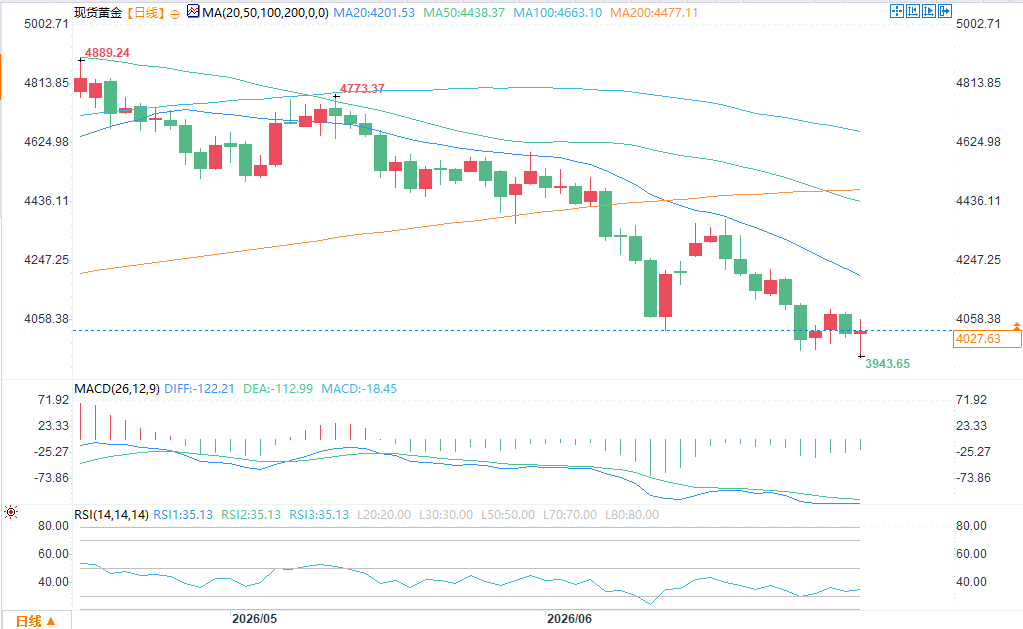
(Spot gold daily chart source: FX678)
In the next 48 hours, gold prices will either reach a trend reversal point or rebound briefly before falling back into the hands of bears. Warsh's speech on Wednesday and the release of the non-farm payroll data on Thursday will directly impact the subsequent movements of the US dollar and US Treasury yields, which have been the core factors dragging down gold prices in recent months.
Gold prices rebounded from $3,942 on Tuesday, but this round of buying lacks a strong long-term bullish outlook. Gold prices must hold above $4,214.30 before the market begins to discuss a bottom; and to reach this level, at least one of the following two events must release a bullish signal for gold.
The most favorable scenario for gold prices is a dovish stance from Warsh, coupled with weaker-than-expected non-farm payroll data, in which case gold prices would have a chance to test the upper resistance level. Conversely, if Warsh's comments are hawkish and the non-farm payroll data is better than expected, the long-term support level of $3886.46 will face another test by the bears. The direction of the US dollar and US Treasury yields in the next two trading days is the only key factor determining the current gold price trend.
This rebound in gold prices is a result of bargain hunting following gold's worst quarterly performance in nearly 13 years. For the past few weeks, traders have been selling on rallies. The aggressive buy-on-dips strategy that drove gold prices higher in the first half of the year has disappeared; now, even a slight rebound in gold prices triggers quick profit-taking. Analysts point out that most traders will only consider a valid bottom reached when gold prices regain and hold above the $4,100 level, a condition that has not yet been met. Two key events in the next 48 hours will determine whether gold prices will surge and hold above $4,100 or weaken again.
Spot Gold Daily Chart Technical Analysis
Spot gold rebounded after hitting a low of $3942.10 in early trading on Tuesday. This rebound has raised questions among traders: is this the start of a new upward trend, or is the bulls merely defending the key support level of $3886.46, a level that has held for several months? Whether gold prices can continue their upward momentum will provide the answer. The upside potential and duration of this rebound will directly define the short-term price pattern for gold.
Gold is currently trading in a short-term range between $4382.62 and $3942.10. Based on market projections, short covering may push gold prices up to the $4162.36-$4214.34 resistance zone. The outcome of the battle between bulls and bears within this range will determine gold's short-term direction.
If gold prices encounter resistance and fall back within the $4162.36-$4214.34 range, or fail to break higher, it indicates that bears still dominate the market. Once strong downward momentum forms, bears will retest the multi-month support level of $3886.46. This level is extremely important; if it is decisively broken, spot gold will begin a deep decline, with no significant support levels until it reaches the next long-term support level of $3087.70.
Once the price breaks below $3886.46, gold will either experience a precipitous drop or enter a slow, gradual decline.
The two potential triggers for the recent sharp drop in gold prices are: first, hawkish comments from Federal Reserve Chairman Warsh on Wednesday; and second, strong US non-farm payroll data released on Thursday, which further weighed on gold prices.
From a bullish perspective, traders need to closely monitor the pullback resistance zone of $4162.36-$4214.30. If gold prices encounter resistance at this level, a new round of short orders will likely enter the market. If gold prices successfully break through this range, they will subsequently challenge the 50-day moving average at $4438.68 and the 200-day moving average at $4477.67.
The continued pressure from the US dollar and US Treasury yields limited the upside potential for gold.
The US dollar index has risen for the second consecutive month. Data from the CME Group's FedWatch Tool shows that the market expects a 64% probability of a Fed rate hike in September, with traders anticipating further monetary tightening by the Fed before the end of the year. This expectation has consistently suppressed gold prices. As long as the market believes the Fed will continue to raise rates, the dollar will maintain strong buying interest, and gold prices will continue to be under pressure.
Currently, the yield on 10-year US Treasury bonds is hovering around 4.39%, while the yield on 2-year US Treasury bonds is stable at around 4.13%. While US Treasury yields did not fluctuate significantly on Tuesday, even if they remain unchanged, it is enough to continue to suppress gold prices. Gold itself does not generate interest income; in recent months, the interest rate advantage of US Treasury bonds has been the core reason for funds abandoning gold and flowing into dollar assets. Tuesday's rebound in gold prices did not change this underlying logic.
Warsh's speech at the Sintra Forum was of special significance, far exceeding that of an ordinary central bank speech.
This Wednesday, Warsh will speak at the European Central Bank's annual forum in Sintra. This forum is typically more academic in nature. However, this speech will be Warsh's first public address at a major international event since becoming Federal Reserve Chairman. Prior to this, Warsh had already discontinued the Fed's traditional forward guidance communication model. With fewer policy signals available to the market, the impact of his public statements is further amplified.
Traders are not expecting a direct interest rate hike decision from this speech; the focus is on assessing Warsh's policy stance. Will Warsh continue the tone of the June meeting, prioritizing inflation control, or will he acknowledge the downside risks to economic growth and the labor market? These two different statements could cause the dollar, Treasury yields, and gold to move in completely opposite directions.
If Warsh signals a hawkish stance, confirming the possibility of further rate hikes, the dollar will strengthen, US Treasury yields will remain high, and the gold price rebound from $3,942 will likely end before reaching $4,100. If Warsh adopts a more neutral stance, mentioning the risks of slowing economic growth and a weakening job market, traders will lower their expectations for further rate hikes. The dollar will then weaken, US Treasury yields will fall, and gold will have the opportunity to continue its rebound.
Warsh has previously stated clearly that the Federal Reserve will try to reduce its policy pronouncements going forward. This means that every word he says publicly will carry more weight. Wednesday's speech at the international forum will be the first test of how the market will price in the future direction of monetary policy given the Fed Chairman's increasingly conservative communication stance.
The impact of the non-farm payroll report may be greater than that of Walsh's speech.
The June non-farm payroll data will be released Thursday morning, and its subsequent market impact may even surpass that of Warsh's speech on Wednesday. Employment data is one of the most crucial indicators for the Federal Reserve's policy-making. If the non-farm payroll data continues to exceed expectations after Warsh's hawkish remarks, it will overturn the entire set of negative factors that have been continuously suppressing gold prices recently.
If non-farm payrolls show a higher-than-expected increase, it will confirm that the US economy can withstand higher interest rates. The probability of a rate hike in September will remain at 64% or even increase further. The US dollar and US Treasury yields will remain strong, and gold, after experiencing its worst quarterly performance in 13 years, will likely continue its decline into July.
However, if the non-farm payroll data falls short of expectations, the entire market logic will reverse. Signals of shrinking job openings and rising unemployment will lead traders to question the necessity of the Federal Reserve continuing to raise interest rates. Lower US Treasury yields and a weaker dollar will provide gold with its first real bullish catalyst in weeks.
Besides the total number of new non-farm payroll jobs, the average hourly wage growth and the unemployment rate are equally crucial. Even if the number of new jobs falls short of expectations, if wage growth picks up, inflation concerns will continue to rise; conversely, if wages slow down, it will confirm that inflation is steadily declining. The breakdown of non-farm payroll data, like the overall non-farm payroll data, often influences market predictions about the direction of the Federal Reserve's interest rates.
Key areas to watch in the future market trend
(Spot gold daily chart source: FX678)
In the next 48 hours, gold prices will either reach a trend reversal point or rebound briefly before falling back into the hands of bears. Warsh's speech on Wednesday and the release of the non-farm payroll data on Thursday will directly impact the subsequent movements of the US dollar and US Treasury yields, which have been the core factors dragging down gold prices in recent months.
Gold prices rebounded from $3,942 on Tuesday, but this round of buying lacks a strong long-term bullish outlook. Gold prices must hold above $4,214.30 before the market begins to discuss a bottom; and to reach this level, at least one of the following two events must release a bullish signal for gold.
The most favorable scenario for gold prices is a dovish stance from Warsh, coupled with weaker-than-expected non-farm payroll data, in which case gold prices would have a chance to test the upper resistance level. Conversely, if Warsh's comments are hawkish and the non-farm payroll data is better than expected, the long-term support level of $3886.46 will face another test by the bears. The direction of the US dollar and US Treasury yields in the next two trading days is the only key factor determining the current gold price trend.
- Risk Warning and Disclaimer
- The market involves risk, and trading may not be suitable for all investors. This article is for reference only and does not constitute personal investment advice, nor does it take into account certain users’ specific investment objectives, financial situation, or other needs. Any investment decisions made based on this information are at your own risk.