60-day countdown: Nuclear agreement remains unchanged, control of the Taiwan Strait has become the real battleground in the US-Iran power struggle.
2026-07-01 08:30:29
Brent crude oil traded above $73 per barrel in early Asian trading on Wednesday (July 1).
Over the past weekend, Iran and the United States exchanged limited strikes, but both sides made it clear that they did not want to return to a full-blown conflict. However, it remains unclear whether the time is ripe for a ceasefire agreement.
Senior negotiators from the United States and Iran traveled to Qatar on Tuesday (June 30), nearly two weeks after the two sides opened a 60-day window for talks to limit Iran's nuclear program. However, Iranian hardliners have so far refused to make significant concessions—including their temporary reluctance to meet with U.S. representatives in person. Therefore, the negotiations in Qatar are still being conducted indirectly through mediators.
President Trump has made it clear that his primary concern right now is gasoline prices. He praised the drop in oil prices for giving him some breathing room—this came after he signed an agreement with Iranian leaders earlier this month. But at the same time, he also complained that gasoline prices haven't fallen in tandem.
"Oil prices have fallen sharply, we've gone down to $69 today," Trump told reporters in the Oval Office on Monday. "It was higher before we started our actions on Iran's denuclearization, and we're doing very well right now." He added, "The Doha talks may or may not be important." However, later that day, he angrily criticized gasoline prices on social media—currently averaging nearly $3.90 per gallon nationwide. He posted a message demanding retailers immediately lower prices and calling for a price target of around $2.50 per gallon.
However, energy analysts point out that this goal is unlikely to be achieved in the short term. Despite falling crude oil prices, refineries are unable to obtain all the crude oil they need. Furthermore, some refineries have switched to producing jet fuel to compensate for shortages in Europe, resulting in reduced diesel and gasoline production ahead of the summer driving peak.
Despite the continued intense scrutiny of the oil market, Trump has signaled his willingness to keep negotiations moving forward. However, the core challenge facing the US negotiating team remains unchanged: despite weeks of intense US-Israeli airstrikes, Iran has gained new leverage in the conflict and has virtually no incentive to back down.
Instead of engaging in in-depth consultations on major limitations to its nuclear program, Tehran focused on the spoils it had won in months of conflict—control of shipping in the Strait of Hormuz. This capability, once a theoretical threat, has now become a real force. Iran can blockade the waterway at relatively low cost and use mines and low-cost drones to attack oil tankers carrying 20% of the world's oil trade.
Last week, Iran used a drone to attack a cargo ship that was allegedly traveling without authorization. The US and Iran then launched mutual strikes against targets in the region before announcing the resumption of negotiations.
A White House press secretary stated that the U.S. will continue to pursue diplomatic channels, but it remains unclear whether both sides have the means to make concessions. Susan Maloney, a Brookings Institution expert on U.S.-Iran relations, noted, "Iran is trying to exert maximum pressure to maintain control of the Straits as much as possible. But neither side is escalating the situation in a way that would make diplomacy unsustainable, and both sides clearly favor continuing through diplomatic channels. I think this situation will likely continue indefinitely for the current administration. Neither side currently has the incentive to escalate the conflict or return to a full-scale war."
Given that Iranian hardliners have little intention of eliminating their stockpile of highly enriched uranium or accepting other major demands from the United States, many diplomats and analysts are skeptical of reaching an agreement within the 60-day window—or even any agreement in the short term.
According to diplomats monitoring the situation, Iran has proven it easier to close the Strait of Hormuz than the US military can keep it open. This reality appears to have lowered expectations for indirect talks, although the ceasefire has been maintained on the surface. A spokesperson for the Qatari Foreign Ministry stated that Iran will send a delegation to participate in "technical" talks, with Qatar and Pakistan acting as mediators.
Meanwhile, Iran has vowed to turn the waterway into a "cash cow," despite opposition from the White House. No reports of further retaliatory attacks in or around the strait were received on Tuesday, and traffic in the waterway was sparse, with many ships unwilling to risk passing through.
Disagreements remain between the two sides regarding the conditions for fully opening the strait between Iran and Oman. According to an agreement signed by the US and Iran two weeks ago, Iran should facilitate free passage through the strait within 60 days and "engage in dialogue" with Oman to determine the "future administration and maritime services" of the waterway.
Preliminary talks between Oman and Iran on Monday touched on the issue of "safe passage fees" for ships. The US stated that no "passage fees" or "charges" should be levied on international waterways. Oman's foreign minister expressed opposition to "fees," but according to Al Jazeera, neither country ruled out the possibility of establishing a "voluntary" fund contribution mechanism, similar to the existing framework in the Strait of Malacca, as suggested by the Secretary-General of the International Maritime Organization.
This week's US-Iran talks may cover the Straits of Hormuz, Iran's nuclear program, and the potential initial release of $6 billion in frozen Iranian assets. A mutually agreed-upon document stipulates that procedures related to the release of these funds will be jointly agreed upon during the negotiations, and it is specified that the funds will ultimately be deposited into the Central Bank of Iran. Iran demands immediate release, while Trump and Vice President Vance have stated that the funds will be used to purchase US wheat, soybeans, and corn for shipment to Iran.
Although the risks of transporting oil through the Strait remain high, crude oil prices have not soared to the high levels seen at the beginning of the war, and are currently relatively stable at around $73 per barrel, well below the wartime peak of around $120.
Traders remain confident that some framework for peace can be maintained. Even if Iran continues to attack ships, crude oil can still be transported through the Straits—shipping companies are working to move dozens of vessels that have been stranded in the region since the start of the war in late February, which is helping to stabilize prices.
Experts say that with the White House repeatedly declaring the war is nearing its end, traders are reluctant to bet on rising oil prices. The market also remembers overestimating the duration of the impact of the Russia-Ukraine conflict, which ultimately led to a price collapse as alternative supplies were found.
A similar situation is unfolding in this round of conflict. As a major importer of Middle Eastern oil, China has drastically reduced its imports, turning instead to its vast reserves and alternative energy sources, thus alleviating pressure on the global market. Countries around the world have also mobilized their strategic reserves, with the United States releasing a significant amount of its strategic petroleum reserves. At the same time, US oil exports have increased substantially, pushing up domestic prices but making up for the overseas shortfall.
Bob McNally, founder of Rapidan Energy and former energy advisor to the Bush administration, said, "After Russia's invasion of Ukraine, crude oil prices remained high for four months, and the market assumed the worst. But when 2022 data showed that supply losses were not as severe as expected, prices collapsed." He added, "Regarding Iran, the market also assumed the worst in the initial weeks. After the ceasefire, the market assumed the situation was not serious, and for most of the war, it was indifferent to the conflict."
But McNally points out that the current relatively stable price of crude oil futures masks significant challenges in the energy market: as Trump has complained, refined gasoline and diesel prices remain high. These refined product prices reflect current realities better than crude oil futures prices, which are based on months of expectations.
Refineries and other energy infrastructure damaged in the war have not yet been fully repaired, and the risks associated with transporting gasoline and diesel through the Strait of Hormuz remain high. Inventories continue to decline, and energy executives warn that if the strait does not reopen, oil prices could surge again to $150 a barrel or even higher.
Analysts warn that these fundamental problems remain unresolved. Production in the Gulf states is far from pre-war levels, and most of the oil currently passing through the straits is simply stockpiled inventory left during Iran's blockade. Shipping companies remain reluctant to send new tankers, and producers are hesitant to resume production.
McNair used a sports analogy to explain: "If all that's going through the strait is clearing out the oil that's stuck there, that doesn't count as a touchdown. A real touchdown is when producers restart the oil fields and get production back on track."
Tommy Inglesby, head of Oliver Wyman's Americas oil, gas and power practice, said the outlook for oil prices is far from settled: "We are still in crisis. We are in a new world, and the turmoil in the Middle East no longer seems to be a 'one-off' event."
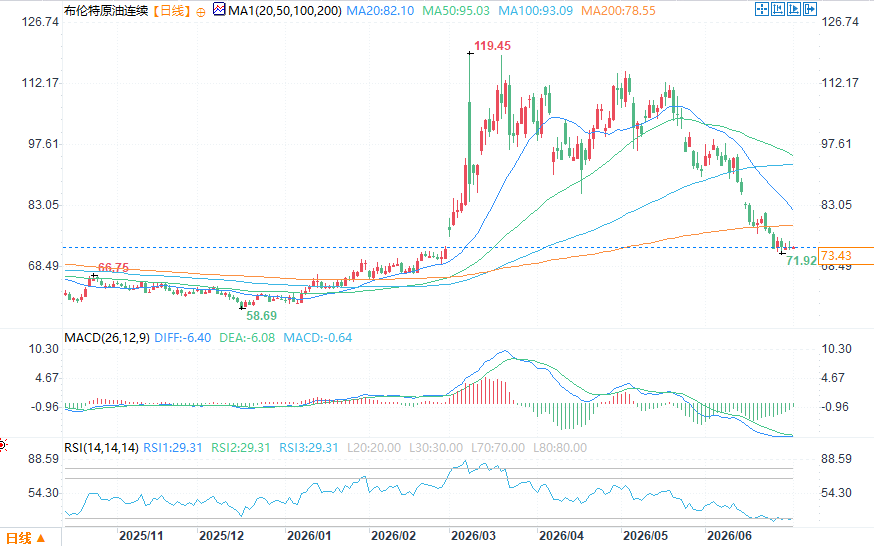
(Brent crude oil futures daily chart, source: FX678)
At 8:07 AM Beijing time on July 1, Brent crude oil futures were trading at $73.43 per barrel.
Over the past weekend, Iran and the United States exchanged limited strikes, but both sides made it clear that they did not want to return to a full-blown conflict. However, it remains unclear whether the time is ripe for a ceasefire agreement.
Senior negotiators from the United States and Iran traveled to Qatar on Tuesday (June 30), nearly two weeks after the two sides opened a 60-day window for talks to limit Iran's nuclear program. However, Iranian hardliners have so far refused to make significant concessions—including their temporary reluctance to meet with U.S. representatives in person. Therefore, the negotiations in Qatar are still being conducted indirectly through mediators.
President Trump has made it clear that his primary concern right now is gasoline prices. He praised the drop in oil prices for giving him some breathing room—this came after he signed an agreement with Iranian leaders earlier this month. But at the same time, he also complained that gasoline prices haven't fallen in tandem.
"Oil prices have fallen sharply, we've gone down to $69 today," Trump told reporters in the Oval Office on Monday. "It was higher before we started our actions on Iran's denuclearization, and we're doing very well right now." He added, "The Doha talks may or may not be important." However, later that day, he angrily criticized gasoline prices on social media—currently averaging nearly $3.90 per gallon nationwide. He posted a message demanding retailers immediately lower prices and calling for a price target of around $2.50 per gallon.
However, energy analysts point out that this goal is unlikely to be achieved in the short term. Despite falling crude oil prices, refineries are unable to obtain all the crude oil they need. Furthermore, some refineries have switched to producing jet fuel to compensate for shortages in Europe, resulting in reduced diesel and gasoline production ahead of the summer driving peak.
Iran's new bargaining chip: actual control of the Straits
Despite the continued intense scrutiny of the oil market, Trump has signaled his willingness to keep negotiations moving forward. However, the core challenge facing the US negotiating team remains unchanged: despite weeks of intense US-Israeli airstrikes, Iran has gained new leverage in the conflict and has virtually no incentive to back down.
Instead of engaging in in-depth consultations on major limitations to its nuclear program, Tehran focused on the spoils it had won in months of conflict—control of shipping in the Strait of Hormuz. This capability, once a theoretical threat, has now become a real force. Iran can blockade the waterway at relatively low cost and use mines and low-cost drones to attack oil tankers carrying 20% of the world's oil trade.
Last week, Iran used a drone to attack a cargo ship that was allegedly traveling without authorization. The US and Iran then launched mutual strikes against targets in the region before announcing the resumption of negotiations.
A White House press secretary stated that the U.S. will continue to pursue diplomatic channels, but it remains unclear whether both sides have the means to make concessions. Susan Maloney, a Brookings Institution expert on U.S.-Iran relations, noted, "Iran is trying to exert maximum pressure to maintain control of the Straits as much as possible. But neither side is escalating the situation in a way that would make diplomacy unsustainable, and both sides clearly favor continuing through diplomatic channels. I think this situation will likely continue indefinitely for the current administration. Neither side currently has the incentive to escalate the conflict or return to a full-scale war."
The prospects for nuclear negotiations are bleak.
Given that Iranian hardliners have little intention of eliminating their stockpile of highly enriched uranium or accepting other major demands from the United States, many diplomats and analysts are skeptical of reaching an agreement within the 60-day window—or even any agreement in the short term.
According to diplomats monitoring the situation, Iran has proven it easier to close the Strait of Hormuz than the US military can keep it open. This reality appears to have lowered expectations for indirect talks, although the ceasefire has been maintained on the surface. A spokesperson for the Qatari Foreign Ministry stated that Iran will send a delegation to participate in "technical" talks, with Qatar and Pakistan acting as mediators.
Meanwhile, Iran has vowed to turn the waterway into a "cash cow," despite opposition from the White House. No reports of further retaliatory attacks in or around the strait were received on Tuesday, and traffic in the waterway was sparse, with many ships unwilling to risk passing through.
Straits toll dispute and asset unfreezing negotiations
Disagreements remain between the two sides regarding the conditions for fully opening the strait between Iran and Oman. According to an agreement signed by the US and Iran two weeks ago, Iran should facilitate free passage through the strait within 60 days and "engage in dialogue" with Oman to determine the "future administration and maritime services" of the waterway.
Preliminary talks between Oman and Iran on Monday touched on the issue of "safe passage fees" for ships. The US stated that no "passage fees" or "charges" should be levied on international waterways. Oman's foreign minister expressed opposition to "fees," but according to Al Jazeera, neither country ruled out the possibility of establishing a "voluntary" fund contribution mechanism, similar to the existing framework in the Strait of Malacca, as suggested by the Secretary-General of the International Maritime Organization.
This week's US-Iran talks may cover the Straits of Hormuz, Iran's nuclear program, and the potential initial release of $6 billion in frozen Iranian assets. A mutually agreed-upon document stipulates that procedures related to the release of these funds will be jointly agreed upon during the negotiations, and it is specified that the funds will ultimately be deposited into the Central Bank of Iran. Iran demands immediate release, while Trump and Vice President Vance have stated that the funds will be used to purchase US wheat, soybeans, and corn for shipment to Iran.
Hidden Concerns Behind Stabilizing Oil Prices
Although the risks of transporting oil through the Strait remain high, crude oil prices have not soared to the high levels seen at the beginning of the war, and are currently relatively stable at around $73 per barrel, well below the wartime peak of around $120.
Traders remain confident that some framework for peace can be maintained. Even if Iran continues to attack ships, crude oil can still be transported through the Straits—shipping companies are working to move dozens of vessels that have been stranded in the region since the start of the war in late February, which is helping to stabilize prices.
Experts say that with the White House repeatedly declaring the war is nearing its end, traders are reluctant to bet on rising oil prices. The market also remembers overestimating the duration of the impact of the Russia-Ukraine conflict, which ultimately led to a price collapse as alternative supplies were found.
A similar situation is unfolding in this round of conflict. As a major importer of Middle Eastern oil, China has drastically reduced its imports, turning instead to its vast reserves and alternative energy sources, thus alleviating pressure on the global market. Countries around the world have also mobilized their strategic reserves, with the United States releasing a significant amount of its strategic petroleum reserves. At the same time, US oil exports have increased substantially, pushing up domestic prices but making up for the overseas shortfall.
Bob McNally, founder of Rapidan Energy and former energy advisor to the Bush administration, said, "After Russia's invasion of Ukraine, crude oil prices remained high for four months, and the market assumed the worst. But when 2022 data showed that supply losses were not as severe as expected, prices collapsed." He added, "Regarding Iran, the market also assumed the worst in the initial weeks. After the ceasefire, the market assumed the situation was not serious, and for most of the war, it was indifferent to the conflict."
Structural risks have not yet been eliminated.
But McNally points out that the current relatively stable price of crude oil futures masks significant challenges in the energy market: as Trump has complained, refined gasoline and diesel prices remain high. These refined product prices reflect current realities better than crude oil futures prices, which are based on months of expectations.
Refineries and other energy infrastructure damaged in the war have not yet been fully repaired, and the risks associated with transporting gasoline and diesel through the Strait of Hormuz remain high. Inventories continue to decline, and energy executives warn that if the strait does not reopen, oil prices could surge again to $150 a barrel or even higher.
Analysts warn that these fundamental problems remain unresolved. Production in the Gulf states is far from pre-war levels, and most of the oil currently passing through the straits is simply stockpiled inventory left during Iran's blockade. Shipping companies remain reluctant to send new tankers, and producers are hesitant to resume production.
McNair used a sports analogy to explain: "If all that's going through the strait is clearing out the oil that's stuck there, that doesn't count as a touchdown. A real touchdown is when producers restart the oil fields and get production back on track."
Tommy Inglesby, head of Oliver Wyman's Americas oil, gas and power practice, said the outlook for oil prices is far from settled: "We are still in crisis. We are in a new world, and the turmoil in the Middle East no longer seems to be a 'one-off' event."
(Brent crude oil futures daily chart, source: FX678)
At 8:07 AM Beijing time on July 1, Brent crude oil futures were trading at $73.43 per barrel.
- Risk Warning and Disclaimer
- The market involves risk, and trading may not be suitable for all investors. This article is for reference only and does not constitute personal investment advice, nor does it take into account certain users’ specific investment objectives, financial situation, or other needs. Any investment decisions made based on this information are at your own risk.