Driven by both the interest rate differential between the US and Japan and the risk of intervention, the USD/JPY pair surged to 162.70, hitting a new multi-decade high.
2026-07-01 10:19:56
The USD/JPY pair continued its upward trend in Asian trading on Wednesday, breaking through the previous day's high and rising to around 162.70 , a multi-decade high, extending its upward trend for the third consecutive trading day. Market concerns about potential intervention by Japanese authorities in the foreign exchange market continued to intensify, but no concrete action has yet occurred, allowing bullish momentum to remain dominant.

In Japan, fiscal and monetary policy officials have recently made several verbal interventions in the foreign exchange market. Chief Cabinet Secretary Minoru Kihara reiterated that the authorities are ready to take necessary measures in the foreign exchange market at any time; Finance Minister Satsuki Katayama also stated that the government will respond appropriately if the exchange rate experiences "excessive volatility." However, judging from market performance, these statements have not effectively curbed the yen's depreciation trend; instead, they have reinforced the market's judgment that "the intervention window has not yet opened."
From a macroeconomic perspective, the core reason for the continued pressure on the yen remains the persistently high interest rate differential between the US and Japan. The Bank of Japan raised its policy rate to 1% in June, the highest level since 1995, but this still represents a significant gap compared to the US federal funds rate target range of 3.5%–3.75% . This interest rate differential environment continues to drive active carry trades, making funds more inclined to borrow low-yielding yen and allocate to high-yielding dollar assets, thereby exacerbating the pressure on the yen to depreciate.
Meanwhile, policy expectations in the US further strengthen the dollar's advantage. The market believes the Federal Reserve is likely to maintain relatively high interest rates, with CME FedWatch data showing an approximately 83% probability of a policy adjustment this year. This expectation keeps the dollar strong, further supporting the upward trend of USD/JPY.
Geopolitical and macroeconomic risks have also enhanced the US dollar's safe-haven appeal to some extent. Recent accusations between the US and Iran of violating the interim agreement have reignited uncertainty in the Middle East, causing fluctuations in market risk appetite. Against this backdrop, the US dollar's status as a safe-haven asset has been strengthened, while the Japanese yen's traditional safe-haven function has been significantly weakened by interest rate differentials.
In the short term, the market is awaiting key US economic data and policy signals. Speeches by Federal Reserve officials at the ECB's Sintra Forum, along with ADP employment data and the ISM Manufacturing PMI, will be important triggers for short-term dollar volatility. The subsequent non-farm payroll data (NFP) will further determine the market's repricing of the Fed's policy path.
Overall, USD/JPY is currently in a complex structure driven by "high interest rate differentials + policy intervention risks + US dollar data dominance". Although the trend is relatively strong, the risk of volatility is rising simultaneously.
From a daily chart perspective, USD/JPY continues its strong upward trend, with both highs and lows consistently moving higher, indicating that the trend momentum remains solid. After breaking through a key resistance level, the exchange rate entered an acceleration phase and has now broken out of its long-term consolidation range. There are currently no significant historical resistance levels to reference above, technically exhibiting characteristics of "trend extension + price discovery." Initial support is located in the 161.20 area. A break below this level could lead to a short-term correction, but the overall trend structure remains intact.
From the 4-hour chart, the exchange rate is steadily rising along the short-term moving average system with limited pullbacks, indicating strong bullish control. Although momentum indicators are at high levels, no obvious divergence signals have appeared, suggesting the trend is likely to continue. However, it's worth noting that after the price has quickly moved away from the moving averages, there is a risk of a short-term technical pullback. If data falls short of expectations or intervention signals emerge, a rapid pullback to the vicinity of the 160 level could be triggered for rebalancing.
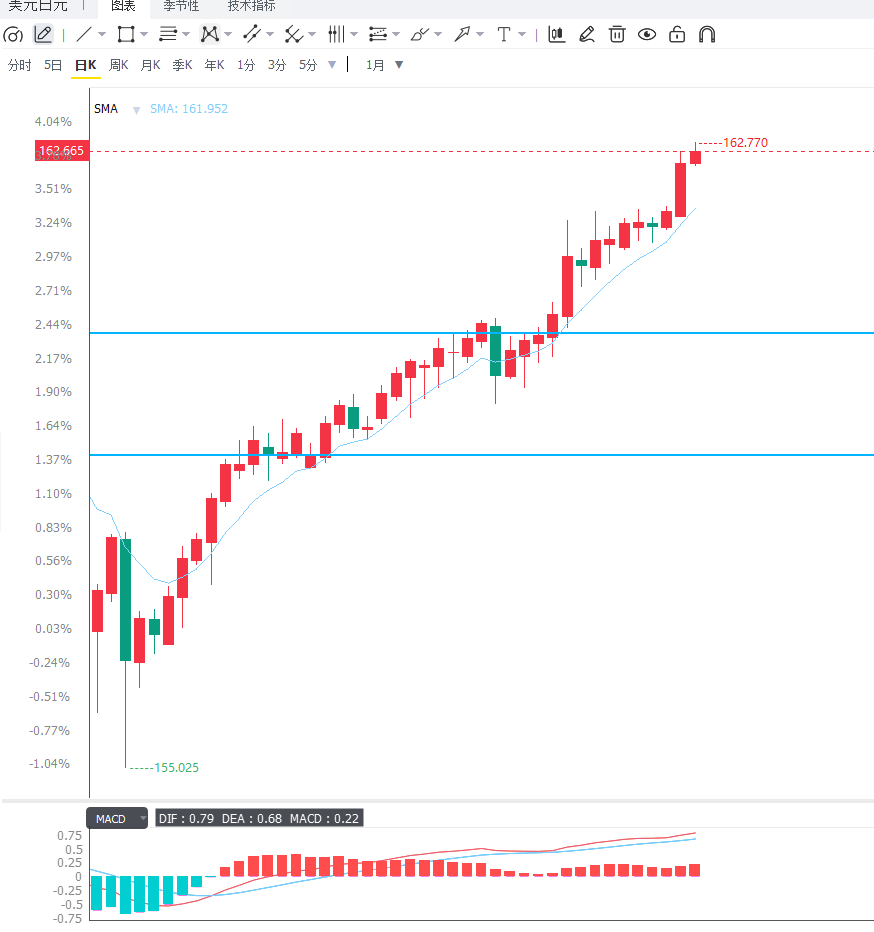
Editor's Summary : The current USD/JPY exchange rate movement is essentially driven by a structural trend fueled by the USD/JPY interest rate differential, coupled with strengthened carry trades and a stronger dollar, jointly propelling the exchange rate to new highs. Despite frequent intervention signals from the Japanese government, the market tends to continue trend trading until there are substantial changes in the fundamentals. Key variables going forward focus on US employment data and the Federal Reserve's policy path. If the data reinforces expectations of a strong dollar, the exchange rate may have further upside potential; however, if actual Japanese intervention is triggered or dollar expectations cool, there is a risk of a rapid and sharp technical pullback.
In Japan, fiscal and monetary policy officials have recently made several verbal interventions in the foreign exchange market. Chief Cabinet Secretary Minoru Kihara reiterated that the authorities are ready to take necessary measures in the foreign exchange market at any time; Finance Minister Satsuki Katayama also stated that the government will respond appropriately if the exchange rate experiences "excessive volatility." However, judging from market performance, these statements have not effectively curbed the yen's depreciation trend; instead, they have reinforced the market's judgment that "the intervention window has not yet opened."
From a macroeconomic perspective, the core reason for the continued pressure on the yen remains the persistently high interest rate differential between the US and Japan. The Bank of Japan raised its policy rate to 1% in June, the highest level since 1995, but this still represents a significant gap compared to the US federal funds rate target range of 3.5%–3.75% . This interest rate differential environment continues to drive active carry trades, making funds more inclined to borrow low-yielding yen and allocate to high-yielding dollar assets, thereby exacerbating the pressure on the yen to depreciate.
Meanwhile, policy expectations in the US further strengthen the dollar's advantage. The market believes the Federal Reserve is likely to maintain relatively high interest rates, with CME FedWatch data showing an approximately 83% probability of a policy adjustment this year. This expectation keeps the dollar strong, further supporting the upward trend of USD/JPY.
Geopolitical and macroeconomic risks have also enhanced the US dollar's safe-haven appeal to some extent. Recent accusations between the US and Iran of violating the interim agreement have reignited uncertainty in the Middle East, causing fluctuations in market risk appetite. Against this backdrop, the US dollar's status as a safe-haven asset has been strengthened, while the Japanese yen's traditional safe-haven function has been significantly weakened by interest rate differentials.
In the short term, the market is awaiting key US economic data and policy signals. Speeches by Federal Reserve officials at the ECB's Sintra Forum, along with ADP employment data and the ISM Manufacturing PMI, will be important triggers for short-term dollar volatility. The subsequent non-farm payroll data (NFP) will further determine the market's repricing of the Fed's policy path.
Overall, USD/JPY is currently in a complex structure driven by "high interest rate differentials + policy intervention risks + US dollar data dominance". Although the trend is relatively strong, the risk of volatility is rising simultaneously.
From a daily chart perspective, USD/JPY continues its strong upward trend, with both highs and lows consistently moving higher, indicating that the trend momentum remains solid. After breaking through a key resistance level, the exchange rate entered an acceleration phase and has now broken out of its long-term consolidation range. There are currently no significant historical resistance levels to reference above, technically exhibiting characteristics of "trend extension + price discovery." Initial support is located in the 161.20 area. A break below this level could lead to a short-term correction, but the overall trend structure remains intact.
From the 4-hour chart, the exchange rate is steadily rising along the short-term moving average system with limited pullbacks, indicating strong bullish control. Although momentum indicators are at high levels, no obvious divergence signals have appeared, suggesting the trend is likely to continue. However, it's worth noting that after the price has quickly moved away from the moving averages, there is a risk of a short-term technical pullback. If data falls short of expectations or intervention signals emerge, a rapid pullback to the vicinity of the 160 level could be triggered for rebalancing.
Editor's Summary : The current USD/JPY exchange rate movement is essentially driven by a structural trend fueled by the USD/JPY interest rate differential, coupled with strengthened carry trades and a stronger dollar, jointly propelling the exchange rate to new highs. Despite frequent intervention signals from the Japanese government, the market tends to continue trend trading until there are substantial changes in the fundamentals. Key variables going forward focus on US employment data and the Federal Reserve's policy path. If the data reinforces expectations of a strong dollar, the exchange rate may have further upside potential; however, if actual Japanese intervention is triggered or dollar expectations cool, there is a risk of a rapid and sharp technical pullback.
- Risk Warning and Disclaimer
- The market involves risk, and trading may not be suitable for all investors. This article is for reference only and does not constitute personal investment advice, nor does it take into account certain users’ specific investment objectives, financial situation, or other needs. Any investment decisions made based on this information are at your own risk.