













Australian Dollar vs. Japanese Yen: A Sentiment Amplifier Driven by Carry Trades
2026-07-01 20:35:43
In the realm of cross-asset analysis and global macro trading, there is a unique trading instrument that has long been regarded as a "barometer of market sentiment"—the Australian dollar against the Japanese yen (AUD/JPY).
Few single assets can capture the pendulum swing between "risk-on" and "risk-off" in the global financial market with such precision and acumen.
Its core secret lies in its perfect blend of offensive, high-yield commodity currencies and defensive, top-tier safe-haven currencies.

To understand the power of this currency pair, we first need to analyze its two extreme components:
Firstly, the Australian dollar acts as a "magnifying glass" for global growth and commodities.
Australia's economy is highly dependent on commodity exports, with core categories including industrial raw materials such as iron ore, coal, and natural gas.
Alternative benchmark for the Asian economy: Due to Australia's deep trade ties with emerging Asian markets as a whole, the Australian dollar has become a highly liquid alternative benchmark reflecting expectations of Asian economic growth.
Risk-on attribute: When the global economy recovers and Asian factories operate at full capacity, demand for commodities surges, arbitrage funds flood in, and the Australian dollar rises.
Interest rate advantage: Compared to other developed economies, the Reserve Bank of Australia has long tended to maintain a relatively higher benchmark interest rate, making its currency attractive due to its high interest rate.
Japanese Yen (JPY): A "safe haven" for global funds. In contrast to the Australian dollar, the yen is recognized globally as the "ultimate safe-haven asset." The underlying logic for this is not due to the strength of the Japanese economy, but rather to its unique financial structure.
Japan, the world's largest net creditor nation, possesses vast overseas assets. When global markets experience crises, Japanese institutions tend to repatriate their overseas profits to yen; simultaneously, global panic buying also leads to the purchase of yen-denominated assets as a hedge against inflation.
Low-interest funding currency: For a long time, due to Japan's maintenance of extremely low interest rate policies, the yen became the lowest-cost "borrowing instrument" in the global financial market.
The reason why the Australian dollar-Japanese yen currency pair can amplify market sentiment in both directions is due to the underlying financial mechanism of one of the largest games in the foreign exchange market—carry trade.
Simply put, it involves traders borrowing low-interest Japanese yen, exchanging it for high-interest Australian dollars, and then depositing or investing in them, thereby profiting from the interest rate differential when the market is stable.
When the market is calm (risk-on), borrowing Japanese yen → selling Japanese yen → buying Australian dollars → the Australian dollar-yen exchange rate will continue to rise.
When a sudden market panic (risk-off) occurs, funds will be sold off in Australian dollars → converted back to Japanese yen → used to repay loans → ultimately causing the Australian dollar to fall in exchange rate.
When market sentiment is optimistic, the scale of global carry trade continues to expand, with funds flowing like an assembly line to "sell yen and buy Australian dollars," driving the exchange rate to strengthen in both directions.
Once there is any disturbance or market panic, traders will frantically close out their arbitrage positions to prevent exchange rate fluctuations from eroding interest rate differentials—that is, collectively liquidating their Australian dollar positions and rushing to buy Japanese yen to repay debts, which may cause a "stampede" drop in the Australian dollar-Japanese yen exchange rate.
This amplified volatility makes the Australian dollar exchange rate far more sensitive to sentiment than some stock indices, and it has exhibited textbook-perfect patterns during several major systemic crises in history.
The 2008 global financial crisis: The collapse of Lehman Brothers triggered a tsunami, global carry trades were wiped out, and the Australian dollar and Japanese yen exchange rates suffered a near "halving" of their value in just a few months. The speed of the reaction even preceded the peaking of many major stock indices.
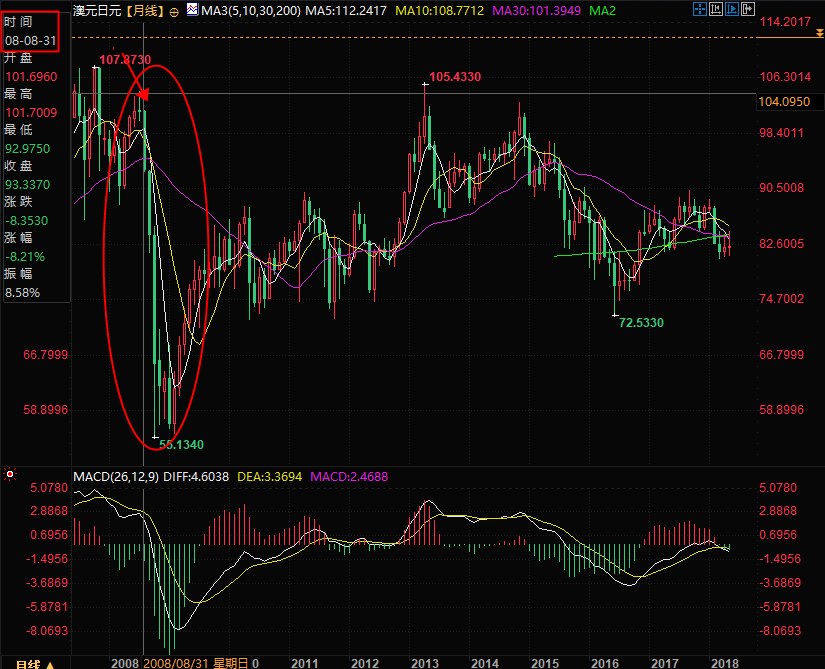
(AUD/JPY monthly chart, source: FX168)
The global pandemic struck suddenly in 2020: a liquidity crisis erupted instantly, the market was in a state of extreme panic, assets were sold off indiscriminately, and the Australian dollar and Japanese yen exchange rates once again plummeted to a precipitous bottom.
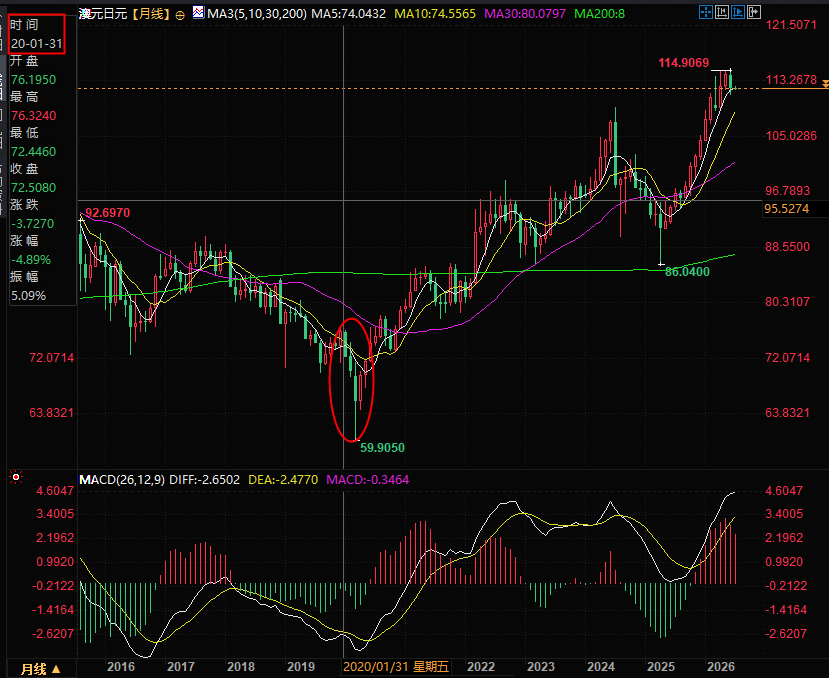
(AUD/JPY monthly chart, source: FX678)
Although the AUD/JPY currency pair is widely recognized as a perfect indicator, investors need to be wary of its potential distortions in practice.
A decline in global markets does not necessarily indicate panic in the following two situations:
If the Bank of Japan (BOJ) adopts a hawkish policy to combat domestic inflation and suddenly launches an unexpected interest rate hike or directly intervenes in the exchange rate, it could trigger a sharp rise in the yen in a short period of time. In this case, the depreciation of the Australian dollar against the yen would reflect the impact of the BOJ's policy rather than a global systemic risk. However, the Japanese monetary authorities recently stated that they have not intervened.
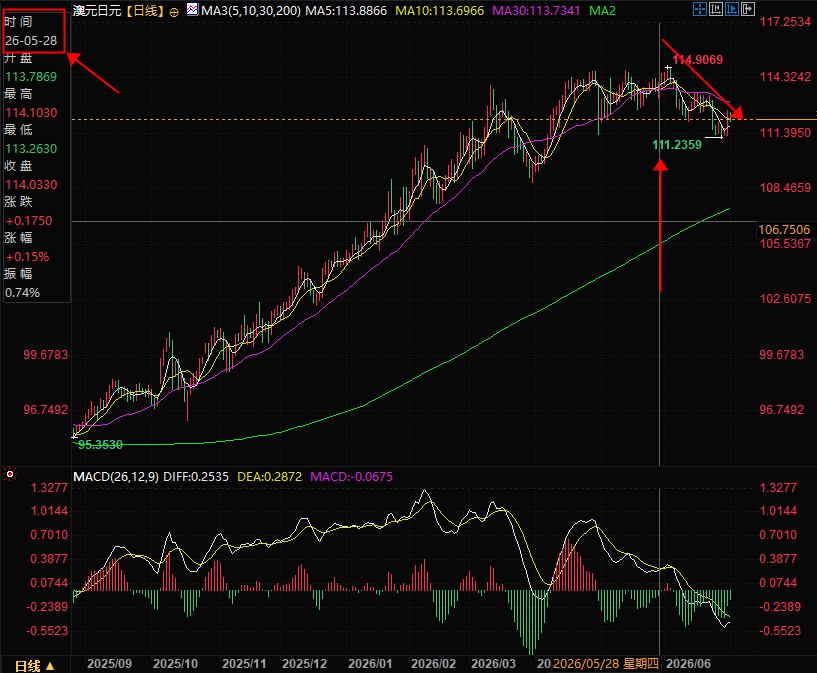
(AUD/JPY daily chart, source: FX678)
The current technical analysis shows that the Australian dollar against the Japanese yen has formed a top pattern. If the price continues to move downwards according to the technical indicators, does this indicate that the risk is increasing?
Australia-specific risks: If Australia experiences a severe natural disaster or if geopolitical circumstances hinder its pillar mineral exports, the Australian dollar may weaken independently.
For cross-asset traders, keeping a close eye on the AUD/JPY currency pair is equivalent to understanding the intensity of the global smart money's struggle between "seeking returns" and "avoiding risks."
When you want to know whether the current market is just following the crowd or there are undercurrents, you might as well take a look at which side the balance of the Australian dollar to Japanese yen exchange rate is tilting to today.
Few single assets can capture the pendulum swing between "risk-on" and "risk-off" in the global financial market with such precision and acumen.
Its core secret lies in its perfect blend of offensive, high-yield commodity currencies and defensive, top-tier safe-haven currencies.
The two sides of the scale: the offensive Australian dollar and the defensive Japanese yen.
To understand the power of this currency pair, we first need to analyze its two extreme components:
Firstly, the Australian dollar acts as a "magnifying glass" for global growth and commodities.
Australia's economy is highly dependent on commodity exports, with core categories including industrial raw materials such as iron ore, coal, and natural gas.
Alternative benchmark for the Asian economy: Due to Australia's deep trade ties with emerging Asian markets as a whole, the Australian dollar has become a highly liquid alternative benchmark reflecting expectations of Asian economic growth.
Risk-on attribute: When the global economy recovers and Asian factories operate at full capacity, demand for commodities surges, arbitrage funds flood in, and the Australian dollar rises.
Interest rate advantage: Compared to other developed economies, the Reserve Bank of Australia has long tended to maintain a relatively higher benchmark interest rate, making its currency attractive due to its high interest rate.
Japanese Yen (JPY): A "safe haven" for global funds. In contrast to the Australian dollar, the yen is recognized globally as the "ultimate safe-haven asset." The underlying logic for this is not due to the strength of the Japanese economy, but rather to its unique financial structure.
Japan, the world's largest net creditor nation, possesses vast overseas assets. When global markets experience crises, Japanese institutions tend to repatriate their overseas profits to yen; simultaneously, global panic buying also leads to the purchase of yen-denominated assets as a hedge against inflation.
Low-interest funding currency: For a long time, due to Japan's maintenance of extremely low interest rate policies, the yen became the lowest-cost "borrowing instrument" in the global financial market.
Core Driver: The Life and Death of Carry Trade
The reason why the Australian dollar-Japanese yen currency pair can amplify market sentiment in both directions is due to the underlying financial mechanism of one of the largest games in the foreign exchange market—carry trade.
Simply put, it involves traders borrowing low-interest Japanese yen, exchanging it for high-interest Australian dollars, and then depositing or investing in them, thereby profiting from the interest rate differential when the market is stable.
When the market is calm (risk-on), borrowing Japanese yen → selling Japanese yen → buying Australian dollars → the Australian dollar-yen exchange rate will continue to rise.
When a sudden market panic (risk-off) occurs, funds will be sold off in Australian dollars → converted back to Japanese yen → used to repay loans → ultimately causing the Australian dollar to fall in exchange rate.
When market sentiment is optimistic, the scale of global carry trade continues to expand, with funds flowing like an assembly line to "sell yen and buy Australian dollars," driving the exchange rate to strengthen in both directions.
Once there is any disturbance or market panic, traders will frantically close out their arbitrage positions to prevent exchange rate fluctuations from eroding interest rate differentials—that is, collectively liquidating their Australian dollar positions and rushing to buy Japanese yen to repay debts, which may cause a "stampede" drop in the Australian dollar-Japanese yen exchange rate.
Historical Witness: The Power of Emotion Amplifiers
This amplified volatility makes the Australian dollar exchange rate far more sensitive to sentiment than some stock indices, and it has exhibited textbook-perfect patterns during several major systemic crises in history.
The 2008 global financial crisis: The collapse of Lehman Brothers triggered a tsunami, global carry trades were wiped out, and the Australian dollar and Japanese yen exchange rates suffered a near "halving" of their value in just a few months. The speed of the reaction even preceded the peaking of many major stock indices.
(AUD/JPY monthly chart, source: FX168)
The global pandemic struck suddenly in 2020: a liquidity crisis erupted instantly, the market was in a state of extreme panic, assets were sold off indiscriminately, and the Australian dollar and Japanese yen exchange rates once again plummeted to a precipitous bottom.
(AUD/JPY monthly chart, source: FX678)
Pitfall Avoidance Guide: When will benchmarks become "short-term distorted"?
Although the AUD/JPY currency pair is widely recognized as a perfect indicator, investors need to be wary of its potential distortions in practice.
A decline in global markets does not necessarily indicate panic in the following two situations:
If the Bank of Japan (BOJ) adopts a hawkish policy to combat domestic inflation and suddenly launches an unexpected interest rate hike or directly intervenes in the exchange rate, it could trigger a sharp rise in the yen in a short period of time. In this case, the depreciation of the Australian dollar against the yen would reflect the impact of the BOJ's policy rather than a global systemic risk. However, the Japanese monetary authorities recently stated that they have not intervened.
(AUD/JPY daily chart, source: FX678)
The current technical analysis shows that the Australian dollar against the Japanese yen has formed a top pattern. If the price continues to move downwards according to the technical indicators, does this indicate that the risk is increasing?
Australia-specific risks: If Australia experiences a severe natural disaster or if geopolitical circumstances hinder its pillar mineral exports, the Australian dollar may weaken independently.
Summarize:
For cross-asset traders, keeping a close eye on the AUD/JPY currency pair is equivalent to understanding the intensity of the global smart money's struggle between "seeking returns" and "avoiding risks."
When you want to know whether the current market is just following the crowd or there are undercurrents, you might as well take a look at which side the balance of the Australian dollar to Japanese yen exchange rate is tilting to today.
- Risk Warning and Disclaimer
- The market involves risk, and trading may not be suitable for all investors. This article is for reference only and does not constitute personal investment advice, nor does it take into account certain users’ specific investment objectives, financial situation, or other needs. Any investment decisions made based on this information are at your own risk.

