July 2nd Financial Breakfast: Weak ADP data coupled with dovish comments from Warsh supported gold prices; Trump's statement that US-Iran negotiations were progressing dragged down oil prices; awaiting the non-farm payrolls report.
2026-07-02 07:29:44
On Thursday (July 2, Beijing time) in early Asian trading, spot gold was trading around $4,038 per ounce. Gold prices were supported by data, with weaker-than-expected US ADP private sector employment data and comments from Federal Reserve Chairman Warsh stating that inflation expectations and risks had eased in recent weeks, pushing bond yields down and boosting gold prices. Oil prices fell, with US crude oil trading around $68 per barrel. US President Trump stated that the US-Iran talks in Qatar were progressing well, and the market awaited the release of non-farm payroll data later in the day.

U.S. stocks closed lower on Wednesday in volatile trading, with all three major indexes falling slightly. The Dow Jones Industrial Average edged down 0.03% to 52,305.24, the S&P 500 declined 0.22% to 7,483.23, and the Nasdaq Composite dropped 0.66% to 26,040.03.
The decline was mainly due to a pullback in technology stocks, with the Philadelphia Semiconductor Index plunging 6.3%, becoming the main factor dragging down the S&P 500 and Nasdaq, as the market worried about overvalued technology companies and huge spending in the field of artificial intelligence.
However, Meta Platforms surged 8.8% after a Bloomberg report that it was building a cloud business to sell excess AI computing power, partially offsetting the decline. Investors were also focused on the lack of progress in indirect negotiations between the US and Iran, coupled with cautious sentiment ahead of the long weekend. Meanwhile, Federal Reserve Chairman Warsh said that recent inflation risks had eased, but reiterated his firm commitment to the 2% inflation target, which cooled market expectations for further easing. Traders still expect the Fed to raise interest rates at least once this year.
On the economic data front, U.S. manufacturing activity slowed in June but remained robust, and the data from the Institute for Supply Management (ISM) was also digested.
Gold prices rose significantly on Wednesday, with spot gold closing up 0.59% at $4,030.94 per ounce, having earlier approached $4,115 per ounce. This was mainly due to weaker-than-expected US ADP private sector employment data (98,000 jobs added in June, below the expected 118,000) and comments from Federal Reserve Chairman Warsh that inflation expectations and risks had eased in recent weeks, pushing bond yields down and boosting the sluggish gold market.
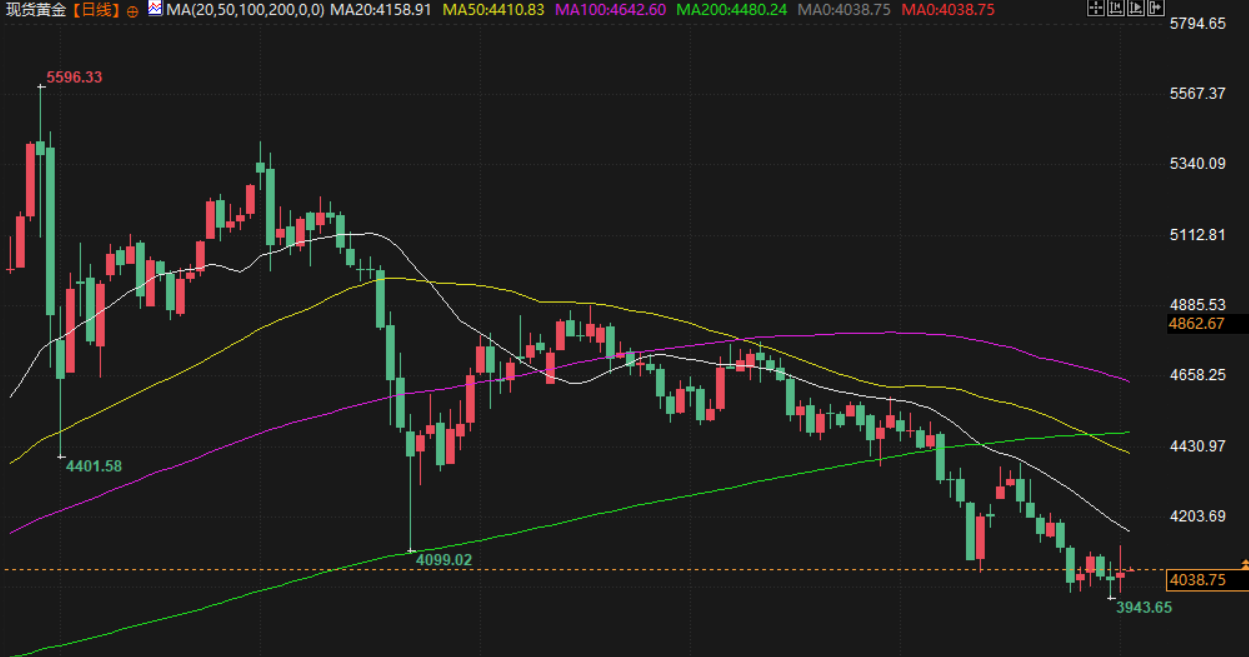
Independent metals traders point out that unless Thursday's nonfarm payroll report is exceptionally strong, gold prices may have already formed a short-term bottom.
Meanwhile, the market expects a 65% probability of a Fed rate hike in September, and geopolitical factors, such as the technical talks between the US and Iran in Doha seeking passage through the Strait of Hormuz and a ceasefire agreement, also provided support for gold prices.
Other precious metals also rose, with spot silver up 0.9% to $59.08 per ounce, palladium up 1.2% to $1218.75, and platinum up 2.2% to $1584.75, after hitting its lowest level since November during the session before rebounding.
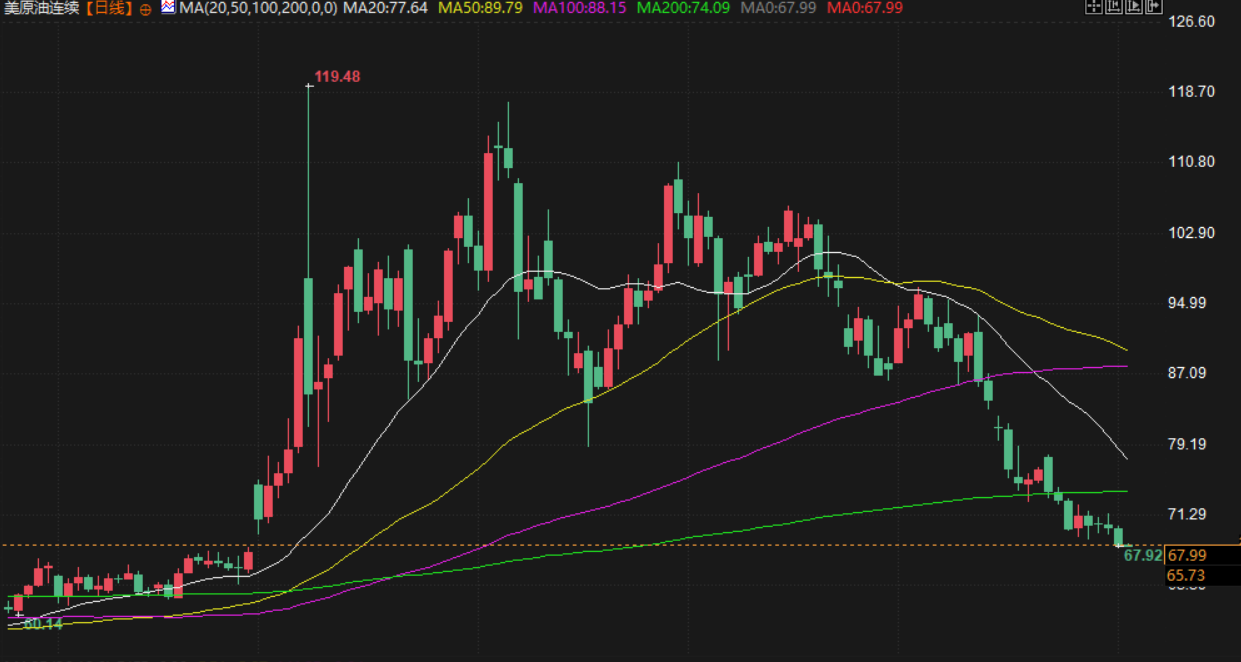
Oil prices fell on Wednesday, with Brent crude dropping 3% to $71.13 a barrel and WTI crude falling 2.77% to $68.09 a barrel, both hitting their lowest levels in four months. This was mainly due to US President Trump's comments that the US-Iran talks in Qatar were progressing well and that relations between the two countries were "very good." Technical talks in Doha aimed to reach an agreement on shipping passage through the Strait of Hormuz and a lasting ceasefire, easing market concerns about supply disruptions.
Meanwhile, tanker traffic has begun to resume, with US Vice President Vance stating that oil flow in the waterway has returned to pre-war levels; in addition, three sources revealed that OPEC+ oil-producing countries are expected to reach a consensus at their meeting on Sunday to further increase production targets starting in August, which also exacerbated the selling pressure.
On the supply side, the U.S. Energy Information Administration (EIA) showed that commercial crude oil inventories fell by 3.8 million barrels to 408.4 million barrels last week, the lowest level since September 2018, but the decline was less than the expected 4.5 million barrels. With the reopening of the Strait of Hormuz, surveys showed analysts lowered their 2026 oil price forecasts for the first time since the start of the Iran-Iraq war. Brent crude oil prices plummeted by about $45 per barrel in the second quarter, marking the largest quarterly drop since the 2008 financial crisis, while U.S. crude oil prices fell by about $31 per barrel, the worst quarterly performance since the COVID-19 pandemic began in 2020.
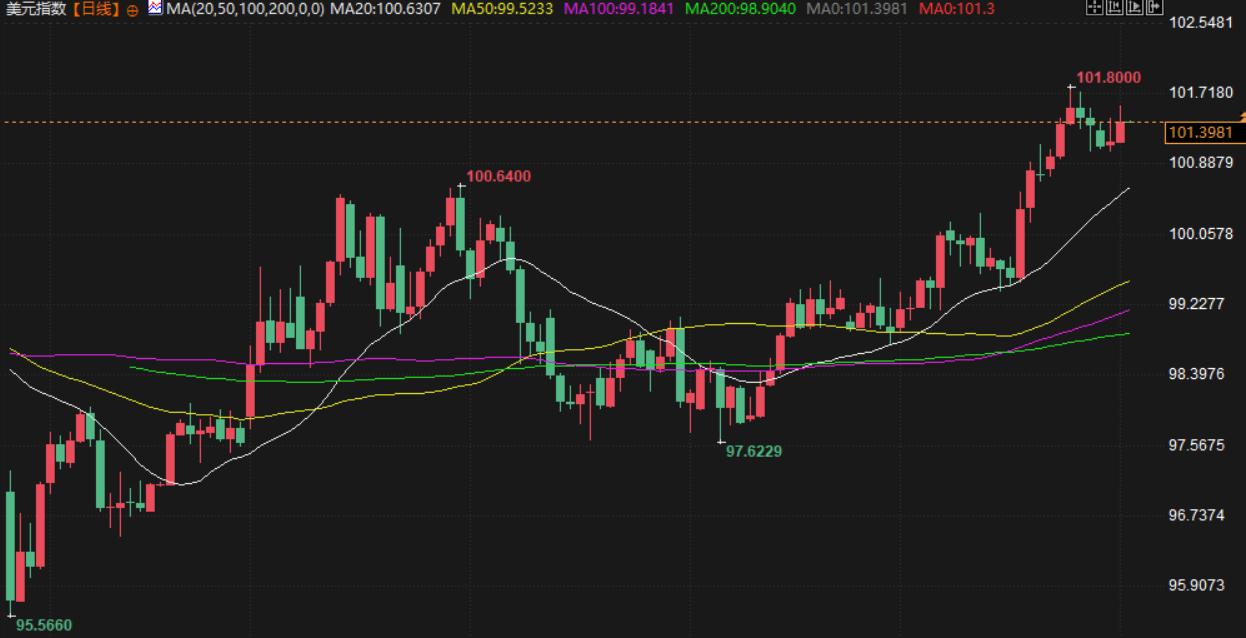
The dollar index rose 0.24% on Wednesday to close at 101.41. The dollar initially rose ahead of the closely watched U.S. nonfarm payrolls report on Wednesday, but subsequently pared gains after Federal Reserve Chairman Warsh said inflation expectations and risks had eased in recent weeks and reiterated the Fed's unwavering commitment to its 2% inflation target, while setting a timeline for the Fed to "discover" and utilize higher-quality real-time data within nine to twelve months.
When asked whether artificial intelligence could drive up inflation, Warsh responded that the Federal Reserve's responsibility is to ensure that AI does not contribute to inflation, rather than analyzing how its specific applications affect resource pressures.
While rising market expectations for a Federal Reserve rate hike this year (federal funds rate futures indicate a roughly 66% probability of a September rate hike) have supported the dollar, many analysts believe that future inflation will improve, and other factors such as a strong labor market and the rapid adoption of AI are also attracting capital inflows to the United States.
The yen fell to a 40-year low, dragged down by a stronger dollar, before rebounding as the dollar weakened, with the dollar/yen pair remaining largely unchanged at 162.56. Japan's Ministry of Finance faces a dilemma regarding intervention. Bloomberg reports that intervention two months ago has been effective and some US officials have expressed "support," but HSBC analysts believe the Ministry may be more tolerant of a weaker yen due to factors including a broad-based strengthening dollar and lower oil prices easing inflationary pressures. They also suggest the Ministry may wait for an unexpectedly weak jobs report on Thursday to attract speculative positions and enhance the impact of intervention. Traders believe Friday's US holiday could be a potential window for intervention, but some analysts point out that intervention during periods of weak liquidity would appear "weak."
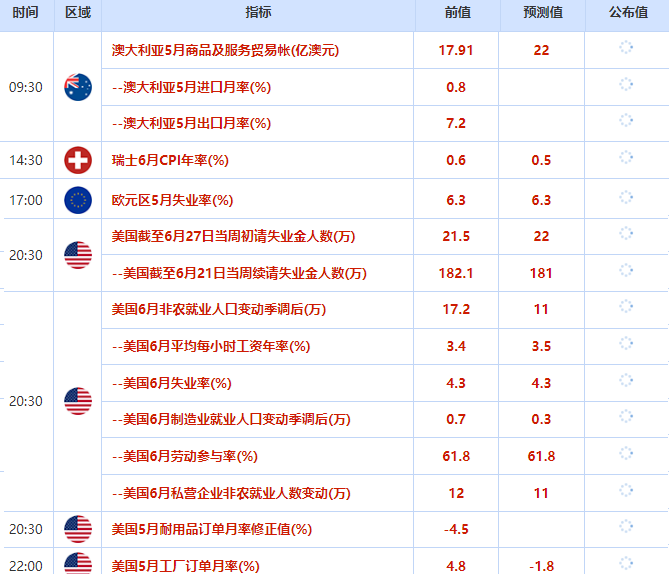
The euro fell 0.39% to 1.1376 against the dollar as eurozone inflation in June fell more than expected, dropping below 3%, easing pressure on the European Central Bank to raise interest rates. Market focus shifted to Thursday's upcoming US June non-farm payrolls report (expected to show 110,000 new jobs and an unemployment rate of 4.3%), while Wednesday's ADP data showed only 98,000 new private sector jobs, below the expected 118,000, adding uncertainty to the dollar's trajectory.
Sources familiar with the matter say the US and Iran have reached an agreement to unfreeze some Iranian assets, with the funds intended to be used to purchase US agricultural products.
A senior source familiar with the matter revealed that the United States and Iran have reached an agreement allowing Tehran to access some of its frozen overseas assets. This move will provide Iran with much-needed foreign exchange to purchase agricultural products from the United States. According to the agreement, the unfrozen Iranian funds will be deposited into an escrow account controlled by the US and specifically used to purchase US-produced food, such as corn, wheat, and soybeans, as well as medical supplies. The US believes this will meet both domestic Iranian needs and benefit American farmers. Iran has offered a different response to the US's claims regarding the use of the funds. The Governor of the Central Bank of Iran, Hemmati, stated that according to the signed memorandum of understanding, Iran is "not obligated to purchase agricultural products from the United States." He also emphasized that Iran will decide how to use the funds entirely based on its national interests and the price and quality of the products. These unfrozen funds originated from the 2023 US-Iran prisoner exchange and humanitarian agreement. The US has oversight of the flow and use of the funds, while Iran emphasizes its independence in decision-making. Currently, the two sides continue to disagree on the specific use of the funds.
Iran says the US violated its commitments under the memorandum of understanding and will establish a monitoring mechanism to review the violations.
On July 1, local time, Iranian Deputy Foreign Minister and head of the Iranian technical negotiation delegation, Gharibabadi, stated that during the trilateral talks between Iran, Qatar, and Pakistan held in Doha that day, the Iranian delegation raised and reviewed the United States' violation of Article 1 of the US-Iran Memorandum of Understanding (MOU) regarding the end of the war in Lebanon. They also discussed reports of the US strengthening its regional military equipment and troop deployments, as well as some threatening and interventionist remarks made by US officials. The Iranian delegation emphasized during the talks that the commitments in the MOU are a unified whole and cannot be viewed in isolation. Gharibabadi announced that a monitoring group will be established to report and review violations related to the MOU through direct communication channels. (CCTV News)
Sources: Iran demands phased implementation of the US-Iran memorandum of understanding, with a focus on unfreezing assets.
On June 1st local time, sources stated that during indirect talks between the Iranian delegation and the US in Doha, Qatar, the Iranian delegation demanded a phased implementation of the previously reached memorandum of understanding, focusing on the provisions regarding frozen Iranian assets. Iran requested the unfreezing of its frozen assets and their provision to the Central Bank of Iran, with the unfrozen funds to be used for food supplies. Reportedly, the Iranian representatives insisted that the Strait of Hormuz should be under the jurisdiction of Iran and Oman, refusing to allow any vessels to choose routes in the Strait without their permission. Iran reiterated its commitment to the Treaty on the Non-Proliferation of Nuclear Weapons and stated its commitment to cooperation with the International Atomic Energy Agency. Furthermore, the Iranian representatives condemned Israel's continued military presence in Lebanon, stating that it undermined the implementation of the US-Iran memorandum of understanding. (CCTV News)
Vance: Indirect talks between the US and Iran are progressing well; discussions on the nuclear issue will begin soon.
On July 1, local time, U.S. Vice President Vance stated that the indirect technical talks between the U.S. and Iran held that day in Doha, the capital of Qatar, were "progressing well," and discussions on the nuclear issue would begin soon. Vance said that technical negotiators were currently in Doha discussing relevant details with representatives from Iran and Qatar. Vance stated, "We are concerned about the nuclear issue, and we will begin discussing this issue. The negotiations are progressing well." (CCTV News)
Federal Reserve Chairman: Current U.S. inflation level remains too high
U.S. Federal Reserve Chairman Kevin Warsh stated at the European Central Bank's Central Bank Forum in Portugal on July 1 that current U.S. inflation remains too high, while reiterating that ensuring price stability is the Fed's top priority. Warsh said the Fed will "blaze a new policy path," but did not elaborate further, avoiding questions about whether interest rates would be raised at the July monetary policy meeting, and emphasizing that it will not provide forward guidance on future interest rate policy. Warsh stated that the Fed is establishing an independent working group to study topics such as monetary policy communication, economic data systems, productivity, the inflation framework, and balance sheet policy. He believes that if the existing policy framework affects decision-making efficiency, reforms should be implemented. (Xinhua)
Shana: Iran is prepared to sell oil to all countries except Israel.
According to Iran's official news agency Shana, Ali Mousavi, Iran's Deputy Minister of Oil for International and Financial Affairs, stated that Iran is ready to export oil to all countries except Israel. Mousavi said, "We hope to expand relations with other countries that are looking to buy Iranian oil." He added that Iran will "make the most of" the 60-day sanctions waiver granted by the US Treasury Department.
Trump said the talks between the US and Iran in Qatar were progressing well.
US President Donald Trump said on July 1 that the latest round of talks between the US and Iran in Qatar progressed smoothly. According to US media reports, Trump stated in an interview that day that "Iran's denuclearization process is progressing well," and that US and Iranian officials held a "very good meeting" in Qatar. According to an informed source and an Iranian official, the US and Iran held technical talks in Doha, the capital of Qatar, on July 1. Trump's son-in-law Jared Kushner and US Presidential Envoy Joshua Witkov met with the Qatari Prime Minister, but they did not attend the specific negotiation sessions. Earlier, sources revealed that the US and Iran held indirect talks in Doha on July 1, with Qatar and Pakistan acting as mediators. The talks focused on implementing the US-Iran memorandum of understanding, discussing issues including unfreezing Iranian assets and ensuring maritime security in the Strait of Hormuz. (Xinhua)
EU agency: Global sea surface temperature broke historical record for the same period in June.
The Copernicus Climate Change Service, the EU's climate monitoring agency, and the Copernicus Marine Service jointly issued a statement on July 1st, saying that the global average sea surface temperature on June 21st broke historical records for that time of year. Data from the Copernicus Climate Change Service showed that the global average sea surface temperature rose to 20.86 degrees Celsius on June 21st, higher than the 20.83 degrees Celsius recorded for the same period in 2023 and 2024. Data from the Copernicus Marine Service showed that the global average sea surface temperature reached 21 degrees Celsius on the same day, 0.1 degrees Celsius higher than the records set in 2023 and 2024.
Federal Reserve's Warsh: Will Uphold Independence Even Under Pressure from Trump
Federal Reserve Chairman Warsh refuted President Donald Trump's pressure campaign against the Fed, stating that the Fed's independence will not change regardless of the president's demands. "We have a long history as an independent central bank," Warsh said. "We will remain committed to our independent position, and that will not waver." This statement marks Warsh's first test since taking office. Trump had repeatedly criticized Jerome Powell's interest rate policies for years, accusing him of being too slow in cutting rates, before Warsh succeeded Powell as Fed Chairman. Powell's term as Fed Chairman ended this year. During his tenure, he repeatedly defended the Fed's independence, emphasizing that Fed officials would only formulate policy based on economic data and would never succumb to political pressure.
Wang Yi spoke by phone with US Secretary of State Rubio.
Wang Yi, member of the Political Bureau of the CPC Central Committee and Foreign Minister, spoke by phone with U.S. Secretary of State Marco Rubio on June 30. Wang Yi pointed out that both sides should always uphold the spirit of equality, respect, and mutual benefit, and translate the important consensus reached by the two heads of state into concrete policies and practical measures. Building a constructive strategic and stable relationship is not just a slogan; it requires action, mutual understanding, and sustained effort. To this end, both sides should lengthen the list of cooperation, create more positive agendas, while simultaneously reducing the list of issues and managing various risks and hidden dangers. Both sides agreed that the phone call between the two foreign ministers was positive and constructive, and agreed to jointly implement the important consensus reached by the two heads of state and continue to maintain communication in a flexible manner. (Xinhua)
Key Focus Today
stock market
U.S. stocks closed lower on Wednesday in volatile trading, with all three major indexes falling slightly. The Dow Jones Industrial Average edged down 0.03% to 52,305.24, the S&P 500 declined 0.22% to 7,483.23, and the Nasdaq Composite dropped 0.66% to 26,040.03.
The decline was mainly due to a pullback in technology stocks, with the Philadelphia Semiconductor Index plunging 6.3%, becoming the main factor dragging down the S&P 500 and Nasdaq, as the market worried about overvalued technology companies and huge spending in the field of artificial intelligence.
However, Meta Platforms surged 8.8% after a Bloomberg report that it was building a cloud business to sell excess AI computing power, partially offsetting the decline. Investors were also focused on the lack of progress in indirect negotiations between the US and Iran, coupled with cautious sentiment ahead of the long weekend. Meanwhile, Federal Reserve Chairman Warsh said that recent inflation risks had eased, but reiterated his firm commitment to the 2% inflation target, which cooled market expectations for further easing. Traders still expect the Fed to raise interest rates at least once this year.
On the economic data front, U.S. manufacturing activity slowed in June but remained robust, and the data from the Institute for Supply Management (ISM) was also digested.
Gold Market
Gold prices rose significantly on Wednesday, with spot gold closing up 0.59% at $4,030.94 per ounce, having earlier approached $4,115 per ounce. This was mainly due to weaker-than-expected US ADP private sector employment data (98,000 jobs added in June, below the expected 118,000) and comments from Federal Reserve Chairman Warsh that inflation expectations and risks had eased in recent weeks, pushing bond yields down and boosting the sluggish gold market.
Independent metals traders point out that unless Thursday's nonfarm payroll report is exceptionally strong, gold prices may have already formed a short-term bottom.
Meanwhile, the market expects a 65% probability of a Fed rate hike in September, and geopolitical factors, such as the technical talks between the US and Iran in Doha seeking passage through the Strait of Hormuz and a ceasefire agreement, also provided support for gold prices.
Other precious metals also rose, with spot silver up 0.9% to $59.08 per ounce, palladium up 1.2% to $1218.75, and platinum up 2.2% to $1584.75, after hitting its lowest level since November during the session before rebounding.
oil market
Oil prices fell on Wednesday, with Brent crude dropping 3% to $71.13 a barrel and WTI crude falling 2.77% to $68.09 a barrel, both hitting their lowest levels in four months. This was mainly due to US President Trump's comments that the US-Iran talks in Qatar were progressing well and that relations between the two countries were "very good." Technical talks in Doha aimed to reach an agreement on shipping passage through the Strait of Hormuz and a lasting ceasefire, easing market concerns about supply disruptions.
Meanwhile, tanker traffic has begun to resume, with US Vice President Vance stating that oil flow in the waterway has returned to pre-war levels; in addition, three sources revealed that OPEC+ oil-producing countries are expected to reach a consensus at their meeting on Sunday to further increase production targets starting in August, which also exacerbated the selling pressure.
On the supply side, the U.S. Energy Information Administration (EIA) showed that commercial crude oil inventories fell by 3.8 million barrels to 408.4 million barrels last week, the lowest level since September 2018, but the decline was less than the expected 4.5 million barrels. With the reopening of the Strait of Hormuz, surveys showed analysts lowered their 2026 oil price forecasts for the first time since the start of the Iran-Iraq war. Brent crude oil prices plummeted by about $45 per barrel in the second quarter, marking the largest quarterly drop since the 2008 financial crisis, while U.S. crude oil prices fell by about $31 per barrel, the worst quarterly performance since the COVID-19 pandemic began in 2020.
Foreign exchange market
The dollar index rose 0.24% on Wednesday to close at 101.41. The dollar initially rose ahead of the closely watched U.S. nonfarm payrolls report on Wednesday, but subsequently pared gains after Federal Reserve Chairman Warsh said inflation expectations and risks had eased in recent weeks and reiterated the Fed's unwavering commitment to its 2% inflation target, while setting a timeline for the Fed to "discover" and utilize higher-quality real-time data within nine to twelve months.
When asked whether artificial intelligence could drive up inflation, Warsh responded that the Federal Reserve's responsibility is to ensure that AI does not contribute to inflation, rather than analyzing how its specific applications affect resource pressures.
While rising market expectations for a Federal Reserve rate hike this year (federal funds rate futures indicate a roughly 66% probability of a September rate hike) have supported the dollar, many analysts believe that future inflation will improve, and other factors such as a strong labor market and the rapid adoption of AI are also attracting capital inflows to the United States.
The yen fell to a 40-year low, dragged down by a stronger dollar, before rebounding as the dollar weakened, with the dollar/yen pair remaining largely unchanged at 162.56. Japan's Ministry of Finance faces a dilemma regarding intervention. Bloomberg reports that intervention two months ago has been effective and some US officials have expressed "support," but HSBC analysts believe the Ministry may be more tolerant of a weaker yen due to factors including a broad-based strengthening dollar and lower oil prices easing inflationary pressures. They also suggest the Ministry may wait for an unexpectedly weak jobs report on Thursday to attract speculative positions and enhance the impact of intervention. Traders believe Friday's US holiday could be a potential window for intervention, but some analysts point out that intervention during periods of weak liquidity would appear "weak."
The euro fell 0.39% to 1.1376 against the dollar as eurozone inflation in June fell more than expected, dropping below 3%, easing pressure on the European Central Bank to raise interest rates. Market focus shifted to Thursday's upcoming US June non-farm payrolls report (expected to show 110,000 new jobs and an unemployment rate of 4.3%), while Wednesday's ADP data showed only 98,000 new private sector jobs, below the expected 118,000, adding uncertainty to the dollar's trajectory.
International News
Sources familiar with the matter say the US and Iran have reached an agreement to unfreeze some Iranian assets, with the funds intended to be used to purchase US agricultural products.
A senior source familiar with the matter revealed that the United States and Iran have reached an agreement allowing Tehran to access some of its frozen overseas assets. This move will provide Iran with much-needed foreign exchange to purchase agricultural products from the United States. According to the agreement, the unfrozen Iranian funds will be deposited into an escrow account controlled by the US and specifically used to purchase US-produced food, such as corn, wheat, and soybeans, as well as medical supplies. The US believes this will meet both domestic Iranian needs and benefit American farmers. Iran has offered a different response to the US's claims regarding the use of the funds. The Governor of the Central Bank of Iran, Hemmati, stated that according to the signed memorandum of understanding, Iran is "not obligated to purchase agricultural products from the United States." He also emphasized that Iran will decide how to use the funds entirely based on its national interests and the price and quality of the products. These unfrozen funds originated from the 2023 US-Iran prisoner exchange and humanitarian agreement. The US has oversight of the flow and use of the funds, while Iran emphasizes its independence in decision-making. Currently, the two sides continue to disagree on the specific use of the funds.
Iran says the US violated its commitments under the memorandum of understanding and will establish a monitoring mechanism to review the violations.
On July 1, local time, Iranian Deputy Foreign Minister and head of the Iranian technical negotiation delegation, Gharibabadi, stated that during the trilateral talks between Iran, Qatar, and Pakistan held in Doha that day, the Iranian delegation raised and reviewed the United States' violation of Article 1 of the US-Iran Memorandum of Understanding (MOU) regarding the end of the war in Lebanon. They also discussed reports of the US strengthening its regional military equipment and troop deployments, as well as some threatening and interventionist remarks made by US officials. The Iranian delegation emphasized during the talks that the commitments in the MOU are a unified whole and cannot be viewed in isolation. Gharibabadi announced that a monitoring group will be established to report and review violations related to the MOU through direct communication channels. (CCTV News)
Sources: Iran demands phased implementation of the US-Iran memorandum of understanding, with a focus on unfreezing assets.
On June 1st local time, sources stated that during indirect talks between the Iranian delegation and the US in Doha, Qatar, the Iranian delegation demanded a phased implementation of the previously reached memorandum of understanding, focusing on the provisions regarding frozen Iranian assets. Iran requested the unfreezing of its frozen assets and their provision to the Central Bank of Iran, with the unfrozen funds to be used for food supplies. Reportedly, the Iranian representatives insisted that the Strait of Hormuz should be under the jurisdiction of Iran and Oman, refusing to allow any vessels to choose routes in the Strait without their permission. Iran reiterated its commitment to the Treaty on the Non-Proliferation of Nuclear Weapons and stated its commitment to cooperation with the International Atomic Energy Agency. Furthermore, the Iranian representatives condemned Israel's continued military presence in Lebanon, stating that it undermined the implementation of the US-Iran memorandum of understanding. (CCTV News)
Vance: Indirect talks between the US and Iran are progressing well; discussions on the nuclear issue will begin soon.
On July 1, local time, U.S. Vice President Vance stated that the indirect technical talks between the U.S. and Iran held that day in Doha, the capital of Qatar, were "progressing well," and discussions on the nuclear issue would begin soon. Vance said that technical negotiators were currently in Doha discussing relevant details with representatives from Iran and Qatar. Vance stated, "We are concerned about the nuclear issue, and we will begin discussing this issue. The negotiations are progressing well." (CCTV News)
Federal Reserve Chairman: Current U.S. inflation level remains too high
U.S. Federal Reserve Chairman Kevin Warsh stated at the European Central Bank's Central Bank Forum in Portugal on July 1 that current U.S. inflation remains too high, while reiterating that ensuring price stability is the Fed's top priority. Warsh said the Fed will "blaze a new policy path," but did not elaborate further, avoiding questions about whether interest rates would be raised at the July monetary policy meeting, and emphasizing that it will not provide forward guidance on future interest rate policy. Warsh stated that the Fed is establishing an independent working group to study topics such as monetary policy communication, economic data systems, productivity, the inflation framework, and balance sheet policy. He believes that if the existing policy framework affects decision-making efficiency, reforms should be implemented. (Xinhua)
Shana: Iran is prepared to sell oil to all countries except Israel.
According to Iran's official news agency Shana, Ali Mousavi, Iran's Deputy Minister of Oil for International and Financial Affairs, stated that Iran is ready to export oil to all countries except Israel. Mousavi said, "We hope to expand relations with other countries that are looking to buy Iranian oil." He added that Iran will "make the most of" the 60-day sanctions waiver granted by the US Treasury Department.
Trump said the talks between the US and Iran in Qatar were progressing well.
US President Donald Trump said on July 1 that the latest round of talks between the US and Iran in Qatar progressed smoothly. According to US media reports, Trump stated in an interview that day that "Iran's denuclearization process is progressing well," and that US and Iranian officials held a "very good meeting" in Qatar. According to an informed source and an Iranian official, the US and Iran held technical talks in Doha, the capital of Qatar, on July 1. Trump's son-in-law Jared Kushner and US Presidential Envoy Joshua Witkov met with the Qatari Prime Minister, but they did not attend the specific negotiation sessions. Earlier, sources revealed that the US and Iran held indirect talks in Doha on July 1, with Qatar and Pakistan acting as mediators. The talks focused on implementing the US-Iran memorandum of understanding, discussing issues including unfreezing Iranian assets and ensuring maritime security in the Strait of Hormuz. (Xinhua)
EU agency: Global sea surface temperature broke historical record for the same period in June.
The Copernicus Climate Change Service, the EU's climate monitoring agency, and the Copernicus Marine Service jointly issued a statement on July 1st, saying that the global average sea surface temperature on June 21st broke historical records for that time of year. Data from the Copernicus Climate Change Service showed that the global average sea surface temperature rose to 20.86 degrees Celsius on June 21st, higher than the 20.83 degrees Celsius recorded for the same period in 2023 and 2024. Data from the Copernicus Marine Service showed that the global average sea surface temperature reached 21 degrees Celsius on the same day, 0.1 degrees Celsius higher than the records set in 2023 and 2024.
Federal Reserve's Warsh: Will Uphold Independence Even Under Pressure from Trump
Federal Reserve Chairman Warsh refuted President Donald Trump's pressure campaign against the Fed, stating that the Fed's independence will not change regardless of the president's demands. "We have a long history as an independent central bank," Warsh said. "We will remain committed to our independent position, and that will not waver." This statement marks Warsh's first test since taking office. Trump had repeatedly criticized Jerome Powell's interest rate policies for years, accusing him of being too slow in cutting rates, before Warsh succeeded Powell as Fed Chairman. Powell's term as Fed Chairman ended this year. During his tenure, he repeatedly defended the Fed's independence, emphasizing that Fed officials would only formulate policy based on economic data and would never succumb to political pressure.
Domestic News
Wang Yi spoke by phone with US Secretary of State Rubio.
Wang Yi, member of the Political Bureau of the CPC Central Committee and Foreign Minister, spoke by phone with U.S. Secretary of State Marco Rubio on June 30. Wang Yi pointed out that both sides should always uphold the spirit of equality, respect, and mutual benefit, and translate the important consensus reached by the two heads of state into concrete policies and practical measures. Building a constructive strategic and stable relationship is not just a slogan; it requires action, mutual understanding, and sustained effort. To this end, both sides should lengthen the list of cooperation, create more positive agendas, while simultaneously reducing the list of issues and managing various risks and hidden dangers. Both sides agreed that the phone call between the two foreign ministers was positive and constructive, and agreed to jointly implement the important consensus reached by the two heads of state and continue to maintain communication in a flexible manner. (Xinhua)
- Risk Warning and Disclaimer
- The market involves risk, and trading may not be suitable for all investors. This article is for reference only and does not constitute personal investment advice, nor does it take into account certain users’ specific investment objectives, financial situation, or other needs. Any investment decisions made based on this information are at your own risk.