Warsh's "First Major Test": If Non-Farm Payrolls Exceed Expectations, a July Rate Hike May Go From "Discussion" to "Implementation"
2026-07-02 10:52:08
On Thursday (July 2) during the Asian session, the US dollar index fluctuated at high levels and is currently trading around 101.35.
The non-farm payrolls report is about to be released, and its importance is far greater than usual—the Federal Reserve is shifting from a "forward guidance" framework to a "current data-driven + rebuilding credibility" model. Against this backdrop, the June non-farm payrolls data will directly determine whether the July FOMC meeting will move into the range of interest rate hikes.
If the June non-farm payroll data reaches any of the following levels, the FOMC will begin substantive discussions on a rate hike in July: an unemployment rate of 4.2% coupled with 150,000 or more new jobs, or an unemployment rate of 4.3% coupled with 175,000 or more new jobs.
If the data falls below the aforementioned threshold, discussions about a July rate hike will quickly subside. An improved inflation outlook (the plunge in oil prices and declining inflation expectations) provides doves with ample reason to wait.
If the doves can hold out through the July meeting, the summer CPI and PCE data will most likely prove that "no rate hike is needed," at which point the June FOMC dot plot will seem outdated.
The June dot plot was submitted against the backdrop of high oil prices. With current retail gasoline prices having fallen back to pre-war levels, it's only a matter of time before the dot plot is revised downwards.
The impact of non-farm payroll data on the USD/JPY exchange rate is not simply a matter of "good data = dollar appreciation." The key variable is whether the Japanese Ministry of Finance will intervene after the data is released.
The consensus within the G7 framework that "exchange rates should reflect fundamentals" means that if non-farm payrolls are strong, intervention by the Ministry of Finance would appear unjustified and inappropriate given the fundamentals supporting a stronger dollar; conversely, if the data is weak and the dollar weakens in line with fundamentals, the tactical value of the Ministry of Finance's intervention would be greatly enhanced.
In terms of scenario analysis, if weak non-farm payroll data is coupled with unilateral intervention from the Ministry of Finance, historical experience shows that such operations typically result in a 3.0%-3.5% decline. Based on the current USD/JPY exchange rate of around 162.00, the buying range after intervention would be approximately 157.10-157.90. In the extremely low probability of coordinated intervention, the price could be pushed directly down to 155.00.
In terms of strategic response, unilateral intervention is often an opportunity to "buy on pullbacks" because its effects are usually short-lived and the market will soon return to the trend driven by interest rate spreads; while joint intervention may mark a trend reversal, at which point the strategy should be to "sell on rallies".
The Ministry of Finance's intervention decision is essentially a tactical maneuver—acting just before the holidays, during a window of opportunity when data is weak, minimizes political costs and maximizes effectiveness. The market needs to consider both the non-farm payroll data itself and the Ministry of Finance's reaction, rather than simply betting on the direction of the data.
The correlation between gold and G10 currencies is returning to a "classic pattern"—interest rate differentials and gold prices fluctuate largely in tandem, closely following the movements of major currencies. This means that tonight's non-farm payroll data will have a decisive impact on the direction of gold prices.
From a short-term technical perspective, gold has formed a noteworthy structure: after twice successfully holding support and a sharp drop followed by a rapid rebound, the price is currently forming a triple top pattern. If the non-farm payroll data is strong, the technical analysis will become ineffective, and the price may break down; if the data is weak, the triple top will become a short-term bottom reversal signal.
For traders who are bullish on gold and are using tight stop-loss orders, the current technical level provides a clear "discord point"—if it breaks below this level, it indicates a misjudgment and it's time to exit the position.
Warsh will reappear at the ECB's Sintra Forum on Thursday. However, the market should not expect him to give a clear signal about the July meeting—Wash's style differs from his predecessors; he will not "throw crumbs" at the forum to guide market expectations.
The practice of "giving the market two weeks in advance," as seen during Powell's era, is unlikely to be repeated under Warsh's leadership.
According to the daily chart, the US dollar index shows a clear medium-term bullish trend. After testing a low of 97.62, it has been steadily rising, with the moving average system in a bullish alignment: the 20-day moving average (MA20) (100.63), 50-day moving average (MA50) (99.52), 100-day moving average (MA100) (99.18), and 200-day moving average (MA200) (98.90) are all below the price, forming a strong support zone. The bullish structure is intact, with the previous high of 101.80 acting as a strong short-term resistance level.
In terms of indicators, the MACD lines are running above the zero axis, the DIFF (0.5602) is slightly higher than the DEA (0.5314), the red bars are narrowing slightly, the bullish momentum has weakened, but there is no signal of a bearish reversal; the RSI value is 68.19, close to the 70 overbought threshold, the short-term upward momentum has been exhausted, and there is a need for a pullback to digest it.
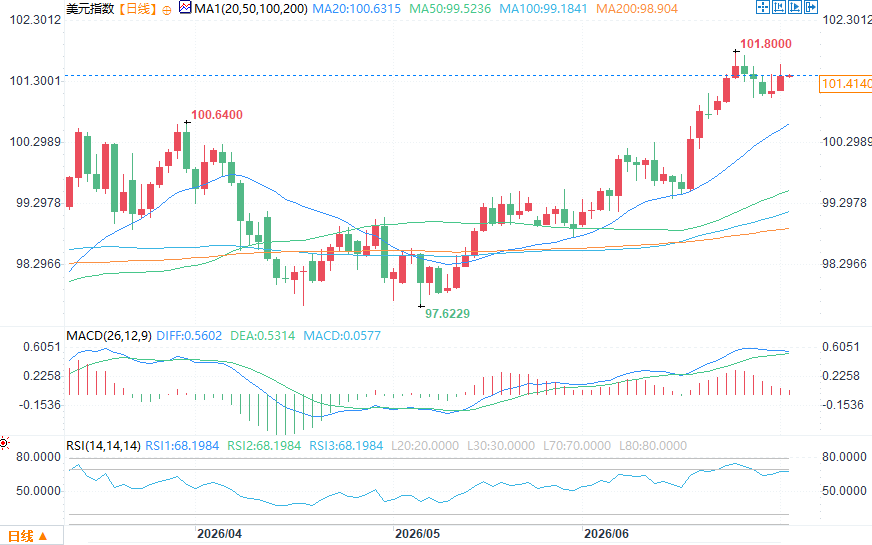
(US Dollar Index Daily Chart, Source: FX678)
At 10:51 AM Beijing time on July 2, the US dollar index was at 101.34.
The non-farm payrolls report is about to be released, and its importance is far greater than usual—the Federal Reserve is shifting from a "forward guidance" framework to a "current data-driven + rebuilding credibility" model. Against this backdrop, the June non-farm payrolls data will directly determine whether the July FOMC meeting will move into the range of interest rate hikes.
Non-farm payrolls "red line": What level would trigger a July rate hike?
If the June non-farm payroll data reaches any of the following levels, the FOMC will begin substantive discussions on a rate hike in July: an unemployment rate of 4.2% coupled with 150,000 or more new jobs, or an unemployment rate of 4.3% coupled with 175,000 or more new jobs.
If the data falls below the aforementioned threshold, discussions about a July rate hike will quickly subside. An improved inflation outlook (the plunge in oil prices and declining inflation expectations) provides doves with ample reason to wait.
If the doves can hold out through the July meeting, the summer CPI and PCE data will most likely prove that "no rate hike is needed," at which point the June FOMC dot plot will seem outdated.
The June dot plot was submitted against the backdrop of high oil prices. With current retail gasoline prices having fallen back to pre-war levels, it's only a matter of time before the dot plot is revised downwards.
USD/JPY: How does non-farm payroll data "resonate" with the Ministry of Finance's intervention?
The impact of non-farm payroll data on the USD/JPY exchange rate is not simply a matter of "good data = dollar appreciation." The key variable is whether the Japanese Ministry of Finance will intervene after the data is released.
The consensus within the G7 framework that "exchange rates should reflect fundamentals" means that if non-farm payrolls are strong, intervention by the Ministry of Finance would appear unjustified and inappropriate given the fundamentals supporting a stronger dollar; conversely, if the data is weak and the dollar weakens in line with fundamentals, the tactical value of the Ministry of Finance's intervention would be greatly enhanced.
In terms of scenario analysis, if weak non-farm payroll data is coupled with unilateral intervention from the Ministry of Finance, historical experience shows that such operations typically result in a 3.0%-3.5% decline. Based on the current USD/JPY exchange rate of around 162.00, the buying range after intervention would be approximately 157.10-157.90. In the extremely low probability of coordinated intervention, the price could be pushed directly down to 155.00.
In terms of strategic response, unilateral intervention is often an opportunity to "buy on pullbacks" because its effects are usually short-lived and the market will soon return to the trend driven by interest rate spreads; while joint intervention may mark a trend reversal, at which point the strategy should be to "sell on rallies".
The Ministry of Finance's intervention decision is essentially a tactical maneuver—acting just before the holidays, during a window of opportunity when data is weak, minimizes political costs and maximizes effectiveness. The market needs to consider both the non-farm payroll data itself and the Ministry of Finance's reaction, rather than simply betting on the direction of the data.
Gold: Non-farm payroll data will determine short-term direction
The correlation between gold and G10 currencies is returning to a "classic pattern"—interest rate differentials and gold prices fluctuate largely in tandem, closely following the movements of major currencies. This means that tonight's non-farm payroll data will have a decisive impact on the direction of gold prices.
From a short-term technical perspective, gold has formed a noteworthy structure: after twice successfully holding support and a sharp drop followed by a rapid rebound, the price is currently forming a triple top pattern. If the non-farm payroll data is strong, the technical analysis will become ineffective, and the price may break down; if the data is weak, the triple top will become a short-term bottom reversal signal.
For traders who are bullish on gold and are using tight stop-loss orders, the current technical level provides a clear "discord point"—if it breaks below this level, it indicates a misjudgment and it's time to exit the position.
Sintra Forum: Walsh won't "throw breadcrumbs"
Warsh will reappear at the ECB's Sintra Forum on Thursday. However, the market should not expect him to give a clear signal about the July meeting—Wash's style differs from his predecessors; he will not "throw crumbs" at the forum to guide market expectations.
The practice of "giving the market two weeks in advance," as seen during Powell's era, is unlikely to be repeated under Warsh's leadership.
Technical Analysis
According to the daily chart, the US dollar index shows a clear medium-term bullish trend. After testing a low of 97.62, it has been steadily rising, with the moving average system in a bullish alignment: the 20-day moving average (MA20) (100.63), 50-day moving average (MA50) (99.52), 100-day moving average (MA100) (99.18), and 200-day moving average (MA200) (98.90) are all below the price, forming a strong support zone. The bullish structure is intact, with the previous high of 101.80 acting as a strong short-term resistance level.
In terms of indicators, the MACD lines are running above the zero axis, the DIFF (0.5602) is slightly higher than the DEA (0.5314), the red bars are narrowing slightly, the bullish momentum has weakened, but there is no signal of a bearish reversal; the RSI value is 68.19, close to the 70 overbought threshold, the short-term upward momentum has been exhausted, and there is a need for a pullback to digest it.
(US Dollar Index Daily Chart, Source: FX678)
At 10:51 AM Beijing time on July 2, the US dollar index was at 101.34.
- Risk Warning and Disclaimer
- The market involves risk, and trading may not be suitable for all investors. This article is for reference only and does not constitute personal investment advice, nor does it take into account certain users’ specific investment objectives, financial situation, or other needs. Any investment decisions made based on this information are at your own risk.