Warsh targets flawed government data and plans to reshape the Federal Reserve's decision-making process within a year.
2026-07-02 08:18:53
On Thursday (July 2) in early Asian trading, the US dollar index fluctuated at high levels and is currently trading around 101.40.
Federal Reserve Chairman Kevin Warsh on Wednesday set an ambitious timeline for the U.S. central bank to “discover” and begin relying on high-quality data that reflects the state of the economy in real time within a year, replacing what he considers problematic government statistical reports.
"My expectation is that in nine to twelve months, we will be able to use new technologies to grasp the state of the real economy in a synchronous, real-time manner, so that central bank policymakers can make more informed judgments," Warsh said at a monetary policy forum in Portugal. "At that time, we will no longer need to rely solely on data released by government agencies—data that suffers from measurement bias and whose survey methods are outdated."
He added, "The data I value most is right in front of me. If we do our job well, and look back a year from now, we can say that we have found data that can help us make better decisions."
Currently, the Federal Reserve is making extensive use of various public and non-public data from the government, private sector, and internally compiled sources to track economic trends, predict future directions, and adjust interest rates accordingly in order to achieve the dual goals of promoting employment and controlling inflation.
Warsh had previously criticized the Federal Reserve for relying too heavily on official data that was outdated or misrepresented the current situation, arguing that it was this poor data that led to the Fed’s flawed decisions, which was the main reason why inflation had remained above target for more than five years.
Warsh's colleagues at the Federal Reserve are generally more cautious about his criticisms.
They pointed out that to avoid being misled by subsequent revisions or data that does not yet reflect the current situation, they would reduce risk by observing long-term trends—Wash also avoided giving a direct answer when asked on Wednesday about the significance of recent economic reports for monetary policy, effectively agreeing with this approach.
In addition, Federal Reserve officials emphasized that they regularly visit business leaders and various organizations across the country and publish research summaries in the form of the Beige Book.
This work helps them grasp real-time economic changes that may be delayed in being reflected in official data, thus compensating for the shortcomings of official statistics.
Walsh announced on Wednesday that he will begin nominating members for his five newly established task forces next week, one of which will focus specifically on finding new sources and methods for data collection.
Walsh's move to reduce reliance on government data comes as the Bureau of Labor Statistics (BLS), one of the major data agencies in the United States, is about to appoint a new director.
The bureau chief has pledged to fix technical issues affecting the reliability of key economic reports, including the closely watched monthly jobs report, which will be released on Thursday.
Previously, US President Trump fired the former director of the Bureau of Labor Statistics after the Bureau significantly revised its data, showing that job growth was far weaker than initially reported, and accused him of releasing "false data."
Trump's newly appointed Brett Matsumoto said he did not believe the data was manipulated, but acknowledged that there was room for improvement in the data collection process.
Economists point out that the problem stems in part from the continued decline in the initial response rate to employment surveys, leading to larger revisions as more responses are entered.
At the same time, the Bureau of Economic Analysis (BEA) recently announced that it will adjust the compilation method of some inflation data, which is widely expected to lead to a downward revision of the data to be released in September this year.
Walsh said his task force will not only make recommendations on how to improve official data, but will also explore how to generate more timely economic information.
Warsh's data reforms, spearheaded after taking office, aim to improve the timeliness and accuracy of the Federal Reserve's decisions. While this effort faces internal scrutiny and demands to supplement existing mechanisms, its successful implementation could alleviate the long-standing impact of data lag on monetary policy. The current performance of the US dollar index reflects market uncertainty regarding this reform process; future employment reports and the progress of the working group will be key indicators.
Q1: What is the core of Kevin Walsh's one-year reform timetable?
Warsh's goal is to establish a real-time, synchronized economic data system using new technologies within 9-12 months, reducing reliance on traditional government statistical reports. He believes that existing data suffers from measurement biases and methodological lags, leading to past ineffective inflation control. This vision aims to make the Federal Reserve's decisions more closely aligned with the actual operation of the real economy.
Q2: Why did Walsh criticize existing government data, while his colleagues were more cautious?
Warsh argues that lagging and distorted official data is one of the contributing factors to persistently high inflation. However, his Federal Reserve colleagues prefer to combine long-term trend analysis with real-time information supplemented by field research, such as the Beige Book, to avoid being misled by a single data source. This difference reflects a balance between aggressive reforms and prudent operations.
Q3: What specific actions does Walsh's reform plan include?
He announced the launch of nominations for five special task forces next week, with a key task force responsible for exploring new data sources. Meanwhile, the new director of the Bureau of Labor Statistics is fixing technical issues related to the employment report, and the BEA will also adjust its inflation data compilation. These moves echo the Trump administration's focus on data accuracy.
Q4: What is the connection between the current high-level fluctuations of the US dollar index and Warsh's remarks?
The US dollar index fluctuated around 101.40, reflecting market expectations for the Federal Reserve's policy path. Warsh's reform signals could influence the pace of future interest rate decisions, and investors are weighing the potential positive impact of data improvements on monetary policy stability against short-term uncertainties.
Q5: What is the background significance of this event for ordinary investors and the economy?
The quality of Federal Reserve data directly impacts interest rates, employment, and inflation. Warsh's reforms aim to improve the scientific basis of decision-making, which, if successful, could reduce policy errors; however, they may face technical challenges and internal coordination pressures. Investors should pay attention to the upcoming jobs report and the subsequent progress of the working group to assess the direction of the dollar and asset prices. Overall, this reflects the Fed's efforts to modernize in a complex economic environment, contributing to long-term economic stability.
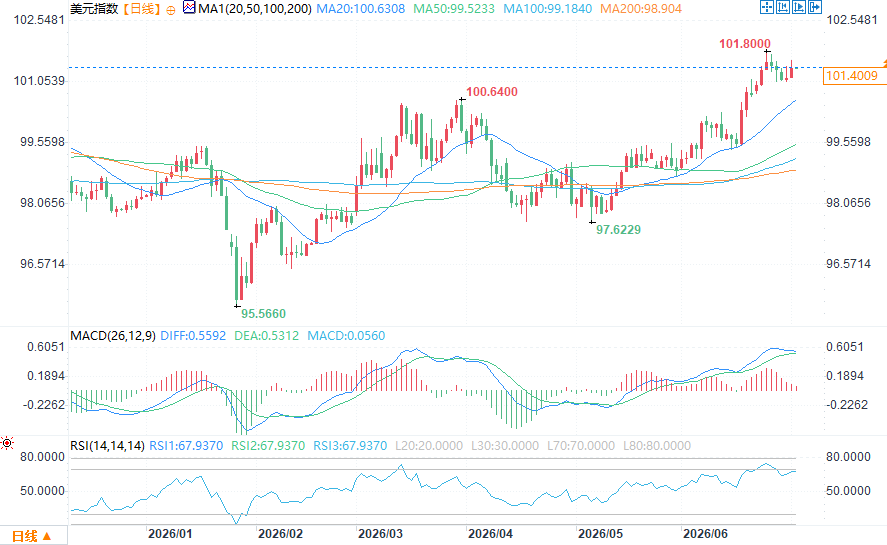
(US Dollar Index Daily Chart, Source: FX678)
At 7:54 AM Beijing time on July 2, the US dollar index was at 101.40.
Federal Reserve Chairman Kevin Warsh on Wednesday set an ambitious timeline for the U.S. central bank to “discover” and begin relying on high-quality data that reflects the state of the economy in real time within a year, replacing what he considers problematic government statistical reports.
Walsh's Vision and Timeline
"My expectation is that in nine to twelve months, we will be able to use new technologies to grasp the state of the real economy in a synchronous, real-time manner, so that central bank policymakers can make more informed judgments," Warsh said at a monetary policy forum in Portugal. "At that time, we will no longer need to rely solely on data released by government agencies—data that suffers from measurement bias and whose survey methods are outdated."
He added, "The data I value most is right in front of me. If we do our job well, and look back a year from now, we can say that we have found data that can help us make better decisions."
Current practices and existing criticisms
Currently, the Federal Reserve is making extensive use of various public and non-public data from the government, private sector, and internally compiled sources to track economic trends, predict future directions, and adjust interest rates accordingly in order to achieve the dual goals of promoting employment and controlling inflation.
Warsh had previously criticized the Federal Reserve for relying too heavily on official data that was outdated or misrepresented the current situation, arguing that it was this poor data that led to the Fed’s flawed decisions, which was the main reason why inflation had remained above target for more than five years.
Colleague's prudent stance and existing remedies
Warsh's colleagues at the Federal Reserve are generally more cautious about his criticisms.
They pointed out that to avoid being misled by subsequent revisions or data that does not yet reflect the current situation, they would reduce risk by observing long-term trends—Wash also avoided giving a direct answer when asked on Wednesday about the significance of recent economic reports for monetary policy, effectively agreeing with this approach.
In addition, Federal Reserve officials emphasized that they regularly visit business leaders and various organizations across the country and publish research summaries in the form of the Beige Book.
This work helps them grasp real-time economic changes that may be delayed in being reflected in official data, thus compensating for the shortcomings of official statistics.
Specific arrangements for reform
Walsh announced on Wednesday that he will begin nominating members for his five newly established task forces next week, one of which will focus specifically on finding new sources and methods for data collection.
Walsh's move to reduce reliance on government data comes as the Bureau of Labor Statistics (BLS), one of the major data agencies in the United States, is about to appoint a new director.
The bureau chief has pledged to fix technical issues affecting the reliability of key economic reports, including the closely watched monthly jobs report, which will be released on Thursday.
Previously, US President Trump fired the former director of the Bureau of Labor Statistics after the Bureau significantly revised its data, showing that job growth was far weaker than initially reported, and accused him of releasing "false data."
Trump's newly appointed Brett Matsumoto said he did not believe the data was manipulated, but acknowledged that there was room for improvement in the data collection process.
Economists point out that the problem stems in part from the continued decline in the initial response rate to employment surveys, leading to larger revisions as more responses are entered.
At the same time, the Bureau of Economic Analysis (BEA) recently announced that it will adjust the compilation method of some inflation data, which is widely expected to lead to a downward revision of the data to be released in September this year.
Walsh said his task force will not only make recommendations on how to improve official data, but will also explore how to generate more timely economic information.
Editor's Summary
Warsh's data reforms, spearheaded after taking office, aim to improve the timeliness and accuracy of the Federal Reserve's decisions. While this effort faces internal scrutiny and demands to supplement existing mechanisms, its successful implementation could alleviate the long-standing impact of data lag on monetary policy. The current performance of the US dollar index reflects market uncertainty regarding this reform process; future employment reports and the progress of the working group will be key indicators.
Frequently Asked Questions
Q1: What is the core of Kevin Walsh's one-year reform timetable?
Warsh's goal is to establish a real-time, synchronized economic data system using new technologies within 9-12 months, reducing reliance on traditional government statistical reports. He believes that existing data suffers from measurement biases and methodological lags, leading to past ineffective inflation control. This vision aims to make the Federal Reserve's decisions more closely aligned with the actual operation of the real economy.
Q2: Why did Walsh criticize existing government data, while his colleagues were more cautious?
Warsh argues that lagging and distorted official data is one of the contributing factors to persistently high inflation. However, his Federal Reserve colleagues prefer to combine long-term trend analysis with real-time information supplemented by field research, such as the Beige Book, to avoid being misled by a single data source. This difference reflects a balance between aggressive reforms and prudent operations.
Q3: What specific actions does Walsh's reform plan include?
He announced the launch of nominations for five special task forces next week, with a key task force responsible for exploring new data sources. Meanwhile, the new director of the Bureau of Labor Statistics is fixing technical issues related to the employment report, and the BEA will also adjust its inflation data compilation. These moves echo the Trump administration's focus on data accuracy.
Q4: What is the connection between the current high-level fluctuations of the US dollar index and Warsh's remarks?
The US dollar index fluctuated around 101.40, reflecting market expectations for the Federal Reserve's policy path. Warsh's reform signals could influence the pace of future interest rate decisions, and investors are weighing the potential positive impact of data improvements on monetary policy stability against short-term uncertainties.
Q5: What is the background significance of this event for ordinary investors and the economy?
The quality of Federal Reserve data directly impacts interest rates, employment, and inflation. Warsh's reforms aim to improve the scientific basis of decision-making, which, if successful, could reduce policy errors; however, they may face technical challenges and internal coordination pressures. Investors should pay attention to the upcoming jobs report and the subsequent progress of the working group to assess the direction of the dollar and asset prices. Overall, this reflects the Fed's efforts to modernize in a complex economic environment, contributing to long-term economic stability.
(US Dollar Index Daily Chart, Source: FX678)
At 7:54 AM Beijing time on July 2, the US dollar index was at 101.40.
- Risk Warning and Disclaimer
- The market involves risk, and trading may not be suitable for all investors. This article is for reference only and does not constitute personal investment advice, nor does it take into account certain users’ specific investment objectives, financial situation, or other needs. Any investment decisions made based on this information are at your own risk.