The USD/JPY pair continued to trade at high levels, awaiting the release of US non-farm payroll data.
2026-07-02 13:08:05
The USD/JPY pair has continued to rise in recent trading, breaking through the 162.00 level and reaching multi-year highs, continuing the one-sided upward trend that has not been reversed since the Bank of Japan raised interest rates. The market has not viewed the Bank of Japan's 1% policy rate hike as a signal of a trend reversal; instead, it has further reinforced the long-term divergence in monetary policy between the US and Japan.

The core driver of exchange rate movements remains the interest rate differential structure. Despite the Bank of Japan ending its long-term ultra-loose policy and implementing this round of "historic tightening," the USD/JPY interest rate differential remains significantly higher than the Federal Reserve's policy rate, at approximately 275 basis points . This structural gap continues to support arbitrage trading strategies, causing funds to flow continuously from low-yield yen to high-yield dollar assets, creating stable pressure for foreign exchange outflows.
Meanwhile, the Federal Reserve maintained a relatively tight stance in its recent policy meetings, ensuring that the dollar's yield advantage was not weakened and further solidifying the carry trade logic. Against this backdrop, market trading behavior was driven more by funding costs than by short-term policy signals, causing the yen to remain under pressure even after the interest rate hike.
Japanese officials are paying close attention to the rapid depreciation of the currency. The Ministry of Finance and related officials have continued to issue verbal warnings, emphasizing vigilance against excessive volatility in the foreign exchange market and reserving necessary intervention measures. However, the market generally believes that the key psychological and technical range is concentrated around the 160.00 level . This area has repeatedly become a sensitive zone for policy intervention, but the authorities have not clearly set a defense line, allowing the market to continuously push up the exchange rate through testing.
Historical experience shows that foreign exchange intervention often leads to sharp short-term fluctuations, but it is difficult to change the medium-term trend structure driven by interest rate differentials. Even when the Japanese Ministry of Finance intervenes in the market, it usually only brings about a temporary correction. Furthermore, if the US-Japan interest rate differential does not narrow significantly, arbitrage funds often flow back in, pushing the exchange rate higher again. Therefore, the market views intervention more as a "timing adjustment tool" than a trend-reversing variable.
In the short term, market focus has shifted to the upcoming US non-farm payroll data. Due to the data's early release, the market expects approximately 110,000 new jobs, significantly lower than the previous figure, and signs of a marginal cooling in the job market are already reflected in some private data. If the data is weak, it could suppress US Treasury yields and the US dollar index, thus providing the yen with a chance for a temporary recovery; conversely, strong data could further widen the US-Japan interest rate differential, pushing the exchange rate higher.
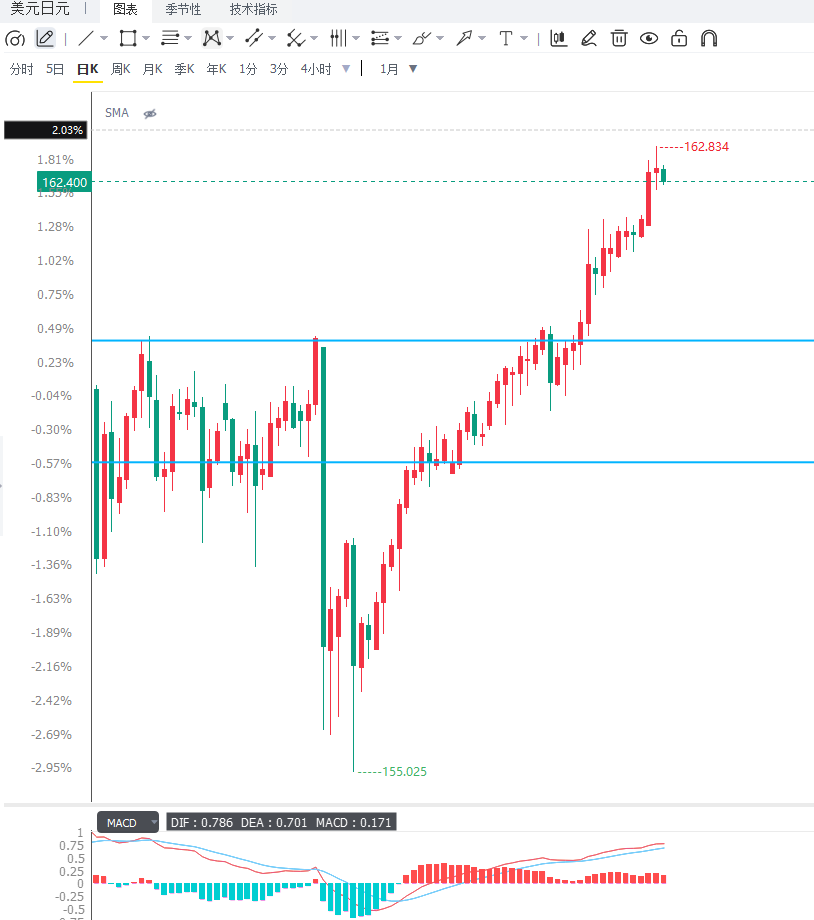
From a daily chart perspective, USD/JPY maintains a strong upward trend overall, with the trend channel remaining intact and the price consistently trading above multiple medium- and long-term moving averages, indicating that bullish momentum dominates. Current resistance levels are gradually moving up to the 163.00 and 164.00 area, which also carries the risk of potential policy intervention and could trigger high volatility. Support is concentrated at the 160.00 psychological level, which is not only psychologically significant but also a recent area of dense moving averages; a break below this level could trigger a phase of trend correction.
From a 4-hour chart perspective, the exchange rate shows a steady upward structure, but short-term momentum indicators have entered overbought territory, indicating that the upward pace has accelerated but lacks a pullback correction. The MACD momentum remains high and expanding, but some divergence is emerging, suggesting a short-term need for technical consolidation. If the price continues to stabilize above 162, it may still advance towards the 163 area, but volatility will increase significantly and it is susceptible to shocks from data or policy statements at any time.
Editor's Summary:
Overall, the USD/JPY pair remains in a typical interest rate-driven upward cycle, with no substantial reversal in its trend structure. The daily uptrend line remains intact, and pullbacks have been limited and consistently absorbed by buying pressure, indicating strong market support for high valuations. The core variable at present remains whether the USD/JPY interest rate differential narrows, rather than changes in a single technical indicator. Without significant interest rate contraction or sustained intervention, the probability of the trend continuing remains high; however, short-term overbought conditions and policy-sensitive zones will significantly amplify volatility risk.
The core driver of exchange rate movements remains the interest rate differential structure. Despite the Bank of Japan ending its long-term ultra-loose policy and implementing this round of "historic tightening," the USD/JPY interest rate differential remains significantly higher than the Federal Reserve's policy rate, at approximately 275 basis points . This structural gap continues to support arbitrage trading strategies, causing funds to flow continuously from low-yield yen to high-yield dollar assets, creating stable pressure for foreign exchange outflows.
Meanwhile, the Federal Reserve maintained a relatively tight stance in its recent policy meetings, ensuring that the dollar's yield advantage was not weakened and further solidifying the carry trade logic. Against this backdrop, market trading behavior was driven more by funding costs than by short-term policy signals, causing the yen to remain under pressure even after the interest rate hike.
Japanese officials are paying close attention to the rapid depreciation of the currency. The Ministry of Finance and related officials have continued to issue verbal warnings, emphasizing vigilance against excessive volatility in the foreign exchange market and reserving necessary intervention measures. However, the market generally believes that the key psychological and technical range is concentrated around the 160.00 level . This area has repeatedly become a sensitive zone for policy intervention, but the authorities have not clearly set a defense line, allowing the market to continuously push up the exchange rate through testing.
Historical experience shows that foreign exchange intervention often leads to sharp short-term fluctuations, but it is difficult to change the medium-term trend structure driven by interest rate differentials. Even when the Japanese Ministry of Finance intervenes in the market, it usually only brings about a temporary correction. Furthermore, if the US-Japan interest rate differential does not narrow significantly, arbitrage funds often flow back in, pushing the exchange rate higher again. Therefore, the market views intervention more as a "timing adjustment tool" than a trend-reversing variable.
In the short term, market focus has shifted to the upcoming US non-farm payroll data. Due to the data's early release, the market expects approximately 110,000 new jobs, significantly lower than the previous figure, and signs of a marginal cooling in the job market are already reflected in some private data. If the data is weak, it could suppress US Treasury yields and the US dollar index, thus providing the yen with a chance for a temporary recovery; conversely, strong data could further widen the US-Japan interest rate differential, pushing the exchange rate higher.
From a daily chart perspective, USD/JPY maintains a strong upward trend overall, with the trend channel remaining intact and the price consistently trading above multiple medium- and long-term moving averages, indicating that bullish momentum dominates. Current resistance levels are gradually moving up to the 163.00 and 164.00 area, which also carries the risk of potential policy intervention and could trigger high volatility. Support is concentrated at the 160.00 psychological level, which is not only psychologically significant but also a recent area of dense moving averages; a break below this level could trigger a phase of trend correction.
From a 4-hour chart perspective, the exchange rate shows a steady upward structure, but short-term momentum indicators have entered overbought territory, indicating that the upward pace has accelerated but lacks a pullback correction. The MACD momentum remains high and expanding, but some divergence is emerging, suggesting a short-term need for technical consolidation. If the price continues to stabilize above 162, it may still advance towards the 163 area, but volatility will increase significantly and it is susceptible to shocks from data or policy statements at any time.
Editor's Summary:
Overall, the USD/JPY pair remains in a typical interest rate-driven upward cycle, with no substantial reversal in its trend structure. The daily uptrend line remains intact, and pullbacks have been limited and consistently absorbed by buying pressure, indicating strong market support for high valuations. The core variable at present remains whether the USD/JPY interest rate differential narrows, rather than changes in a single technical indicator. Without significant interest rate contraction or sustained intervention, the probability of the trend continuing remains high; however, short-term overbought conditions and policy-sensitive zones will significantly amplify volatility risk.
- Risk Warning and Disclaimer
- The market involves risk, and trading may not be suitable for all investors. This article is for reference only and does not constitute personal investment advice, nor does it take into account certain users’ specific investment objectives, financial situation, or other needs. Any investment decisions made based on this information are at your own risk.