The British pound continued its volatile rebound against the US dollar, awaiting a stress test.
2026-07-02 13:33:10
The British pound rebounded against the US dollar after hitting a low near 1.3150, briefly rising above 1.3300, but was quickly suppressed by technical selling pressure. The current price is under pressure from the dense resistance of the 50-day and 200-day exponential moving averages, reflecting that the medium-term trend has not fundamentally reversed. Market momentum has weakened after the continuous rebound, and the market has entered a short-term consolidation phase.
From a fundamental perspective, the pound's movement exhibits a typical structure of "interest rate support and political risk hedging." The Bank of England's recent relatively hawkish stance has provided some interest rate differential support for the pound, but rising domestic political uncertainty has weakened market confidence in pound assets, limiting the sustainability of any rebound. Faced with a combination of macroeconomic and political factors, investors tend to reduce their long pound positions on rallies.
Meanwhile, the US dollar remained relatively stable ahead of the release of the US non-farm payroll data. The market is generally awaiting the employment data results to determine the Federal Reserve's subsequent policy path. The lack of a clear directional breakout for the dollar has led to the pound exhibiting more passive volatility. Current exchange rate movements are more driven by technical factors than by fundamentals alone.
From a market structure perspective, the current rebound in the pound is more of a technical correction than a trend reversal. The bearish structure formed by the previous decline has not been completely broken, and the moving average system remains under pressure. If the rebound fails to effectively break through the 1.3350 to 1.3400 area, the overall trend will likely remain weak and volatile.
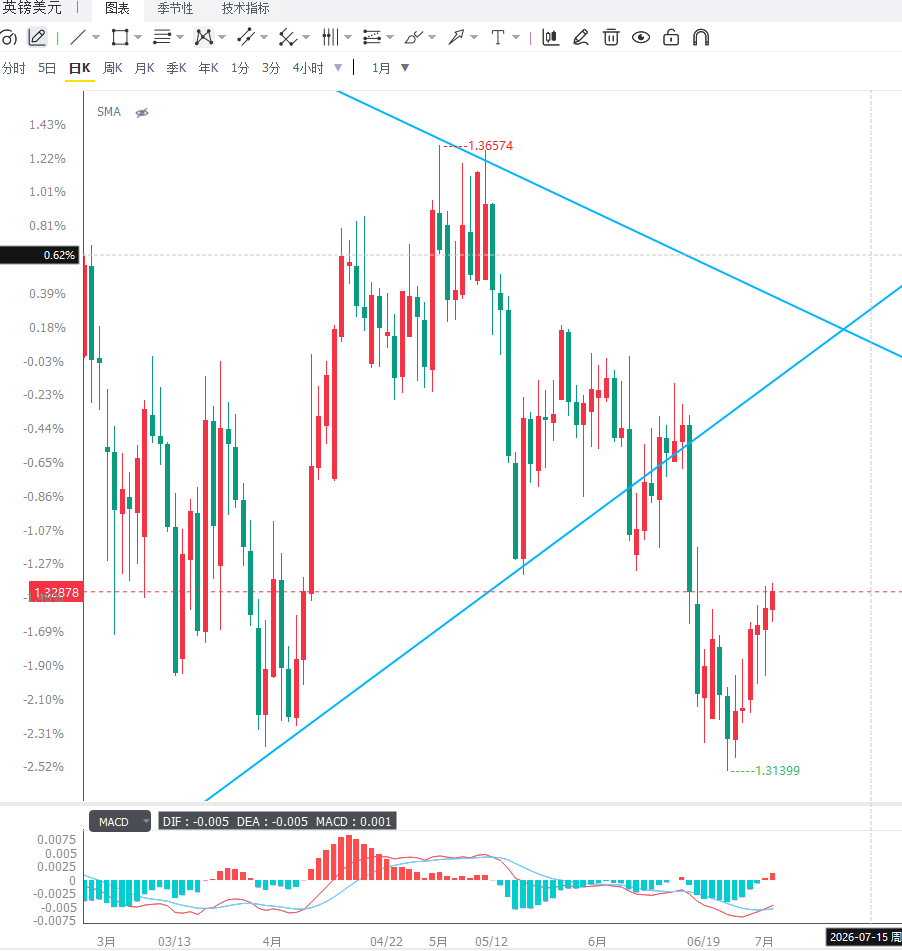
The daily chart shows that GBP/USD has entered a consolidation phase after a rapid decline, with the price forming a short-term trading range between 1.3150 and 1.3400. Key resistance levels are concentrated in the 1.3350 and 1.3400 area, which also coincides with a multi-moving average resistance zone, making a breakout difficult. Further upward movement requires confirmation of a strengthening trend structure; otherwise, the rebound is likely to be met with resistance and a pullback. Support levels are located in the 1.3250 and 1.3150 area; a break below this level could reopen downside potential.
From a 4-hour chart perspective, the upward momentum of the exchange rate is gradually weakening, and short-term moving averages are beginning to flatten and slightly turn downwards, indicating a weakening of bullish power. The Stochastic RSI indicator has fallen from its high level, suggesting that the short-term overbought condition is being corrected, and the price may need further consolidation. If it fails to break through 1.3350 effectively, it may retest the 1.3250 support area in the short term.
Editor's Summary:
Overall, the GBP/USD pair is currently exhibiting a typical pattern of "technical rebound stalled + fundamental divergence." The Bank of England's interest rate support provides stability at the bottom, but political uncertainty limits upside potential, while the dollar's resilience ahead of key data releases prevents a trend breakout. The market is expected to remain range-bound in the short term, with strong resistance at the upper end of the range and support below, though not fully solidified. Future direction will heavily depend on the performance of US non-farm payroll data and changes in the dollar's exchange rate.
From a fundamental perspective, the pound's movement exhibits a typical structure of "interest rate support and political risk hedging." The Bank of England's recent relatively hawkish stance has provided some interest rate differential support for the pound, but rising domestic political uncertainty has weakened market confidence in pound assets, limiting the sustainability of any rebound. Faced with a combination of macroeconomic and political factors, investors tend to reduce their long pound positions on rallies.
Meanwhile, the US dollar remained relatively stable ahead of the release of the US non-farm payroll data. The market is generally awaiting the employment data results to determine the Federal Reserve's subsequent policy path. The lack of a clear directional breakout for the dollar has led to the pound exhibiting more passive volatility. Current exchange rate movements are more driven by technical factors than by fundamentals alone.
From a market structure perspective, the current rebound in the pound is more of a technical correction than a trend reversal. The bearish structure formed by the previous decline has not been completely broken, and the moving average system remains under pressure. If the rebound fails to effectively break through the 1.3350 to 1.3400 area, the overall trend will likely remain weak and volatile.
The daily chart shows that GBP/USD has entered a consolidation phase after a rapid decline, with the price forming a short-term trading range between 1.3150 and 1.3400. Key resistance levels are concentrated in the 1.3350 and 1.3400 area, which also coincides with a multi-moving average resistance zone, making a breakout difficult. Further upward movement requires confirmation of a strengthening trend structure; otherwise, the rebound is likely to be met with resistance and a pullback. Support levels are located in the 1.3250 and 1.3150 area; a break below this level could reopen downside potential.
From a 4-hour chart perspective, the upward momentum of the exchange rate is gradually weakening, and short-term moving averages are beginning to flatten and slightly turn downwards, indicating a weakening of bullish power. The Stochastic RSI indicator has fallen from its high level, suggesting that the short-term overbought condition is being corrected, and the price may need further consolidation. If it fails to break through 1.3350 effectively, it may retest the 1.3250 support area in the short term.
Editor's Summary:
Overall, the GBP/USD pair is currently exhibiting a typical pattern of "technical rebound stalled + fundamental divergence." The Bank of England's interest rate support provides stability at the bottom, but political uncertainty limits upside potential, while the dollar's resilience ahead of key data releases prevents a trend breakout. The market is expected to remain range-bound in the short term, with strong resistance at the upper end of the range and support below, though not fully solidified. Future direction will heavily depend on the performance of US non-farm payroll data and changes in the dollar's exchange rate.
- Risk Warning and Disclaimer
- The market involves risk, and trading may not be suitable for all investors. This article is for reference only and does not constitute personal investment advice, nor does it take into account certain users’ specific investment objectives, financial situation, or other needs. Any investment decisions made based on this information are at your own risk.