Eurozone inflation slowdown dampened expectations of interest rate hikes, while the pound was supported by fiscal discipline, causing the EUR/GBP exchange rate to accelerate its decline and hit a new low for the period.
2026-07-02 15:04:39
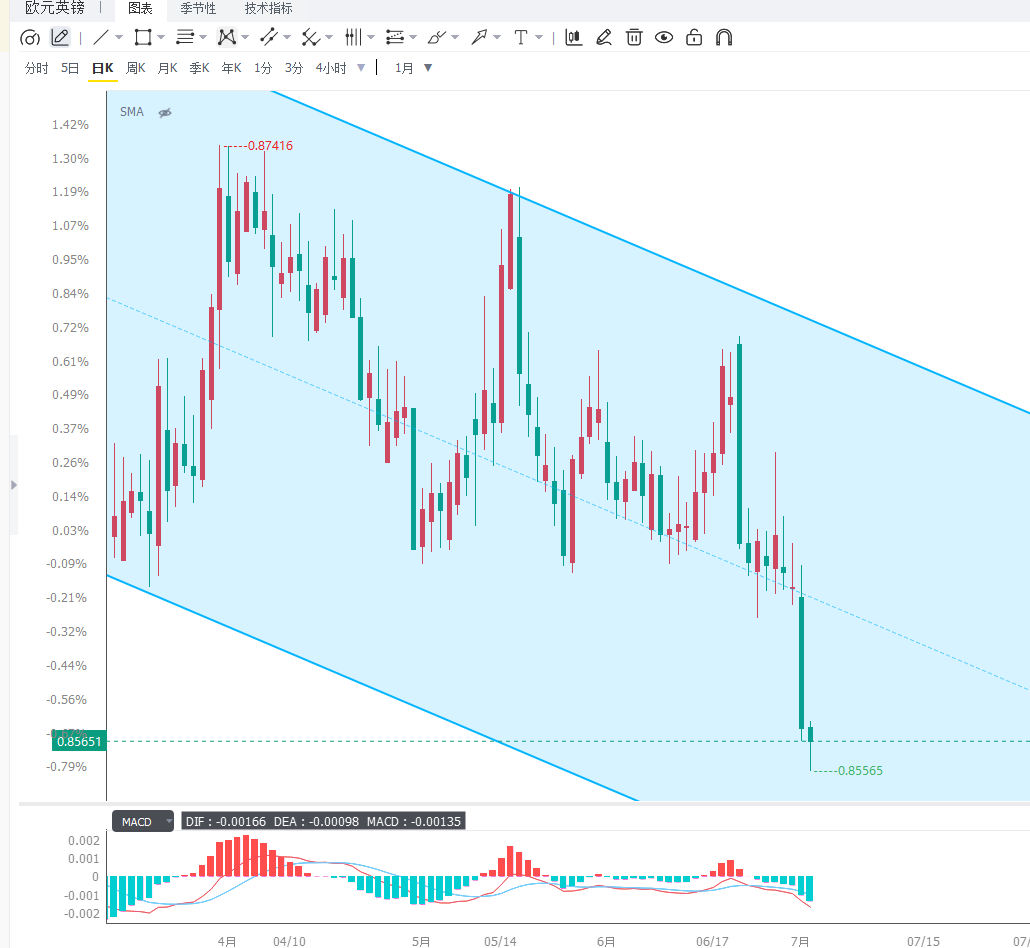
The euro weakened against the pound in early European trading on Thursday, falling to around 0.8565 , continuing its recent downward trend. Current market pricing is primarily driven by expectations of cooling inflation in the Eurozone and changes in UK fiscal policy, resulting in a clear euro-weak, pound-strong exchange rate structure.

The core reason for the euro's weakness stems from the continued cooling of expectations regarding the European Central Bank's (ECB) policy. With a significant decline in Eurozone inflation data for June, market bets on further ECB rate hikes have rapidly decreased. Market surveys show that the Eurozone's harmonized CPI fell to 2.8% year-on-year, lower than the previous value of 3.2% and market expectations of 3.0%, indicating a significant easing of inflationary pressures. The simultaneous decline in core inflation has further weakened market expectations for monetary policy tightening.
Amid slowing inflation, many institutions believe the European Central Bank (ECB) is increasingly likely to remain on the sidelines after its July meeting, and may even end its tightening cycle earlier at a subsequent meeting. This shift in expectations weakens the euro's interest rate advantage, putting it under continued pressure in cross-currency pairs with the pound.
In contrast, the pound received support from expectations of fiscal policy. The potential UK leadership's commitment to fiscal discipline eased market concerns about public finance expansion, leading to a decrease in the pound's short-term risk premium. The market generally believes that maintaining fiscal rules will help stabilize UK asset pricing, thus supporting the pound's performance to some extent.
However, the market remains cautious about the future path of UK fiscal policy. Some analysts believe that under growth pressure, there may still be room for flexible adjustments to future budget policies, which could cause temporary fluctuations in the pound.
Meanwhile, market focus is gradually shifting to upcoming speeches by central bank officials. European Central Bank President Christine Lagarde and Bank of England Governor Andrew Bailey are expected to speak on Friday, and their remarks will provide important clues for judging the future policy path and could trigger short-term fluctuations in the EUR/GBP exchange rate.
From a daily chart perspective, EUR/GBP has maintained an overall downward trend, with prices repeatedly encountering resistance above 0.8600 before gradually declining, indicating a slightly weak short-term trend. Current resistance levels are concentrated in the 0.8600 and 0.8640 area, which corresponds to a previous area of dense trading volume; support levels are located in the 0.8540 and 0.8500 area, and a break below these levels could open up further downside potential.
From a 4-hour chart perspective, the exchange rate shows a mild downward structure, with short-term moving averages gradually diverging downwards, indicating that bearish momentum is dominant. The MACD momentum remains in a weak range, with limited rebound strength, suggesting that the current trend is driven more by the weakening of the euro than by a one-sided strengthening of the pound. If it fails to recover above 0.8600, the short-term bias remains towards testing the support area.
Overall, EUR/GBP is currently in a structural correction phase driven by weakening euro fundamentals. Falling eurozone inflation has reduced expectations of interest rate hikes, diminishing the euro's interest rate advantage, while the pound remains relatively stable, supported by expectations of fiscal discipline, resulting in continued weakness in the cross rate. Technically, prices are trading below short-term moving averages, indicating bearish momentum, but a rapid decline has not yet materialized, instead exhibiting more of a downward, oscillating pattern. Future direction will depend on the repricing effect of central bank statements on policy expectations.
Editor's Summary:
The recent weakness in EUR/GBP is mainly driven by adjustments in policy expectations resulting from cooling inflation in the Eurozone, while the pound has remained relatively stable supported by expectations of fiscal discipline. In the short term, the exchange rate is expected to remain in a weak, volatile pattern, but a clear trend has not yet fully emerged. The market remains cautious ahead of speeches from ECB and Bank of England officials. If policy signals become further dovish, the euro may continue to face downward pressure; conversely, a more dovish stance could trigger a period of corrective rebound.
The core reason for the euro's weakness stems from the continued cooling of expectations regarding the European Central Bank's (ECB) policy. With a significant decline in Eurozone inflation data for June, market bets on further ECB rate hikes have rapidly decreased. Market surveys show that the Eurozone's harmonized CPI fell to 2.8% year-on-year, lower than the previous value of 3.2% and market expectations of 3.0%, indicating a significant easing of inflationary pressures. The simultaneous decline in core inflation has further weakened market expectations for monetary policy tightening.
Amid slowing inflation, many institutions believe the European Central Bank (ECB) is increasingly likely to remain on the sidelines after its July meeting, and may even end its tightening cycle earlier at a subsequent meeting. This shift in expectations weakens the euro's interest rate advantage, putting it under continued pressure in cross-currency pairs with the pound.
In contrast, the pound received support from expectations of fiscal policy. The potential UK leadership's commitment to fiscal discipline eased market concerns about public finance expansion, leading to a decrease in the pound's short-term risk premium. The market generally believes that maintaining fiscal rules will help stabilize UK asset pricing, thus supporting the pound's performance to some extent.
However, the market remains cautious about the future path of UK fiscal policy. Some analysts believe that under growth pressure, there may still be room for flexible adjustments to future budget policies, which could cause temporary fluctuations in the pound.
Meanwhile, market focus is gradually shifting to upcoming speeches by central bank officials. European Central Bank President Christine Lagarde and Bank of England Governor Andrew Bailey are expected to speak on Friday, and their remarks will provide important clues for judging the future policy path and could trigger short-term fluctuations in the EUR/GBP exchange rate.
From a daily chart perspective, EUR/GBP has maintained an overall downward trend, with prices repeatedly encountering resistance above 0.8600 before gradually declining, indicating a slightly weak short-term trend. Current resistance levels are concentrated in the 0.8600 and 0.8640 area, which corresponds to a previous area of dense trading volume; support levels are located in the 0.8540 and 0.8500 area, and a break below these levels could open up further downside potential.
From a 4-hour chart perspective, the exchange rate shows a mild downward structure, with short-term moving averages gradually diverging downwards, indicating that bearish momentum is dominant. The MACD momentum remains in a weak range, with limited rebound strength, suggesting that the current trend is driven more by the weakening of the euro than by a one-sided strengthening of the pound. If it fails to recover above 0.8600, the short-term bias remains towards testing the support area.
Overall, EUR/GBP is currently in a structural correction phase driven by weakening euro fundamentals. Falling eurozone inflation has reduced expectations of interest rate hikes, diminishing the euro's interest rate advantage, while the pound remains relatively stable, supported by expectations of fiscal discipline, resulting in continued weakness in the cross rate. Technically, prices are trading below short-term moving averages, indicating bearish momentum, but a rapid decline has not yet materialized, instead exhibiting more of a downward, oscillating pattern. Future direction will depend on the repricing effect of central bank statements on policy expectations.
Editor's Summary:
The recent weakness in EUR/GBP is mainly driven by adjustments in policy expectations resulting from cooling inflation in the Eurozone, while the pound has remained relatively stable supported by expectations of fiscal discipline. In the short term, the exchange rate is expected to remain in a weak, volatile pattern, but a clear trend has not yet fully emerged. The market remains cautious ahead of speeches from ECB and Bank of England officials. If policy signals become further dovish, the euro may continue to face downward pressure; conversely, a more dovish stance could trigger a period of corrective rebound.
- Risk Warning and Disclaimer
- The market involves risk, and trading may not be suitable for all investors. This article is for reference only and does not constitute personal investment advice, nor does it take into account certain users’ specific investment objectives, financial situation, or other needs. Any investment decisions made based on this information are at your own risk.