Hawkish stance is superficial; during the window of opportunity for the Fed's new framework, gold is being bought on bets.
2026-07-02 16:04:49
On Thursday (July 2), during the Asian and European sessions, gold continued its rebound, currently trading around 4070, up 1%. As mentioned in previous articles, the safe-haven and allocation logic of gold is beginning to return. Today, facing a sharp decline in global capital markets, gold has shown a clear low correlation, playing a role in hedging and safe-haven. Of course, another important reason for the rise in gold is the latest statement from Federal Reserve Chairman Warsh.
New Federal Reserve Chairman Kevin Warsh's latest remarks at the Sintra Forum in Portugal appear to be a tight-lipped "hawkish defense of his title"—holding firm to the 2% inflation target and resolutely defending the central bank's independence.
However, under the magnifying glass of Wall Street traders, this speech revealed a completely different subtext.
Walsh not only conveyed a sense of easing of short-term inflation concerns, but also unveiled a year-long "new macroeconomic framework transformation period."
The essence of this statement is announcing that the Federal Reserve will enter a long period of "interest rate freeze." For the gold market, this is tantamount to a frenzy where investors can position themselves in advance.
The core of understanding Walsh's current policy logic lies in his proposed "one-year agreement".
After taking office, Warsh expressed great disdain for the lagging and distorted official government data that the Federal Reserve had previously relied on.
To this end, he drastically restructured the decision-making mechanism and established five new special working groups, aiming to use big data and AI to rebuild a new economic data and inflation governance framework that is "simultaneous, synchronized, real-time, and accurate".
However, the key here is the time lag; the new departments have not yet completed their integration: these five special working groups have only just been established, and the basic data acquisition network has not even fully started operating.
The argumentation and reporting process takes time. Walsh clearly stated that the formation of the new framework and the unveiling of the most important data will take "9 to 12 months (about a year)".
During this period, each department will inevitably need to write a large number of internal argumentation articles, go through a long period of bargaining and closed-door debates, and finally make an interest rate decision based on the new framework.
Ultimately, we concluded that since the old telescope (traditional guidance and government data) has been rejected by Warsh, and the new navigator (new framework) cannot be fully completed within a year, the safest course of action for the Federal Reserve in the coming quarters is to keep interest rates unchanged.
The market's initial bet on a "certain rate hike in September" is likely to be a false alarm. The Federal Reserve will enter a policy observation period of up to one year, waiting for the new department's paper to be released.
With interest rates remaining unchanged, gold should theoretically see a surge (the negative news has been fully priced in), but Warsh's other stubborn move—completely abandoning forward guidance—has put a chain on gold.
Warsh refused to submit his personal interest rate dot plot, refusing to give the market any clear hints about the future.
This "no-safety-net" approach directly removes the crutches of predicting the future from the financial market. For the market, the lack of certainty means an increase in hedging costs and liquidity premiums.
When the market cannot predict the Fed's next move, the risk premium of long-term US Treasury bonds will be amplified, directly causing the yield on long-term US Treasury bonds to fluctuate at high levels or even move upward.
Since gold is a non-interest-bearing asset, the persistently high yields on US Treasury bonds will act as a ceiling for gold prices, limiting their potential for explosive, one-sided price increases in the short term.
However, there is an important detail: when Walsh emphasized that inflation was intolerable, the reporter immediately asked whether this meant that interest rates would continue to rise. Walsh smiled and remained silent, keeping his mouth shut. Because it was an instantaneous reaction, there was no indication that he intended to raise interest rates. Moreover, he told the market that the information he received from AI companies was that AI would not lead to inflation due to excess demand.
Although gold prices are fluctuating at high levels in the short term due to high US Treasury yields, if we look at the next year, the probability of betting that the Federal Reserve will be "forced to restart interest rate cuts" is becoming extremely high.
Beneath the surface of the US economic fundamentals lies an irreconcilable structural deterioration:
The long-tail effect of the energy crisis and the global economic recession: Although the temporary glimmer of peace in the Middle East has led to a drop in oil prices, the fragility of the global supply chain and geopolitical frictions have not been eradicated. The aftereffects of high inflation are seriously eroding the growth momentum of Europe and emerging markets, and the shadow of a global economic recession has not dissipated.
The deteriorating structure of the US labor force and the collapse of the "K-shaped economy": the US employment recovery is highly deceptive.
The severe "K-shaped divergence" between low-end service industries and high-end technology industries, coupled with the high borrowing costs for real economy enterprises, is quietly squeezing the real economy.
The increased costs of AI are draining and clogging other industries: Walsh hopes that AI will reduce inflation in the long term.
However, on the other hand, the high-intensity, haphazard investment in AI infrastructure (semiconductors, computing power, and electricity) in the short term is draining liquidity from the real economy like a sponge, severely stagnating and sacrificing investment and survival space for other traditional industries, which may ultimately lead to a broader economic slowdown.
Currently, the possibility of the US economy cooling down and experiencing a structural recession in the medium to long term remains high.
Once a year later, when Warsh's new department issues relevant economic assessment reports confirming the squeeze on AI investment, the deterioration of the labor force, and signs of recession, the Fed's policy focus will inevitably be forced to shift from "fighting inflation" to "saving growth."
Therefore, the current rebound in gold prices is not because the Federal Reserve will cut interest rates now, but because global funds are taking advantage of the Fed's one-year "policy wait-and-see period" to price in the inevitable future interest rate cuts.
Although the formal implementation of the interest rate cut requires the completion of the relevant argumentation articles by Warsh's new department, during this year-long vacuum, the phased decline in inflationary pressures, coupled with the approaching recession logic, presents a strategic allocation possibility and potential for market funds to "buy on dips and get ahead of the curve."
From a technical perspective, spot gold has risen above the 5-day moving average and the downtrend line. At the same time, the single-needle bottoming pattern from two days ago has also been confirmed. Currently, attention is focused on the important support level of 4030. If the gold price does not break through this level, there is a chance for it to continue to rebound.
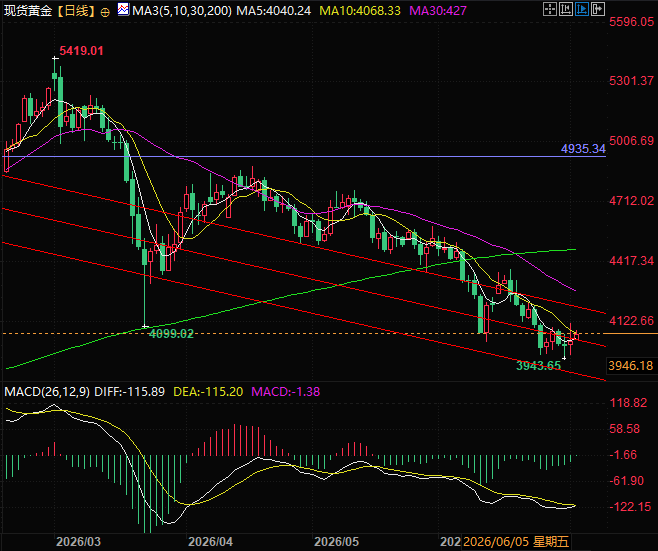
(Spot gold daily chart, source: FX678)
At 15:59 Beijing time, spot gold was trading at $4,064 per ounce.
New Federal Reserve Chairman Kevin Warsh's latest remarks at the Sintra Forum in Portugal appear to be a tight-lipped "hawkish defense of his title"—holding firm to the 2% inflation target and resolutely defending the central bank's independence.
However, under the magnifying glass of Wall Street traders, this speech revealed a completely different subtext.
Walsh not only conveyed a sense of easing of short-term inflation concerns, but also unveiled a year-long "new macroeconomic framework transformation period."
The essence of this statement is announcing that the Federal Reserve will enter a long period of "interest rate freeze." For the gold market, this is tantamount to a frenzy where investors can position themselves in advance.
With no new framework established, the Federal Reserve is likely to remain on hold for at least a year.
The core of understanding Walsh's current policy logic lies in his proposed "one-year agreement".
After taking office, Warsh expressed great disdain for the lagging and distorted official government data that the Federal Reserve had previously relied on.
To this end, he drastically restructured the decision-making mechanism and established five new special working groups, aiming to use big data and AI to rebuild a new economic data and inflation governance framework that is "simultaneous, synchronized, real-time, and accurate".
However, the key here is the time lag; the new departments have not yet completed their integration: these five special working groups have only just been established, and the basic data acquisition network has not even fully started operating.
The argumentation and reporting process takes time. Walsh clearly stated that the formation of the new framework and the unveiling of the most important data will take "9 to 12 months (about a year)".
During this period, each department will inevitably need to write a large number of internal argumentation articles, go through a long period of bargaining and closed-door debates, and finally make an interest rate decision based on the new framework.
Ultimately, we concluded that since the old telescope (traditional guidance and government data) has been rejected by Warsh, and the new navigator (new framework) cannot be fully completed within a year, the safest course of action for the Federal Reserve in the coming quarters is to keep interest rates unchanged.
The market's initial bet on a "certain rate hike in September" is likely to be a false alarm. The Federal Reserve will enter a policy observation period of up to one year, waiting for the new department's paper to be released.
Abandoning forward guidance: High US Treasury yields will limit gold price surge
With interest rates remaining unchanged, gold should theoretically see a surge (the negative news has been fully priced in), but Warsh's other stubborn move—completely abandoning forward guidance—has put a chain on gold.
Warsh refused to submit his personal interest rate dot plot, refusing to give the market any clear hints about the future.
This "no-safety-net" approach directly removes the crutches of predicting the future from the financial market. For the market, the lack of certainty means an increase in hedging costs and liquidity premiums.
When the market cannot predict the Fed's next move, the risk premium of long-term US Treasury bonds will be amplified, directly causing the yield on long-term US Treasury bonds to fluctuate at high levels or even move upward.
Since gold is a non-interest-bearing asset, the persistently high yields on US Treasury bonds will act as a ceiling for gold prices, limiting their potential for explosive, one-sided price increases in the short term.
However, there is an important detail: when Walsh emphasized that inflation was intolerable, the reporter immediately asked whether this meant that interest rates would continue to rise. Walsh smiled and remained silent, keeping his mouth shut. Because it was an instantaneous reaction, there was no indication that he intended to raise interest rates. Moreover, he told the market that the information he received from AI companies was that AI would not lead to inflation due to excess demand.
A deep crisis is looming: Gold can be used to bet on the "inevitable interest rate cut".
Although gold prices are fluctuating at high levels in the short term due to high US Treasury yields, if we look at the next year, the probability of betting that the Federal Reserve will be "forced to restart interest rate cuts" is becoming extremely high.
Beneath the surface of the US economic fundamentals lies an irreconcilable structural deterioration:
The long-tail effect of the energy crisis and the global economic recession: Although the temporary glimmer of peace in the Middle East has led to a drop in oil prices, the fragility of the global supply chain and geopolitical frictions have not been eradicated. The aftereffects of high inflation are seriously eroding the growth momentum of Europe and emerging markets, and the shadow of a global economic recession has not dissipated.
The deteriorating structure of the US labor force and the collapse of the "K-shaped economy": the US employment recovery is highly deceptive.
The severe "K-shaped divergence" between low-end service industries and high-end technology industries, coupled with the high borrowing costs for real economy enterprises, is quietly squeezing the real economy.
The increased costs of AI are draining and clogging other industries: Walsh hopes that AI will reduce inflation in the long term.
However, on the other hand, the high-intensity, haphazard investment in AI infrastructure (semiconductors, computing power, and electricity) in the short term is draining liquidity from the real economy like a sponge, severely stagnating and sacrificing investment and survival space for other traditional industries, which may ultimately lead to a broader economic slowdown.
Gold Trading Strategy: Getting Ahead While "Waiting for Papers"
Currently, the possibility of the US economy cooling down and experiencing a structural recession in the medium to long term remains high.
Once a year later, when Warsh's new department issues relevant economic assessment reports confirming the squeeze on AI investment, the deterioration of the labor force, and signs of recession, the Fed's policy focus will inevitably be forced to shift from "fighting inflation" to "saving growth."
Therefore, the current rebound in gold prices is not because the Federal Reserve will cut interest rates now, but because global funds are taking advantage of the Fed's one-year "policy wait-and-see period" to price in the inevitable future interest rate cuts.
Although the formal implementation of the interest rate cut requires the completion of the relevant argumentation articles by Warsh's new department, during this year-long vacuum, the phased decline in inflationary pressures, coupled with the approaching recession logic, presents a strategic allocation possibility and potential for market funds to "buy on dips and get ahead of the curve."
From a technical perspective, spot gold has risen above the 5-day moving average and the downtrend line. At the same time, the single-needle bottoming pattern from two days ago has also been confirmed. Currently, attention is focused on the important support level of 4030. If the gold price does not break through this level, there is a chance for it to continue to rebound.
(Spot gold daily chart, source: FX678)
At 15:59 Beijing time, spot gold was trading at $4,064 per ounce.
- Risk Warning and Disclaimer
- The market involves risk, and trading may not be suitable for all investors. This article is for reference only and does not constitute personal investment advice, nor does it take into account certain users’ specific investment objectives, financial situation, or other needs. Any investment decisions made based on this information are at your own risk.