Burnham's commitment to fiscal discipline boosted the pound; the non-farm payroll report will be key to short-term direction.
2026-07-02 15:07:54
On Thursday (July 2) during the Asian session, the pound rose moderately against the dollar, trading around 1.3300.
Andy Burnham, a leading candidate to become the next British prime minister, pledged strict fiscal discipline, easing market concerns about the UK's public finances and providing support for the pound.
However, market focus has shifted to tonight's US June non-farm payrolls report, the results of which will determine the short-term direction of the pound.
British politics is in a transitional period of power. Andy Burnham, the likely successor to the prime minister, vowed on Monday to push for "radical changes" in national politics, with core principles including decentralizing more power to the local level, encouraging cooperation rather than confrontation, and promoting "healthy" economic growth over a ten-year cycle.
For the market, the most crucial signal is his commitment to fiscal discipline.
Natixis analysts point out that maintaining investor confidence in UK public finances is crucial. Burnham's commitments provided short-term support for the pound, but the market will be closely watching subsequent budgets to determine whether fiscal rules will be relaxed to support higher public spending.
This statement comes at a time of market anxiety over uncertainty surrounding the UK political situation – any sign of loosening fiscal discipline could trigger a sell-off in the pound, and Burnham’s commitment has temporarily calmed those concerns.
The pound is currently caught between two forces. On the one hand, Burnham's signals of fiscal discipline have stabilized market sentiment to some extent; on the other hand, the uncertainty inherent in the political transition itself—the new prime minister has not yet officially taken office, and the cabinet composition and policy priorities are still unclear—poses potential downward pressure on the pound.
This coexistence of "stabilizing signals" and "uncertainty" means that the upside potential for the pound is temporarily limited. The market needs to see more fiscal details and how the new government will balance the tension between "radical reforms" and "fiscal discipline" in practice.
Tonight's US June non-farm payrolls report will be a key variable for the pound against the dollar. The market expects 110,000 new jobs and the unemployment rate to remain at 4.3%. With the Federal Reserve under Warsh's leadership shifting towards a "data-driven" decision-making model, the impact of non-farm payroll data on exchange rates is further amplified.
If the data is strong, the dollar will receive buying support, and the pound may test the 1.3200 support level.
If the data meets expectations (110,000-150,000), the market reaction will be neutral to mild, and the pound is expected to hold above 1.3250; if the data is weak (below 110,000), the dollar will be under pressure, and the pound may challenge the 1.3350-1.3400 area.
It is important to emphasize that the Federal Reserve is currently more focused on inflation trends than on the employment report alone. Therefore, the impact of non-farm payrolls on the pound is more of a pulse-like phenomenon – after short-term fluctuations, the market will return to the inflation-driven trend.
According to the daily chart, the GBP/USD pair is in a bearish trend in the medium term. After reaching a high of 1.3657, it has been trending downwards. The moving average system is providing resistance: the 50-day moving average (MA50) (1.3409), 100-day moving average (MA100) (1.3411), and 200-day moving average (MA200) (1.3397) are all above the current price. In the short term, the price is closely following the 20-day moving average, with the recent low of 1.3139 serving as a key support level.
In terms of indicators, the MACD lines are below the zero axis, the DIFF line (-0.0048) has slightly crossed the DEA line (-0.0053), and the red bars have turned slightly red, indicating that the bearish momentum has temporarily subsided and a slight bottoming signal has appeared, but a strong bullish reversal has not yet formed; the RSI value is 45.99, which is in the neutral range, with no obvious overbought or oversold conditions, indicating a balance between bulls and bears.
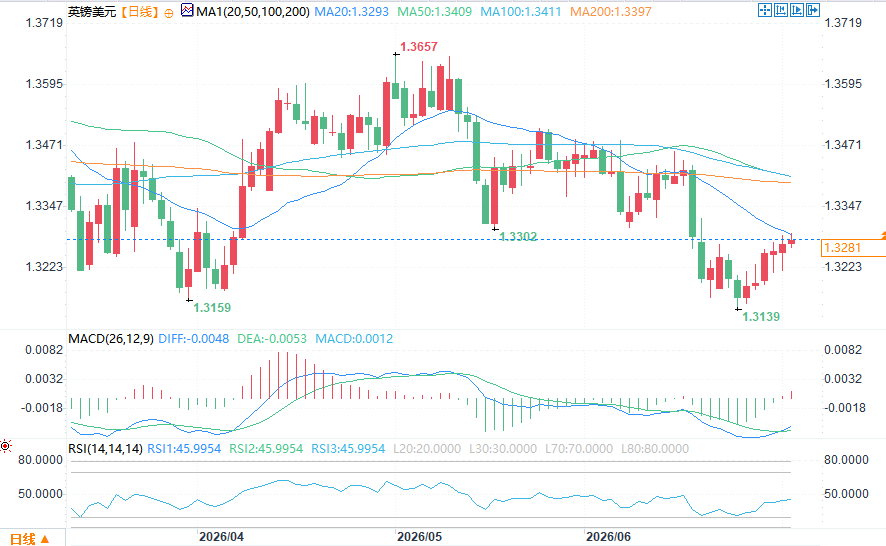
(GBP/USD daily chart, source: FX678)
At 15:07 Beijing time on July 2, the British pound was trading at 1.3298/99 against the US dollar.
Andy Burnham, a leading candidate to become the next British prime minister, pledged strict fiscal discipline, easing market concerns about the UK's public finances and providing support for the pound.
However, market focus has shifted to tonight's US June non-farm payrolls report, the results of which will determine the short-term direction of the pound.
Burnham's "fiscal discipline" commitment: The market initially accepted it.
British politics is in a transitional period of power. Andy Burnham, the likely successor to the prime minister, vowed on Monday to push for "radical changes" in national politics, with core principles including decentralizing more power to the local level, encouraging cooperation rather than confrontation, and promoting "healthy" economic growth over a ten-year cycle.
For the market, the most crucial signal is his commitment to fiscal discipline.
Natixis analysts point out that maintaining investor confidence in UK public finances is crucial. Burnham's commitments provided short-term support for the pound, but the market will be closely watching subsequent budgets to determine whether fiscal rules will be relaxed to support higher public spending.
This statement comes at a time of market anxiety over uncertainty surrounding the UK political situation – any sign of loosening fiscal discipline could trigger a sell-off in the pound, and Burnham’s commitment has temporarily calmed those concerns.
The Pound Sterling's "Dual Narrative": Fiscal Discipline vs. Political Vacuum
The pound is currently caught between two forces. On the one hand, Burnham's signals of fiscal discipline have stabilized market sentiment to some extent; on the other hand, the uncertainty inherent in the political transition itself—the new prime minister has not yet officially taken office, and the cabinet composition and policy priorities are still unclear—poses potential downward pressure on the pound.
This coexistence of "stabilizing signals" and "uncertainty" means that the upside potential for the pound is temporarily limited. The market needs to see more fiscal details and how the new government will balance the tension between "radical reforms" and "fiscal discipline" in practice.
Non-farm payroll data: the determinant of the short-term direction of the pound.
Tonight's US June non-farm payrolls report will be a key variable for the pound against the dollar. The market expects 110,000 new jobs and the unemployment rate to remain at 4.3%. With the Federal Reserve under Warsh's leadership shifting towards a "data-driven" decision-making model, the impact of non-farm payroll data on exchange rates is further amplified.
If the data is strong, the dollar will receive buying support, and the pound may test the 1.3200 support level.
If the data meets expectations (110,000-150,000), the market reaction will be neutral to mild, and the pound is expected to hold above 1.3250; if the data is weak (below 110,000), the dollar will be under pressure, and the pound may challenge the 1.3350-1.3400 area.
It is important to emphasize that the Federal Reserve is currently more focused on inflation trends than on the employment report alone. Therefore, the impact of non-farm payrolls on the pound is more of a pulse-like phenomenon – after short-term fluctuations, the market will return to the inflation-driven trend.
Technical Analysis
According to the daily chart, the GBP/USD pair is in a bearish trend in the medium term. After reaching a high of 1.3657, it has been trending downwards. The moving average system is providing resistance: the 50-day moving average (MA50) (1.3409), 100-day moving average (MA100) (1.3411), and 200-day moving average (MA200) (1.3397) are all above the current price. In the short term, the price is closely following the 20-day moving average, with the recent low of 1.3139 serving as a key support level.
In terms of indicators, the MACD lines are below the zero axis, the DIFF line (-0.0048) has slightly crossed the DEA line (-0.0053), and the red bars have turned slightly red, indicating that the bearish momentum has temporarily subsided and a slight bottoming signal has appeared, but a strong bullish reversal has not yet formed; the RSI value is 45.99, which is in the neutral range, with no obvious overbought or oversold conditions, indicating a balance between bulls and bears.
(GBP/USD daily chart, source: FX678)
At 15:07 Beijing time on July 2, the British pound was trading at 1.3298/99 against the US dollar.
- Risk Warning and Disclaimer
- The market involves risk, and trading may not be suitable for all investors. This article is for reference only and does not constitute personal investment advice, nor does it take into account certain users’ specific investment objectives, financial situation, or other needs. Any investment decisions made based on this information are at your own risk.