OPEC+ production cuts implemented, UAE exports surging, and record US output putting continued downward pressure on oil prices.
2026-07-03 11:42:03
Affected by the conflict in the Middle East, the OPEC+ seven countries plan to continue to increase their monthly production quotas, with a planned increase of 188,000 barrels per day in August. Previous rounds of production increases have only been on paper, but the production increases in July and August are expected to be implemented in practice.
The alliance faces a major shift: the UAE's withdrawal from the cooperation mechanism has led to record-high crude oil exports, thanks to the large-scale release of previously stored oil. Coupled with continued record-breaking US crude oil production, the alliance's overall market influence is weakening. Multiple increases in supply are collectively suppressing international oil prices, with benchmark crude oil prices falling back to pre-conflict levels. Major oil-producing countries are unwilling to endure a low-price environment for an extended period.
According to overseas media reports on July 2, seven OPEC+ countries, including Saudi Arabia, Russia, Iraq, Kuwait, Algeria, Kazakhstan, and Oman, plan to increase their crude oil production quotas by 188,000 barrels per day in August. The same amount of production increase was already agreed upon in July. This round of production increase is different from previous plans on paper and is ready to be implemented.
The root cause of this series of production increase plans lies in the Middle East energy supply crisis triggered by the US-Iran conflict. After Iran blocked the Strait of Hormuz, the production and transportation of oil-producing countries along the Persian Gulf were completely blocked, forcing them to stockpile crude oil and shut down oil wells. Iraq was the most severely affected, with its daily production halved from 4 million barrels to less than 2 million barrels.
The previous announcements of increased production were solely intended to stabilize market expectations, relying on the production capacity of Russia and Kazakhstan, which is unaffected by shipping, to offset the supply gap.
The UAE, which had been a member of OPEC for 60 years, has officially left the OPEC system and is independently formulating its crude oil production and sales strategy. The market had previously predicted that the country would rapidly increase its production. Although it has not significantly increased its production capacity, its export data has risen sharply.
According to Kpler, an energy data agency, the UAE exported an average of 3.7 million barrels of crude oil per day in June, while Vortexa estimates the peak to be as high as 4 million barrels per day.
Johannes Rauball, senior oil analyst at Kepler, said that the resumption of navigation in the Strait of Hormuz released stranded oil shipments, and the country's supply steadily recovered to pre-conflict levels, jointly driving up exports. At the same time, record exports included the depletion of inventories accumulated over five months of conflict; once these inventories are depleted, exports will naturally decline if there is no new production.
The UAE's withdrawal has reignited industry discussions about whether the alliance's control over the global oil market is continuing to decline. Looking at the actions of core member states, Kazakhstan has explicitly stated it has no plans to withdraw, while Iraq, which initially threatened to leave the alliance and increase production, quickly reversed its stance. Therefore, the core of the alliance is unlikely to disintegrate in the short term.
However, the rise of the United States as the world's leading oil producer has significantly diluted the alliance's pricing power. The UAE's production increase is highly flexible, with daily crude oil output approaching 14 million barrels in May, creating strong competition. The UAE's choice to operate independently also reflects the declining appeal of the traditional alliance coordination mechanism.
Increased exports from the UAE, substantial production increases from OPEC+, continued growth in US crude oil production capacity, and the resumption of shipping in the Strait of Hormuz—these multiple factors combined to create a loose supply environment have continued to suppress international crude oil prices.
The current global benchmark price for crude oil has fallen back to levels seen before the outbreak of the Middle East conflict.
A low-price environment is not in the interest of the United States, the United Arab Emirates, and all OPEC+ oil-producing economies. The market continues to observe how far non-OPEC major oil-producing countries will tolerate oil prices falling before they introduce measures to stabilize oil prices, such as production cuts and export controls.
Overall, OPEC+ is about to implement two rounds of substantial production increases, but the UAE's replenishment of inventory and the continued expansion of US production capacity will significantly offset the supply risks in the Middle East, weakening the alliance's ability to control oil prices.
The current loose supply of crude oil is unlikely to change in the short term, putting downward pressure on oil prices. Going forward, it is crucial to monitor the pace of inventory replenishment in the UAE, the extent to which OPEC increases are implemented, and changes in US crude oil production.
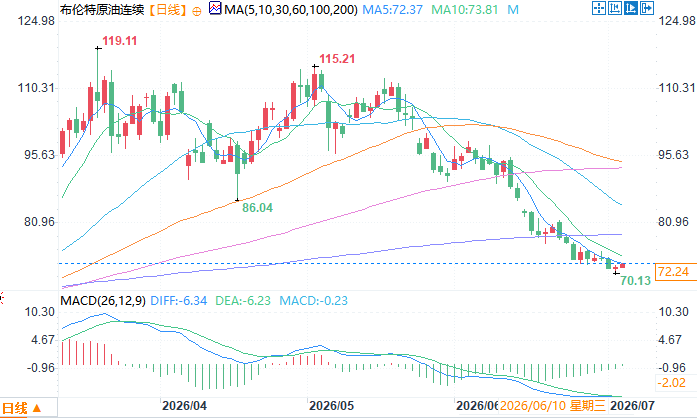
Brent crude oil daily chart source: EasyForex
At 11:41 AM Beijing time on July 3, Brent crude oil futures were trading at $72.25 per barrel.
The alliance faces a major shift: the UAE's withdrawal from the cooperation mechanism has led to record-high crude oil exports, thanks to the large-scale release of previously stored oil. Coupled with continued record-breaking US crude oil production, the alliance's overall market influence is weakening. Multiple increases in supply are collectively suppressing international oil prices, with benchmark crude oil prices falling back to pre-conflict levels. Major oil-producing countries are unwilling to endure a low-price environment for an extended period.
OPEC+ has finalized a new round of production increases, after previous increases were hampered by the Straits blockade.
According to overseas media reports on July 2, seven OPEC+ countries, including Saudi Arabia, Russia, Iraq, Kuwait, Algeria, Kazakhstan, and Oman, plan to increase their crude oil production quotas by 188,000 barrels per day in August. The same amount of production increase was already agreed upon in July. This round of production increase is different from previous plans on paper and is ready to be implemented.
The root cause of this series of production increase plans lies in the Middle East energy supply crisis triggered by the US-Iran conflict. After Iran blocked the Strait of Hormuz, the production and transportation of oil-producing countries along the Persian Gulf were completely blocked, forcing them to stockpile crude oil and shut down oil wells. Iraq was the most severely affected, with its daily production halved from 4 million barrels to less than 2 million barrels.
The previous announcements of increased production were solely intended to stabilize market expectations, relying on the production capacity of Russia and Kazakhstan, which is unaffected by shipping, to offset the supply gap.
The UAE withdrew from the coalition and went it alone, with crude oil exports reaching a record high.
The UAE, which had been a member of OPEC for 60 years, has officially left the OPEC system and is independently formulating its crude oil production and sales strategy. The market had previously predicted that the country would rapidly increase its production. Although it has not significantly increased its production capacity, its export data has risen sharply.
According to Kpler, an energy data agency, the UAE exported an average of 3.7 million barrels of crude oil per day in June, while Vortexa estimates the peak to be as high as 4 million barrels per day.
Johannes Rauball, senior oil analyst at Kepler, said that the resumption of navigation in the Strait of Hormuz released stranded oil shipments, and the country's supply steadily recovered to pre-conflict levels, jointly driving up exports. At the same time, record exports included the depletion of inventories accumulated over five months of conflict; once these inventories are depleted, exports will naturally decline if there is no new production.
The influence of the alliance continues to decline, and increased US production is squeezing the space for traditional oil-producing countries.
The UAE's withdrawal has reignited industry discussions about whether the alliance's control over the global oil market is continuing to decline. Looking at the actions of core member states, Kazakhstan has explicitly stated it has no plans to withdraw, while Iraq, which initially threatened to leave the alliance and increase production, quickly reversed its stance. Therefore, the core of the alliance is unlikely to disintegrate in the short term.
However, the rise of the United States as the world's leading oil producer has significantly diluted the alliance's pricing power. The UAE's production increase is highly flexible, with daily crude oil output approaching 14 million barrels in May, creating strong competition. The UAE's choice to operate independently also reflects the declining appeal of the traditional alliance coordination mechanism.
Multiple increases in supply are putting downward pressure on oil prices, with oil-producing countries awaiting signs of a price floor.
Increased exports from the UAE, substantial production increases from OPEC+, continued growth in US crude oil production capacity, and the resumption of shipping in the Strait of Hormuz—these multiple factors combined to create a loose supply environment have continued to suppress international crude oil prices.
The current global benchmark price for crude oil has fallen back to levels seen before the outbreak of the Middle East conflict.
A low-price environment is not in the interest of the United States, the United Arab Emirates, and all OPEC+ oil-producing economies. The market continues to observe how far non-OPEC major oil-producing countries will tolerate oil prices falling before they introduce measures to stabilize oil prices, such as production cuts and export controls.
Summarize
Overall, OPEC+ is about to implement two rounds of substantial production increases, but the UAE's replenishment of inventory and the continued expansion of US production capacity will significantly offset the supply risks in the Middle East, weakening the alliance's ability to control oil prices.
The current loose supply of crude oil is unlikely to change in the short term, putting downward pressure on oil prices. Going forward, it is crucial to monitor the pace of inventory replenishment in the UAE, the extent to which OPEC increases are implemented, and changes in US crude oil production.
Brent crude oil daily chart source: EasyForex
At 11:41 AM Beijing time on July 3, Brent crude oil futures were trading at $72.25 per barrel.
- Risk Warning and Disclaimer
- The market involves risk, and trading may not be suitable for all investors. This article is for reference only and does not constitute personal investment advice, nor does it take into account certain users’ specific investment objectives, financial situation, or other needs. Any investment decisions made based on this information are at your own risk.