Unexpectedly weak non-farm payroll data pushed gold to a near two-week high. What's the next target?
2026-07-03 10:54:42
On Friday (July 3) during the Asian session, spot gold continued its upward trend, reaching a near two-week high of $4,195.27 per ounce as of 10:45, a gain of about 1.74%, and is currently trading around $4,180 per ounce.
On Thursday, the US June non-farm payrolls report fell short of expectations across the board—only 57,000 jobs were added, far below the market expectation of 110,000, and both May and April data were revised significantly downward. While the unemployment rate slightly decreased to 4.2%, this was driven by a decline in the labor force participation rate, not a genuine improvement in the job market. This data significantly cooled market expectations for a Federal Reserve rate hike this year, putting pressure on the dollar and US Treasury yields, and providing an opportunity for a gold price rebound.
The U.S. Bureau of Labor Statistics released its June jobs report on Thursday, delivering a far weaker-than-expected result. Non-farm payrolls increased by only 57,000, less than half of the market expectation of 110,000. Even more worrying was the significant downward revision of previous figures—May was revised down from 172,000 to 129,000, and April from 179,000 to 148,000, a combined downward revision of over 70,000 over the two months.
The unemployment rate slightly decreased from 4.3% to 4.2%, which seems like good news on the surface, but a closer look reveals a less optimistic picture—the main reason for the decline was a drop in the labor force participation rate, rather than an increase in the employed population. In other words, more people have left the labor market, making the unemployment rate appear "passively good."
This is consistent with the economic slowdown picture depicted in the ADP employment report (98,000 new jobs in June, lower than the expected 113,000) and the ISM manufacturing PMI (which fell to 53.3).
For the Federal Reserve, this report is "neither urgent nor fatal"—a single month's data is insufficient to change the policy direction, but under Warsh's "data-driven" decision-making framework, the continuously weakening employment data is eroding the foundation of expectations for interest rate hikes.
Following the data release, the US dollar index weakened to around 100.85, falling nearly 1% from its more than one-year high of 101.80 reached last weekend. The 10-year US Treasury yield declined to 4.46%.
It is worth noting that market expectations for a September rate hike have not collapsed.
According to CME's "FedWatch": The probability of the Federal Reserve keeping interest rates unchanged in July is 82.4%, and the probability of a cumulative 25 basis point rate hike is 17.6%. The probability of the Fed keeping interest rates unchanged by September is 46.8%, the probability of a cumulative 25 basis point rate hike is 45.6%, and the probability of a cumulative 50 basis point rate hike is 7.6%. The probability of the Fed keeping interest rates unchanged by December is 23.5%, the probability of a cumulative 25 basis point rate hike is 42.2%, and the probability of at least a 50 basis point rate hike is 34.3%.
Prime Terminal data shows the market is pricing in a tightening of approximately 17 basis points. This suggests traders are still on the sidelines: a weak non-farm payroll report is not enough to fundamentally alter the Fed's policy trajectory, and more data (especially CPI and PCE) is needed to confirm whether inflation has truly returned to its target path.
San Francisco Federal Reserve President Mary Daly said there were "positive signs" in the U.S. economy, but also noted upward price pressures from tariffs and oil price shocks. She described current policy as "somewhat restrictive," while acknowledging that there are scenarios where the Fed must combat inflation.
Warsh noted on Wednesday that inflation expectations had declined over the past four weeks, but reiterated that the Fed's focus was on "price stability." Neither official's remarks signaled a clear dovish shift.
In the Middle East, the US-Iran talks in Doha ended with "no substantial progress".
Although navigation in the Strait of Hormuz has resumed, a fundamental agreement has not yet been reached, and Iran’s position on core issues such as the method of nuclear program verification and future management rights of the strait has not softened.
This provides support for gold: geopolitical uncertainty has not completely dissipated, meaning safe-haven demand will not systematically withdraw. However, the market's reaction to Middle East news has become noticeably muted—unless there is a major reversal in negotiations (either a collapse leading to escalation of conflict or a breakthrough agreement), geopolitical factors will not be the primary driver of gold prices for the time being.
UBS maintains its base scenario of $5,500/oz for gold by the end of 2026 and is optimistic about a potential path to $6,200.
The analysis by the institution pointed out that the continued momentum of global central bank gold purchases, geopolitical tensions, and inflationary concerns will continue to support gold prices.
UBS emphasizes that gold is playing an increasingly important role in diversified reserves, with emerging market central banks expected to become major buyers. Risk factors include a stronger-than-expected US dollar and stronger-than-expected global economic growth.
Citigroup holds a cautiously optimistic view on gold, predicting a price range of $5,000-$6,000 per ounce in 2026, with the potential for further increases in 2027.
Analysts believe that central bank gold purchases and safe-haven demand are the core supporting factors, but the Federal Reserve's policy path and the global growth outlook will determine short-term trends. The current pullback in gold prices from their highs reflects market adjustments in expectations for interest rate cuts. Citi suggests paying attention to US economic data and geopolitical events as catalysts.
The agency pointed out that although gold's performance is under pressure in a high-interest-rate environment, its long-term value preservation attribute remains unchanged, making it suitable as an inflation and geopolitical hedging tool.
According to the daily chart, spot gold is in a medium-term downtrend, but has seen a short-term rebound. After peaking at 4889.24, it has continued to decline, with moving averages forming a bearish resistance structure: the 50-day moving average (MA50) (4401.94), 100-day moving average (MA100) (4636.03), and 200-day moving average (MA200) are all above the price, providing strong resistance. In the short term, the resistance around 4220, the high from June 22nd, should be noted. Support around Wednesday's high of 4114 needs to be observed, and the 20-day moving average is currently around 4155.
In terms of indicators, the MACD lines are below the zero axis, the DIFF line at -97.35 crosses above the DEA line at -110.89 to form a golden cross, the red bars are slightly expanding, the downward momentum is clearly weakening, and the short-term bullish recovery force is emerging; the RSI value is 47.05, which is in the neutral range, with no obvious overbought or oversold conditions, and the struggle between bulls and bears is tending to be balanced.
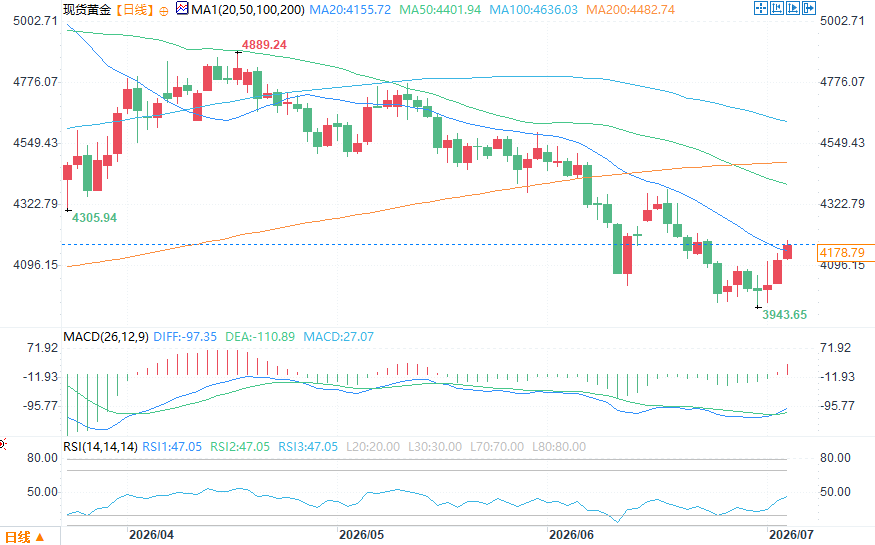
(Spot gold daily chart, source: FX678)
At 10:53 AM Beijing time on July 3, spot gold was trading at $4,185.69 per ounce.
On Thursday, the US June non-farm payrolls report fell short of expectations across the board—only 57,000 jobs were added, far below the market expectation of 110,000, and both May and April data were revised significantly downward. While the unemployment rate slightly decreased to 4.2%, this was driven by a decline in the labor force participation rate, not a genuine improvement in the job market. This data significantly cooled market expectations for a Federal Reserve rate hike this year, putting pressure on the dollar and US Treasury yields, and providing an opportunity for a gold price rebound.
Non-farm payrolls report surprises across the board: The real picture behind the data
The U.S. Bureau of Labor Statistics released its June jobs report on Thursday, delivering a far weaker-than-expected result. Non-farm payrolls increased by only 57,000, less than half of the market expectation of 110,000. Even more worrying was the significant downward revision of previous figures—May was revised down from 172,000 to 129,000, and April from 179,000 to 148,000, a combined downward revision of over 70,000 over the two months.
The unemployment rate slightly decreased from 4.3% to 4.2%, which seems like good news on the surface, but a closer look reveals a less optimistic picture—the main reason for the decline was a drop in the labor force participation rate, rather than an increase in the employed population. In other words, more people have left the labor market, making the unemployment rate appear "passively good."
This is consistent with the economic slowdown picture depicted in the ADP employment report (98,000 new jobs in June, lower than the expected 113,000) and the ISM manufacturing PMI (which fell to 53.3).
For the Federal Reserve, this report is "neither urgent nor fatal"—a single month's data is insufficient to change the policy direction, but under Warsh's "data-driven" decision-making framework, the continuously weakening employment data is eroding the foundation of expectations for interest rate hikes.
US Dollar and US Treasury Yields: Rate Hike Expectations Ease, But Have Not Collapsed
Following the data release, the US dollar index weakened to around 100.85, falling nearly 1% from its more than one-year high of 101.80 reached last weekend. The 10-year US Treasury yield declined to 4.46%.
It is worth noting that market expectations for a September rate hike have not collapsed.
According to CME's "FedWatch": The probability of the Federal Reserve keeping interest rates unchanged in July is 82.4%, and the probability of a cumulative 25 basis point rate hike is 17.6%. The probability of the Fed keeping interest rates unchanged by September is 46.8%, the probability of a cumulative 25 basis point rate hike is 45.6%, and the probability of a cumulative 50 basis point rate hike is 7.6%. The probability of the Fed keeping interest rates unchanged by December is 23.5%, the probability of a cumulative 25 basis point rate hike is 42.2%, and the probability of at least a 50 basis point rate hike is 34.3%.
Prime Terminal data shows the market is pricing in a tightening of approximately 17 basis points. This suggests traders are still on the sidelines: a weak non-farm payroll report is not enough to fundamentally alter the Fed's policy trajectory, and more data (especially CPI and PCE) is needed to confirm whether inflation has truly returned to its target path.
San Francisco Federal Reserve President Mary Daly said there were "positive signs" in the U.S. economy, but also noted upward price pressures from tariffs and oil price shocks. She described current policy as "somewhat restrictive," while acknowledging that there are scenarios where the Fed must combat inflation.
Warsh noted on Wednesday that inflation expectations had declined over the past four weeks, but reiterated that the Fed's focus was on "price stability." Neither official's remarks signaled a clear dovish shift.
US-Iran negotiations: No substantial progress, geopolitical risk premium remains.
In the Middle East, the US-Iran talks in Doha ended with "no substantial progress".
Although navigation in the Strait of Hormuz has resumed, a fundamental agreement has not yet been reached, and Iran’s position on core issues such as the method of nuclear program verification and future management rights of the strait has not softened.
This provides support for gold: geopolitical uncertainty has not completely dissipated, meaning safe-haven demand will not systematically withdraw. However, the market's reaction to Middle East news has become noticeably muted—unless there is a major reversal in negotiations (either a collapse leading to escalation of conflict or a breakthrough agreement), geopolitical factors will not be the primary driver of gold prices for the time being.
Institutional Views
UBS maintains its base scenario of $5,500/oz for gold by the end of 2026 and is optimistic about a potential path to $6,200.
The analysis by the institution pointed out that the continued momentum of global central bank gold purchases, geopolitical tensions, and inflationary concerns will continue to support gold prices.
UBS emphasizes that gold is playing an increasingly important role in diversified reserves, with emerging market central banks expected to become major buyers. Risk factors include a stronger-than-expected US dollar and stronger-than-expected global economic growth.
Citigroup holds a cautiously optimistic view on gold, predicting a price range of $5,000-$6,000 per ounce in 2026, with the potential for further increases in 2027.
Analysts believe that central bank gold purchases and safe-haven demand are the core supporting factors, but the Federal Reserve's policy path and the global growth outlook will determine short-term trends. The current pullback in gold prices from their highs reflects market adjustments in expectations for interest rate cuts. Citi suggests paying attention to US economic data and geopolitical events as catalysts.
The agency pointed out that although gold's performance is under pressure in a high-interest-rate environment, its long-term value preservation attribute remains unchanged, making it suitable as an inflation and geopolitical hedging tool.
Technical Analysis
According to the daily chart, spot gold is in a medium-term downtrend, but has seen a short-term rebound. After peaking at 4889.24, it has continued to decline, with moving averages forming a bearish resistance structure: the 50-day moving average (MA50) (4401.94), 100-day moving average (MA100) (4636.03), and 200-day moving average (MA200) are all above the price, providing strong resistance. In the short term, the resistance around 4220, the high from June 22nd, should be noted. Support around Wednesday's high of 4114 needs to be observed, and the 20-day moving average is currently around 4155.
In terms of indicators, the MACD lines are below the zero axis, the DIFF line at -97.35 crosses above the DEA line at -110.89 to form a golden cross, the red bars are slightly expanding, the downward momentum is clearly weakening, and the short-term bullish recovery force is emerging; the RSI value is 47.05, which is in the neutral range, with no obvious overbought or oversold conditions, and the struggle between bulls and bears is tending to be balanced.
(Spot gold daily chart, source: FX678)
At 10:53 AM Beijing time on July 3, spot gold was trading at $4,185.69 per ounce.
- Risk Warning and Disclaimer
- The market involves risk, and trading may not be suitable for all investors. This article is for reference only and does not constitute personal investment advice, nor does it take into account certain users’ specific investment objectives, financial situation, or other needs. Any investment decisions made based on this information are at your own risk.