Resurgence of air traffic around the Strait of Hormuz vs. Iranian military threat: Oil prices rebound amidst challenges.
2026-07-03 11:36:30
Brent crude futures rebounded from their lows during the Asian session on Friday (July 3) and are currently trading above $72 per barrel.
Geopolitical risk signals have reappeared, giving oil prices a temporary respite from their lows.
On Thursday, Iran’s Joint Military Command issued a strong warning to oil tankers passing through the Strait of Hormuz: they must use Iranian-approved routes or face a “strong response.”
The timing of this statement, released just after the US and Iran met with mediators in Doha on Wednesday, is intriguing.
The Strait of Hormuz has been a central issue in negotiations to end the Iraq War—a war that began on February 28 with a joint U.S.-Israeli strike on several key Iranian locations.
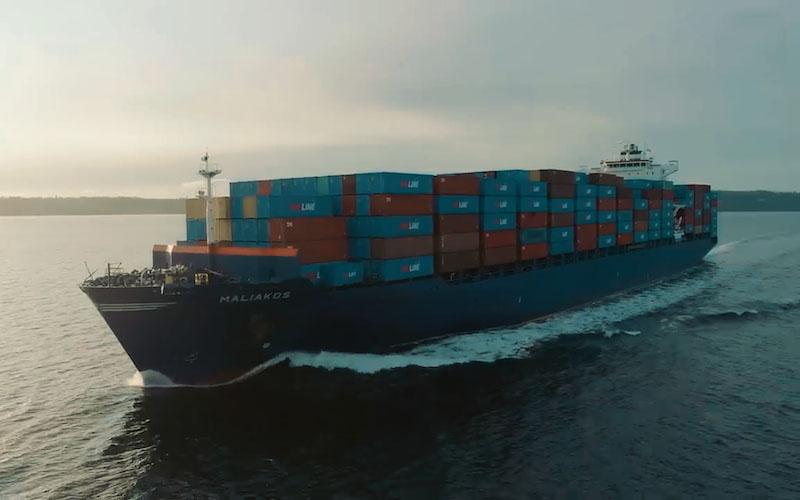
The Joint Command of the Iranian Revolutionary Guard Corps issued a strongly worded statement via state television: "Any act that violates regulations, deviates from designated routes, or disregards the navigation agreement of the Islamic Republic of Iran in the Strait of Hormuz will be met with an immediate and forceful response from the armed forces, endangering the safety of the offending vessels."
The statement also indicated that the U.S. military's "intervention" in the Strait would be met with a "swift and decisive counterattack."
Iran's position has remained unchanged: as part of the interim agreement, the US and Iran agreed to free passage for ships for 60 days, but Tehran insists on controlling the shipping lanes and charging tolls in the future. The US and the Gulf Arab states have made it clear that they will not agree to Iran charging tolls on passage through the straits—which would overturn decades of established practice in the waterway.
The trigger for Iran's warning is still unclear, but the timeline provides important clues.
On Wednesday, the US and Iran met with mediators in Doha, while the US Central Command had previously issued a statement regarding a meeting with Middle Eastern officials in Bahrain, saying that "leaders reaffirmed their shared commitment to the free flow of commerce across the Straits."
Iran’s warning is likely a direct response to this statement—Tehran views the U.S. “freedom of passage” statement as a direct challenge to its intention to control the Straits.
Despite escalating tensions, the number of oil tankers crossing the Strait continues to rebound.
Data from Lloyds List Intelligence, a well-known shipping data company, shows that at least 258 ships passed through the channel last week, a significant increase from 138 the previous week. However, this number is still far below pre-war levels—when approximately 130 ships passed through the strait daily, equivalent to about 910 ships per week.
Current traffic volume is less than one-third of pre-war levels, reflecting shipping companies' continued concerns about safety risks.
Last weekend, Oman's efforts to open new shipping routes off the coast of Oman in cooperation with UN agencies triggered attacks in the Middle East. This demonstrates that any attempt to bypass Iranian control and find alternative routes could be met with a military response.
Iran is attempting to institutionalize control of the Strait of Hormuz through a dual approach of "designated routes" and "future fees"—this is not only a military issue, but also a long-term game involving sovereignty claims and economic interests.
This long-term struggle for institutionalized control is the fundamental reason why current oil prices are unable to completely detach from geopolitical risk premiums. According to the daily chart, Brent crude oil futures formed a double top at the previous high of 115.21 and continued to decline. The moving average system is in a bearish alignment: MA20 (79.78), MA50 (93.61), and MA100 (93.11) are all above the price, forming strong resistance. Only MA200 (78.58) forms a medium-term resistance zone above. The price has fallen sharply below all medium- and long-term moving averages, and the stage low of 70.13 is a key short-term support.
In terms of indicators, the MACD lines are running below the zero axis, the DIFF line at -6.36 is consistently lower than the DEA line at -6.23, the bearish green bars continue to spread, and the downward momentum has not yet fully exhausted, with no bottoming golden cross stabilization signal yet; the RSI value is 29.18, entering the oversold zone below 30, indicating a short-term technical rebound demand, but the indicators have not yet turned around, and the rebound strength is relatively weak.
In terms of trend structure, since the high point in May, the highs and lows have moved down in tandem, forming a complete standard downward channel. The 70 support level is a watershed between bulls and bears in the short term; a decisive break below it would open up new downside potential. The rebound based on oversold indicators faces key resistance at the 20-day moving average of 79.78, and this rebound is merely a corrective move within the downtrend.
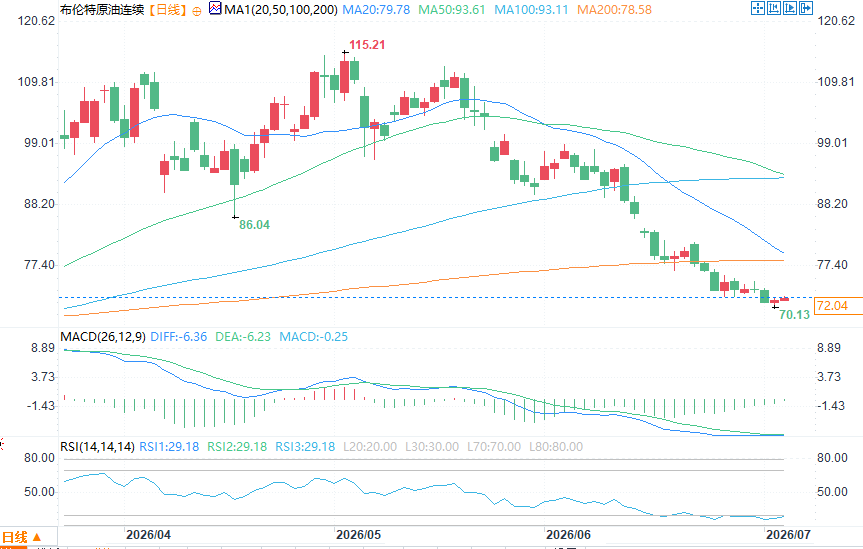
(Brent crude oil futures daily chart, source: FX678)
At 11:36 AM Beijing time on July 3, Brent crude oil futures were trading at $72.24 per barrel.
Geopolitical risk signals have reappeared, giving oil prices a temporary respite from their lows.
On Thursday, Iran’s Joint Military Command issued a strong warning to oil tankers passing through the Strait of Hormuz: they must use Iranian-approved routes or face a “strong response.”
The timing of this statement, released just after the US and Iran met with mediators in Doha on Wednesday, is intriguing.
The Strait of Hormuz has been a central issue in negotiations to end the Iraq War—a war that began on February 28 with a joint U.S.-Israeli strike on several key Iranian locations.
Iran warns: Designated routes + mandatory fees, core stance unchanged.
The Joint Command of the Iranian Revolutionary Guard Corps issued a strongly worded statement via state television: "Any act that violates regulations, deviates from designated routes, or disregards the navigation agreement of the Islamic Republic of Iran in the Strait of Hormuz will be met with an immediate and forceful response from the armed forces, endangering the safety of the offending vessels."
The statement also indicated that the U.S. military's "intervention" in the Strait would be met with a "swift and decisive counterattack."
Iran's position has remained unchanged: as part of the interim agreement, the US and Iran agreed to free passage for ships for 60 days, but Tehran insists on controlling the shipping lanes and charging tolls in the future. The US and the Gulf Arab states have made it clear that they will not agree to Iran charging tolls on passage through the straits—which would overturn decades of established practice in the waterway.
The timing of the US statement coincides with Iran's warning.
The trigger for Iran's warning is still unclear, but the timeline provides important clues.
On Wednesday, the US and Iran met with mediators in Doha, while the US Central Command had previously issued a statement regarding a meeting with Middle Eastern officials in Bahrain, saying that "leaders reaffirmed their shared commitment to the free flow of commerce across the Straits."
Iran’s warning is likely a direct response to this statement—Tehran views the U.S. “freedom of passage” statement as a direct challenge to its intention to control the Straits.
Traffic volume has rebounded but is far from returning to normal.
Despite escalating tensions, the number of oil tankers crossing the Strait continues to rebound.
Data from Lloyds List Intelligence, a well-known shipping data company, shows that at least 258 ships passed through the channel last week, a significant increase from 138 the previous week. However, this number is still far below pre-war levels—when approximately 130 ships passed through the strait daily, equivalent to about 910 ships per week.
Current traffic volume is less than one-third of pre-war levels, reflecting shipping companies' continued concerns about safety risks.
Attacks triggered by planned new shipping route to Oman escalate regional security rivalry.
Last weekend, Oman's efforts to open new shipping routes off the coast of Oman in cooperation with UN agencies triggered attacks in the Middle East. This demonstrates that any attempt to bypass Iranian control and find alternative routes could be met with a military response.
Iran is attempting to institutionalize control of the Strait of Hormuz through a dual approach of "designated routes" and "future fees"—this is not only a military issue, but also a long-term game involving sovereignty claims and economic interests.
Technical Analysis
This long-term struggle for institutionalized control is the fundamental reason why current oil prices are unable to completely detach from geopolitical risk premiums. According to the daily chart, Brent crude oil futures formed a double top at the previous high of 115.21 and continued to decline. The moving average system is in a bearish alignment: MA20 (79.78), MA50 (93.61), and MA100 (93.11) are all above the price, forming strong resistance. Only MA200 (78.58) forms a medium-term resistance zone above. The price has fallen sharply below all medium- and long-term moving averages, and the stage low of 70.13 is a key short-term support.
In terms of indicators, the MACD lines are running below the zero axis, the DIFF line at -6.36 is consistently lower than the DEA line at -6.23, the bearish green bars continue to spread, and the downward momentum has not yet fully exhausted, with no bottoming golden cross stabilization signal yet; the RSI value is 29.18, entering the oversold zone below 30, indicating a short-term technical rebound demand, but the indicators have not yet turned around, and the rebound strength is relatively weak.
In terms of trend structure, since the high point in May, the highs and lows have moved down in tandem, forming a complete standard downward channel. The 70 support level is a watershed between bulls and bears in the short term; a decisive break below it would open up new downside potential. The rebound based on oversold indicators faces key resistance at the 20-day moving average of 79.78, and this rebound is merely a corrective move within the downtrend.
(Brent crude oil futures daily chart, source: FX678)
At 11:36 AM Beijing time on July 3, Brent crude oil futures were trading at $72.24 per barrel.
- Risk Warning and Disclaimer
- The market involves risk, and trading may not be suitable for all investors. This article is for reference only and does not constitute personal investment advice, nor does it take into account certain users’ specific investment objectives, financial situation, or other needs. Any investment decisions made based on this information are at your own risk.