Crude oil price declines weakened support for the Canadian dollar, coupled with divergent expectations regarding the Federal Reserve, leading to USD/CAD trading in a range at high levels.
2026-07-03 13:21:46
The USD/CAD pair continued its correction during the Asian trading session, trading around 1.4160 , stabilizing and rebounding after a slight pullback in the previous session. The current exchange rate movement is driven by the tug-of-war between the US dollar and the Canadian dollar: on the one hand, the US dollar is under pressure due to weak US employment data, while on the other hand, the Canadian dollar is being dragged down by the continued decline in oil prices.

From the perspective of the Canadian dollar, the recent continued decline in the oil market has become the main source of pressure. With the easing of geopolitical tensions in the Middle East and the progress of US-Iran diplomacy, the risk premium in the global energy market has decreased significantly, causing oil prices to shift downwards. As a typical commodity currency, the Canadian dollar is highly correlated with oil prices, and weakening oil prices directly weaken its fundamental support. The market generally expects that against the backdrop of easing energy inflationary pressures, the Bank of Canada's future policy stance may further lean towards easing, which will continue to suppress the Canadian dollar's performance in the medium term.
Despite some resilience in Canadian domestic economic data, the impact was limited. The latest manufacturing PMI rose to 53.0 , a slight improvement from the previous reading of 52.9, indicating that the manufacturing sector remains in a moderate expansionary phase. However, this improvement was insufficient to offset the external shock from declining energy prices, and the Canadian dollar remained generally weak.
On the other hand, the dollar's performance was also influenced by macroeconomic data. US non-farm payrolls increased by only about 57,000 in June, significantly lower than the market expectation of 110,000, indicating a clear cooling in the job market. However, the unemployment rate unexpectedly fell to 4.2% , a slight improvement from the previous value of 4.3%, causing market opinions on the economic slowdown to diverge. This structure of "weak employment but stable unemployment" prevented the dollar from experiencing a one-sided decline, instead maintaining relative resilience.
The market is currently exhibiting a clear tug-of-war between two factors: falling crude oil prices are putting downward pressure on the Canadian dollar, but the US dollar lacks upward momentum due to expectations of an economic slowdown, causing the USD/CAD pair to maintain a high-level consolidation structure without a clear trend.
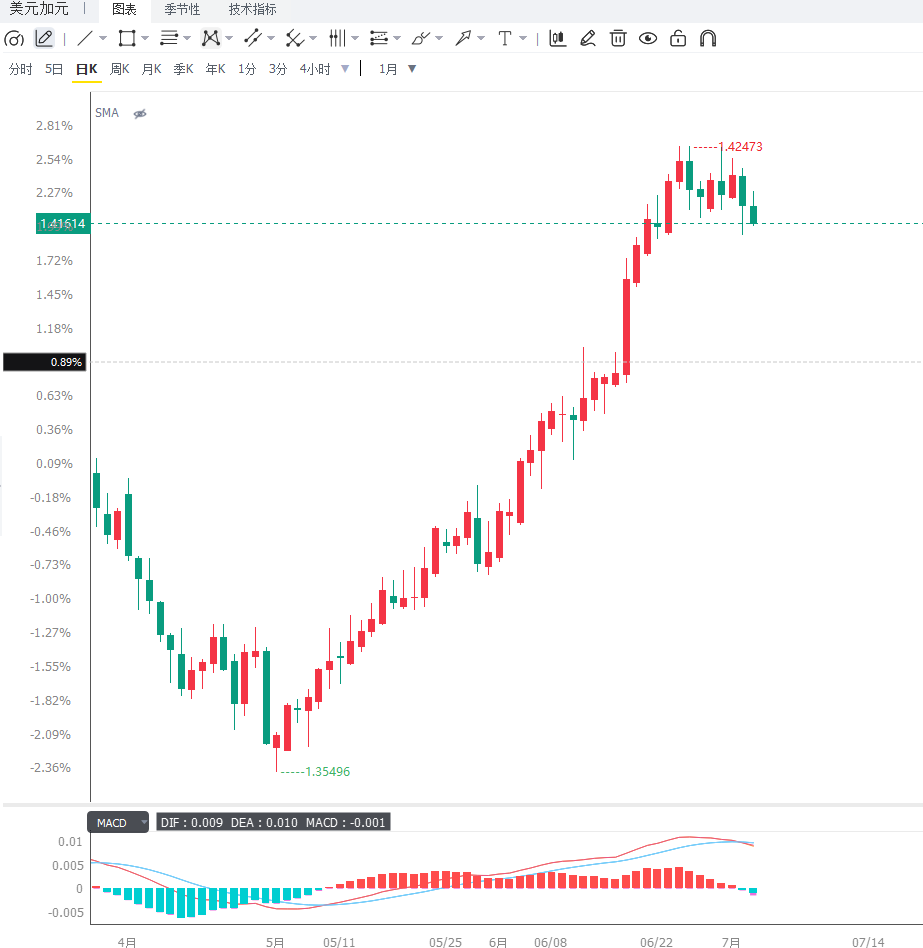
From a technical perspective, the daily chart shows that USD/CAD has been consolidating after a period of upward movement above 1.4100. The overall trend remains bullish, but momentum has slowed. The key resistance level to watch is the 1.4250 area, which is a previous high and a short-term moving average resistance zone. A break above this level could open up further upside potential towards the 1.4320 area. On the downside, the key support level is around 1.4120 , a short-term structural support area and a dense cluster of previous pullback lows. A break below this level could lead to a decline to the 1.4050 level.
From the 4-hour chart, the exchange rate has repeatedly encountered resistance around 1.4200. The short-term moving average system shows signs of flattening, and the MACD histogram is converging, indicating that the bullish momentum is weakening but has not yet turned completely. If it fails to hold above 1.4200 in the short term, it may enter a range-bound movement between 1.4120 and 1.4200; conversely, if the US dollar strengthens again, it still has the potential to break upwards. Overall, the short-term trend maintains a slightly bullish structure, but the continuity of the trend is insufficient.
Editor's Summary:
The current USD/CAD exchange rate is driven by both declining crude oil prices and weak US employment data, resulting in a typical two-way tug-of-war pattern. The Canadian dollar is significantly pressured by falling energy prices, while the US dollar remains relatively resilient due to divergent employment data, keeping the exchange rate oscillating at high levels. In the short term, USD/CAD lacks a clear unilateral driver and is more likely to consolidate within a range. The medium-term trend will still depend on crude oil price movements and changes in expectations regarding Federal Reserve policy. If oil prices continue to weaken and the US dollar remains stable, the exchange rate may have further upside potential.
From the perspective of the Canadian dollar, the recent continued decline in the oil market has become the main source of pressure. With the easing of geopolitical tensions in the Middle East and the progress of US-Iran diplomacy, the risk premium in the global energy market has decreased significantly, causing oil prices to shift downwards. As a typical commodity currency, the Canadian dollar is highly correlated with oil prices, and weakening oil prices directly weaken its fundamental support. The market generally expects that against the backdrop of easing energy inflationary pressures, the Bank of Canada's future policy stance may further lean towards easing, which will continue to suppress the Canadian dollar's performance in the medium term.
Despite some resilience in Canadian domestic economic data, the impact was limited. The latest manufacturing PMI rose to 53.0 , a slight improvement from the previous reading of 52.9, indicating that the manufacturing sector remains in a moderate expansionary phase. However, this improvement was insufficient to offset the external shock from declining energy prices, and the Canadian dollar remained generally weak.
On the other hand, the dollar's performance was also influenced by macroeconomic data. US non-farm payrolls increased by only about 57,000 in June, significantly lower than the market expectation of 110,000, indicating a clear cooling in the job market. However, the unemployment rate unexpectedly fell to 4.2% , a slight improvement from the previous value of 4.3%, causing market opinions on the economic slowdown to diverge. This structure of "weak employment but stable unemployment" prevented the dollar from experiencing a one-sided decline, instead maintaining relative resilience.
The market is currently exhibiting a clear tug-of-war between two factors: falling crude oil prices are putting downward pressure on the Canadian dollar, but the US dollar lacks upward momentum due to expectations of an economic slowdown, causing the USD/CAD pair to maintain a high-level consolidation structure without a clear trend.
From a technical perspective, the daily chart shows that USD/CAD has been consolidating after a period of upward movement above 1.4100. The overall trend remains bullish, but momentum has slowed. The key resistance level to watch is the 1.4250 area, which is a previous high and a short-term moving average resistance zone. A break above this level could open up further upside potential towards the 1.4320 area. On the downside, the key support level is around 1.4120 , a short-term structural support area and a dense cluster of previous pullback lows. A break below this level could lead to a decline to the 1.4050 level.
From the 4-hour chart, the exchange rate has repeatedly encountered resistance around 1.4200. The short-term moving average system shows signs of flattening, and the MACD histogram is converging, indicating that the bullish momentum is weakening but has not yet turned completely. If it fails to hold above 1.4200 in the short term, it may enter a range-bound movement between 1.4120 and 1.4200; conversely, if the US dollar strengthens again, it still has the potential to break upwards. Overall, the short-term trend maintains a slightly bullish structure, but the continuity of the trend is insufficient.
Editor's Summary:
The current USD/CAD exchange rate is driven by both declining crude oil prices and weak US employment data, resulting in a typical two-way tug-of-war pattern. The Canadian dollar is significantly pressured by falling energy prices, while the US dollar remains relatively resilient due to divergent employment data, keeping the exchange rate oscillating at high levels. In the short term, USD/CAD lacks a clear unilateral driver and is more likely to consolidate within a range. The medium-term trend will still depend on crude oil price movements and changes in expectations regarding Federal Reserve policy. If oil prices continue to weaken and the US dollar remains stable, the exchange rate may have further upside potential.
- Risk Warning and Disclaimer
- The market involves risk, and trading may not be suitable for all investors. This article is for reference only and does not constitute personal investment advice, nor does it take into account certain users’ specific investment objectives, financial situation, or other needs. Any investment decisions made based on this information are at your own risk.