The unexpectedly weak non-farm payrolls data caused the dollar to fall, and oil prices rebounded accordingly! But a bigger variable lies in the Middle East.
2026-07-03 15:06:46
On Friday (July 3) during Asian trading hours, US crude oil futures rebounded from their lows and are currently trading around $69 per barrel.
Weak US non-farm payroll data for June cooled market expectations for a near-term interest rate hike by the Federal Reserve, putting downward pressure on the dollar and providing support for dollar-denominated crude oil prices.
However, cautious optimism surrounding the US-Iran peace talks continues to limit oil price gains, as the market awaits substantial evidence to confirm the direction of the Middle East situation.

The U.S. nonfarm payrolls report released on Thursday showed that only 57,000 jobs were added in June, far below the expected 110,000, and the previous figure was also revised down significantly.
Although the unemployment rate dropped slightly from 4.3% to 4.2%, the overall data clearly points to a cooling labor market.
This result prompted financial markets to significantly reduce their bets on a near-term rate hike by the Federal Reserve, putting pressure on the dollar near a two-week low and providing tailwind support for dollar-denominated WTI crude oil.
Although the weakening dollar is beneficial to oil prices, progress in the Middle East peace process continues to limit further increases in oil prices.
According to media reports, the United States and Iran concluded a round of indirect talks on Wednesday, but failed to show any breakthrough in achieving lasting peace.
Meanwhile, Iran's Joint Military Command warned that any US intervention in the Strait of Hormuz would be met with a "decisive and swift response," and the negotiation situation remained tense.
However, the market also received some positive signals. US President Trump said on Thursday that he believed Iran "has essentially accepted all of our demands."
These remarks come as Qatar announces "positive progress" following indirect technical negotiations between Washington and Tehran in Doha on issues related to the Memorandum of Understanding (MoU) signed on June 17.
Tim Waterer, chief market analyst at KCM Trade, commented, "This is a cautious optimism – the market hopes the peace efforts will continue, but is still hedging its bets until real evidence surfaces." This assessment accurately summarizes the complex market sentiment regarding the situation in the Middle East.
The crude oil market is currently caught in a tug-of-war between bullish and bearish factors. On the one hand, weak US economic data has weakened the dollar and expectations of interest rate hikes, causing a sharp drop in the probability of a Fed rate hike, which has provided tailwind support for WTI crude oil priced in dollars, pushing oil prices back to around $69. The dollar index fell sharply by 0.5% on Thursday and continued its decline on Friday, currently trading around 100.70, down about 0.15%.
On the other hand, cautious optimism surrounding US-Iran negotiations is limiting further upside potential for oil prices. While the market anticipates peace efforts, it remains cautiously hedging, as any substantial progress could further depress geopolitical risk premiums. Conversely, if negotiations break down or tensions in the Middle East escalate again, oil prices could gain new upward momentum. In the short term, oil price movements will closely follow the direction of the US dollar and the evolution of geopolitical news.
Citigroup's energy research team predicted on Thursday (July 2) that WTI crude oil's third-quarter target is $83 per barrel, and it may fall back to $78 in the fourth quarter.
The agency believes that stable US demand and China's economic stimulus policies will support oil prices, but OPEC+ production increase plans and global inventory replenishment will put pressure on prices.
Citigroup points out that oil prices may face a seasonal correction after the peak demand during the summer driving season.
UBS's commodities research team on Wednesday (July 1) predicted that the average price of WTI crude oil in 2026 would be $79 per barrel, with a year-end target of $80-85.
The agency pointed out that OPEC+ production cut discipline and low global inventories provide bottom support for oil prices, but non-OPEC supply growth and increased electric vehicle penetration limit upside potential.
UBS emphasizes that geopolitical risks remain the main catalyst, and the situation in the Middle East may push up oil prices in the short term.
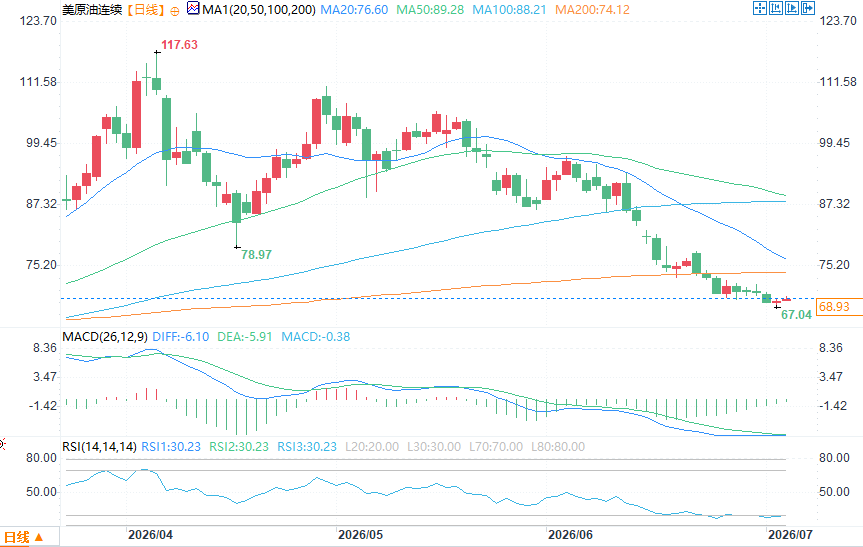
(US crude oil futures daily chart, source: FX678)
At 15:06 Beijing time on July 3, US crude oil futures were trading at $68.82 per barrel.
Weak US non-farm payroll data for June cooled market expectations for a near-term interest rate hike by the Federal Reserve, putting downward pressure on the dollar and providing support for dollar-denominated crude oil prices.
However, cautious optimism surrounding the US-Iran peace talks continues to limit oil price gains, as the market awaits substantial evidence to confirm the direction of the Middle East situation.
The dollar weakened, providing support for oil prices.
The U.S. nonfarm payrolls report released on Thursday showed that only 57,000 jobs were added in June, far below the expected 110,000, and the previous figure was also revised down significantly.
Although the unemployment rate dropped slightly from 4.3% to 4.2%, the overall data clearly points to a cooling labor market.
This result prompted financial markets to significantly reduce their bets on a near-term rate hike by the Federal Reserve, putting pressure on the dollar near a two-week low and providing tailwind support for dollar-denominated WTI crude oil.
US-Iran negotiations: Cautious optimism limits oil price upside.
Although the weakening dollar is beneficial to oil prices, progress in the Middle East peace process continues to limit further increases in oil prices.
According to media reports, the United States and Iran concluded a round of indirect talks on Wednesday, but failed to show any breakthrough in achieving lasting peace.
Meanwhile, Iran's Joint Military Command warned that any US intervention in the Strait of Hormuz would be met with a "decisive and swift response," and the negotiation situation remained tense.
However, the market also received some positive signals. US President Trump said on Thursday that he believed Iran "has essentially accepted all of our demands."
These remarks come as Qatar announces "positive progress" following indirect technical negotiations between Washington and Tehran in Doha on issues related to the Memorandum of Understanding (MoU) signed on June 17.
Tim Waterer, chief market analyst at KCM Trade, commented, "This is a cautious optimism – the market hopes the peace efforts will continue, but is still hedging its bets until real evidence surfaces." This assessment accurately summarizes the complex market sentiment regarding the situation in the Middle East.
Geopolitical risk premium: A double-edged sword of uncertainty
The crude oil market is currently caught in a tug-of-war between bullish and bearish factors. On the one hand, weak US economic data has weakened the dollar and expectations of interest rate hikes, causing a sharp drop in the probability of a Fed rate hike, which has provided tailwind support for WTI crude oil priced in dollars, pushing oil prices back to around $69. The dollar index fell sharply by 0.5% on Thursday and continued its decline on Friday, currently trading around 100.70, down about 0.15%.
On the other hand, cautious optimism surrounding US-Iran negotiations is limiting further upside potential for oil prices. While the market anticipates peace efforts, it remains cautiously hedging, as any substantial progress could further depress geopolitical risk premiums. Conversely, if negotiations break down or tensions in the Middle East escalate again, oil prices could gain new upward momentum. In the short term, oil price movements will closely follow the direction of the US dollar and the evolution of geopolitical news.
Institutional Views
Citigroup's energy research team predicted on Thursday (July 2) that WTI crude oil's third-quarter target is $83 per barrel, and it may fall back to $78 in the fourth quarter.
The agency believes that stable US demand and China's economic stimulus policies will support oil prices, but OPEC+ production increase plans and global inventory replenishment will put pressure on prices.
Citigroup points out that oil prices may face a seasonal correction after the peak demand during the summer driving season.
UBS's commodities research team on Wednesday (July 1) predicted that the average price of WTI crude oil in 2026 would be $79 per barrel, with a year-end target of $80-85.
The agency pointed out that OPEC+ production cut discipline and low global inventories provide bottom support for oil prices, but non-OPEC supply growth and increased electric vehicle penetration limit upside potential.
UBS emphasizes that geopolitical risks remain the main catalyst, and the situation in the Middle East may push up oil prices in the short term.
(US crude oil futures daily chart, source: FX678)
At 15:06 Beijing time on July 3, US crude oil futures were trading at $68.82 per barrel.
- Risk Warning and Disclaimer
- The market involves risk, and trading may not be suitable for all investors. This article is for reference only and does not constitute personal investment advice, nor does it take into account certain users’ specific investment objectives, financial situation, or other needs. Any investment decisions made based on this information are at your own risk.