Japan employs a surprising tactic: no more rhetoric, just a surprise attack! Those shorting the yen are trembling with fear.
2026-07-03 15:12:55
The US dollar continued its decline against the Japanese yen during the Asian session on Friday (July 3). Although it rebounded slightly to around 161.50 in the early Asian session, it subsequently encountered selling pressure and is currently trading below the 161.00 level. The previous trading day, the US dollar fell by 0.9% against the Japanese yen, marking its biggest drop in over a month.
The market is gradually digesting weak US employment data, while Japan's shift in intervention strategy continues to support the yen, and cooling expectations for a Fed rate hike are limiting the dollar's upside. These multiple factors combined suggest that the currency pair is likely to continue its pullback since hitting its highest point since 1986 on Wednesday.
In early Asian trading, the US dollar received some buying support due to safe-haven demand.
Persistent geopolitical uncertainty has become a key factor: US media reports that US officials are concerned that Israel may plot to assassinate two senior Iranian negotiators during indirect peace talks, and any such action could undermine the negotiations and trigger a new conflict.
In addition, the Iranian military warned that if the United States intervenes in the Strait of Hormuz, it will face a "decisive and swift response".
These news items initially boosted the safe-haven dollar, pulling it away from its lowest level since June 18th, and provided initial support for the dollar against the yen.

However, the further upside of the US dollar is clearly constrained.
The U.S. June nonfarm payrolls report was far below expectations: only 57,000 jobs were added that month, significantly lower than the expected 110,000, and the previous figure was revised down from 172,000 to 129,000, highlighting a softening labor market.
Despite a slight drop in the unemployment rate to 4.2%, market expectations for the number of Federal Reserve rate hikes in 2026 have been lowered from two to zero or one. This shift has made dollar bulls more cautious, limiting any substantial appreciation of the dollar against the yen.
At the same time, the yen received new support from domestic policy levels.
According to two sources familiar with the matter, Japanese authorities are abandoning their usual practice of signaling intervention in advance and instead adopting a more targeted strategy aimed at squeezing out speculators and increasing the cost of shorting the yen.
This significant shift in strategy has injected new uncertainty into the market and may prompt further adjustments to speculative short yen positions. Against the backdrop of thin market liquidity due to the US holiday, this factor further strengthens the short-term bearish outlook for USD/JPY.
Citigroup's FX team predicted on Wednesday (July 1) that the USD/JPY target for the third quarter of 2026 is 153, and it may fall back to the 147-150 range in the fourth quarter.
The agency believes that the delayed pace of interest rate cuts by the Federal Reserve, coupled with Japan's slow economic recovery, will support the US dollar in the medium term. However, as global growth concerns intensify, safe-haven buying of the yen may increase in stages.
Citigroup warned that verbal intervention and actual actions by Japanese authorities will limit the upside potential of the exchange rate.
UBS FX strategists believe on Tuesday (June 30) that the USD/JPY pair will fluctuate widely between 145 and 158, with a neutral target of 150 by the end of the year.
The agency noted that the Bank of Japan may signal a stronger interest rate hike at its July-September meetings, but will remain cautious in its actual actions. Stronger-than-expected US economic growth and a widening fiscal deficit continue to benefit the US dollar, while the yen's status as a funding currency is unlikely to change in the short term.
UBS emphasizes that intervention remains the main downside risk, and if the exchange rate continues to rise above 155, the Japanese Ministry of Finance may intervene in the market in conjunction with the central bank.
According to the daily chart, the medium-to-long-term bullish trend of USD/JPY remains intact, although a short-term pullback is underway. After reaching a high of 162.83, a large bearish candlestick appeared, indicating a pullback. The moving average system remains bullish: the 50-day moving average (MA50) (159.63), 100-day moving average (MA100) (158.87), and 200-day moving average (MA200) are all below the current price, providing solid support from the medium-to-long-term moving averages.
In terms of indicators, the MACD is still running above the zero axis, but the DIFF at 0.591 has crossed below the DEA at 0.662 to form a death cross, and the red bars have turned green, indicating that the short-term bullish momentum is weakening; the RSI has fallen back to 52.56, moving away from the previous overbought zone above 70, and the bullish and bearish forces have returned to equilibrium.
In terms of price structure, after bottoming out at 155.03 in May, the price has been trending upwards in a volatile manner, with both highs and lows rising simultaneously. After reaching a high of 162.83 in this round, it encountered resistance and fell back, entering a short-term consolidation phase at higher levels. Strong resistance lies at 162.83, while the first support level below, the 20-day moving average (MA20) at 161.13, has already been broken. The next level to test will be the psychological level of 160.
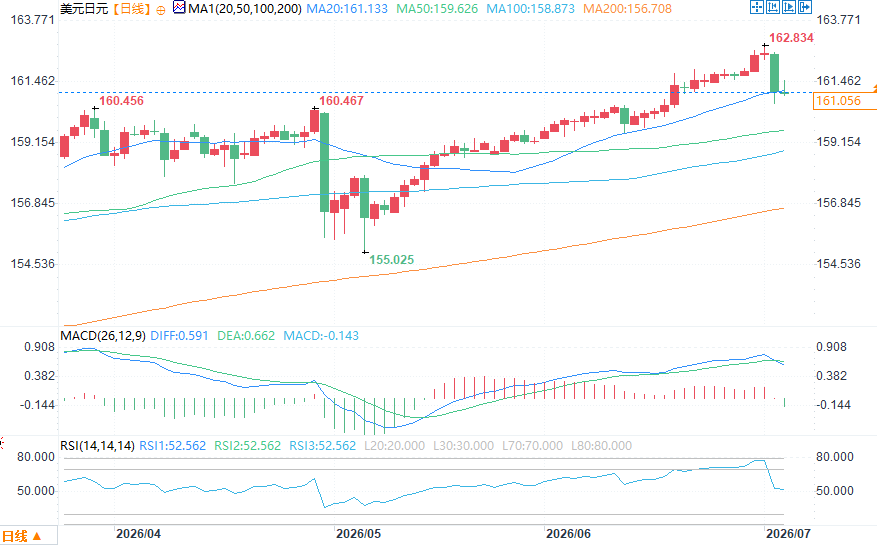
(USD/JPY daily chart, source: FX678)
At 15:12 Beijing time on July 3, the USD/JPY exchange rate was 160.77/78.
The market is gradually digesting weak US employment data, while Japan's shift in intervention strategy continues to support the yen, and cooling expectations for a Fed rate hike are limiting the dollar's upside. These multiple factors combined suggest that the currency pair is likely to continue its pullback since hitting its highest point since 1986 on Wednesday.
The US dollar initially received safe-haven support, but its gains were limited.
In early Asian trading, the US dollar received some buying support due to safe-haven demand.
Persistent geopolitical uncertainty has become a key factor: US media reports that US officials are concerned that Israel may plot to assassinate two senior Iranian negotiators during indirect peace talks, and any such action could undermine the negotiations and trigger a new conflict.
In addition, the Iranian military warned that if the United States intervenes in the Strait of Hormuz, it will face a "decisive and swift response".
These news items initially boosted the safe-haven dollar, pulling it away from its lowest level since June 18th, and provided initial support for the dollar against the yen.
Weak US jobs data weakens expectations of a Federal Reserve rate hike.
However, the further upside of the US dollar is clearly constrained.
The U.S. June nonfarm payrolls report was far below expectations: only 57,000 jobs were added that month, significantly lower than the expected 110,000, and the previous figure was revised down from 172,000 to 129,000, highlighting a softening labor market.
Despite a slight drop in the unemployment rate to 4.2%, market expectations for the number of Federal Reserve rate hikes in 2026 have been lowered from two to zero or one. This shift has made dollar bulls more cautious, limiting any substantial appreciation of the dollar against the yen.
Japan's intervention strategy shifts, continuing to support the yen.
At the same time, the yen received new support from domestic policy levels.
According to two sources familiar with the matter, Japanese authorities are abandoning their usual practice of signaling intervention in advance and instead adopting a more targeted strategy aimed at squeezing out speculators and increasing the cost of shorting the yen.
This significant shift in strategy has injected new uncertainty into the market and may prompt further adjustments to speculative short yen positions. Against the backdrop of thin market liquidity due to the US holiday, this factor further strengthens the short-term bearish outlook for USD/JPY.
Institutional Views
Citigroup's FX team predicted on Wednesday (July 1) that the USD/JPY target for the third quarter of 2026 is 153, and it may fall back to the 147-150 range in the fourth quarter.
The agency believes that the delayed pace of interest rate cuts by the Federal Reserve, coupled with Japan's slow economic recovery, will support the US dollar in the medium term. However, as global growth concerns intensify, safe-haven buying of the yen may increase in stages.
Citigroup warned that verbal intervention and actual actions by Japanese authorities will limit the upside potential of the exchange rate.
UBS FX strategists believe on Tuesday (June 30) that the USD/JPY pair will fluctuate widely between 145 and 158, with a neutral target of 150 by the end of the year.
The agency noted that the Bank of Japan may signal a stronger interest rate hike at its July-September meetings, but will remain cautious in its actual actions. Stronger-than-expected US economic growth and a widening fiscal deficit continue to benefit the US dollar, while the yen's status as a funding currency is unlikely to change in the short term.
UBS emphasizes that intervention remains the main downside risk, and if the exchange rate continues to rise above 155, the Japanese Ministry of Finance may intervene in the market in conjunction with the central bank.
Technical Analysis
According to the daily chart, the medium-to-long-term bullish trend of USD/JPY remains intact, although a short-term pullback is underway. After reaching a high of 162.83, a large bearish candlestick appeared, indicating a pullback. The moving average system remains bullish: the 50-day moving average (MA50) (159.63), 100-day moving average (MA100) (158.87), and 200-day moving average (MA200) are all below the current price, providing solid support from the medium-to-long-term moving averages.
In terms of indicators, the MACD is still running above the zero axis, but the DIFF at 0.591 has crossed below the DEA at 0.662 to form a death cross, and the red bars have turned green, indicating that the short-term bullish momentum is weakening; the RSI has fallen back to 52.56, moving away from the previous overbought zone above 70, and the bullish and bearish forces have returned to equilibrium.
In terms of price structure, after bottoming out at 155.03 in May, the price has been trending upwards in a volatile manner, with both highs and lows rising simultaneously. After reaching a high of 162.83 in this round, it encountered resistance and fell back, entering a short-term consolidation phase at higher levels. Strong resistance lies at 162.83, while the first support level below, the 20-day moving average (MA20) at 161.13, has already been broken. The next level to test will be the psychological level of 160.
(USD/JPY daily chart, source: FX678)
At 15:12 Beijing time on July 3, the USD/JPY exchange rate was 160.77/78.
- Risk Warning and Disclaimer
- The market involves risk, and trading may not be suitable for all investors. This article is for reference only and does not constitute personal investment advice, nor does it take into account certain users’ specific investment objectives, financial situation, or other needs. Any investment decisions made based on this information are at your own risk.