The US dollar received support from safe-haven demand, but expectations of interest rate hikes cooled, causing the USD/JPY pair to rise and then fall back, fluctuating around the 161 level.
2026-07-03 13:29:42
USD/JPY retreated from its highs during the Asian trading session, briefly touching around 161.50 before coming under pressure and currently trading near the 161.00 level . This marks the second consecutive day of pullback, and the pair remains within a corrective structure from its recent highs since 1986.

Regarding the US dollar, its performance showed a clear divergence. On the one hand, US non-farm payrolls increased by only about 57,000 in June, far below market expectations, indicating a continued cooling trend in the labor market and prompting the market to significantly lower its expectations for the Fed's future interest rate path. On the other hand, the unemployment rate unexpectedly fell to 4.2% , suggesting that the overall economic signals had not fully succumbed to recession expectations. As a result, the US dollar received some support after the decline and did not experience a one-sided weakening.
Meanwhile, geopolitical risks provided temporary safe-haven support for the US dollar. Market news indicates that uncertainty remains in the Middle East, with ongoing discussions involving indirect US-Iran negotiations and regional security risks, and some potential events even impacting shipping stability in the Strait of Hormuz. Against this backdrop, the US dollar, as a traditional safe-haven asset, received some financial support, limiting the downside potential of USD/JPY.
In Japan, the yen has recently received support from renewed policy expectations. Market rumors suggest that Japanese authorities may adjust their intervention strategy, ceasing to issue pre-emptive intervention signals and instead employing more sudden market operations to increase the cost of shorting the yen. This change enhances uncertainty in the foreign exchange market, putting pressure on speculative short positions to be readjusted, thus providing short-term support for the yen.
Overall, USD/JPY is currently in a tug-of-war between "cooling expectations of lower US dollar interest rates" and "geopolitical safe-haven demand supporting the US dollar + expectations of Japanese intervention strengthening the yen," causing the exchange rate to enter a technical correction structure from its highs, but the trend has not yet completely reversed.
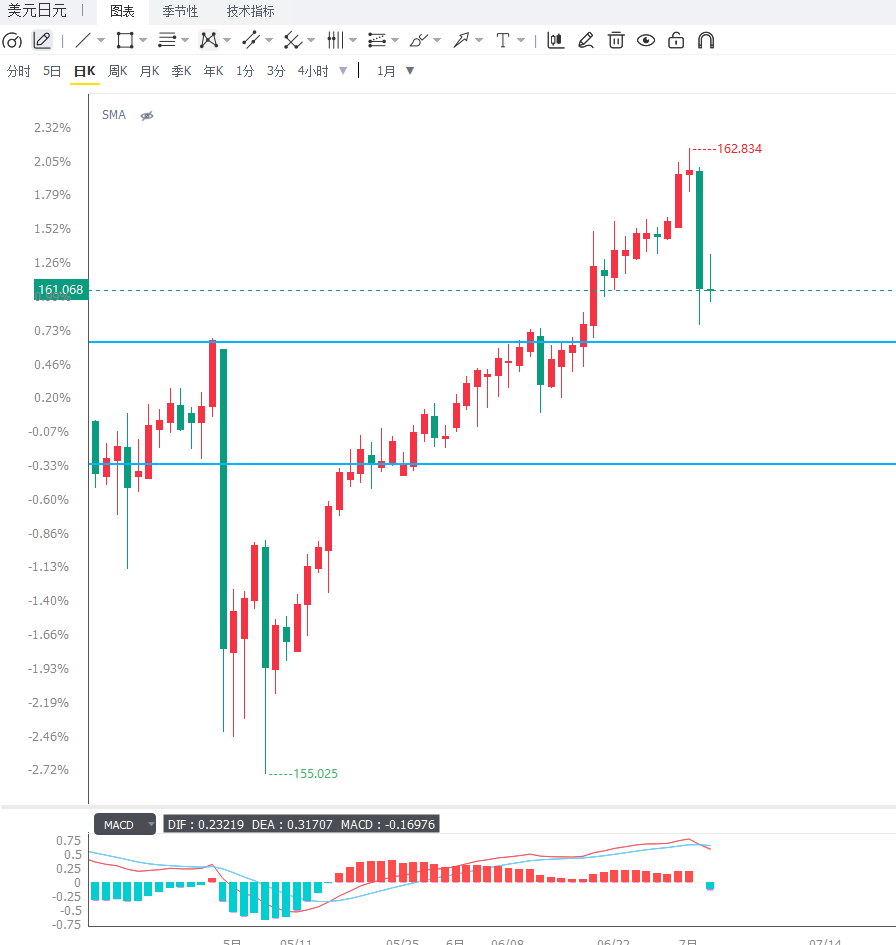
From a technical perspective, the daily chart shows that USD/JPY has entered a high-level consolidation and pullback phase after a continuous upward move. The overall trend remains strong, but the momentum has clearly slowed. The key resistance level to watch is the 161.80-162.00 area, which represents recent highs and a key psychological level. A break above this level could lead to a continuation of the upward trend. On the downside, the key support level is around 160.20 , which is a short-term moving average support and a previous breakout platform. A break below this level could lead to a further pullback to the 159.50 area.
From the 4-hour chart, the exchange rate has formed a short-term double-top resistance structure around 161.50, and the MACD histogram continues to contract, indicating a significant weakening of upward momentum. If it fails to regain 161.50 in the short term, it may continue to consolidate below 161.00; conversely, if the US dollar strengthens again, there is still a possibility of testing the 162 level. Overall, the short-term trend has turned to a weak, high-level consolidation, but a clear reversal signal has not yet formed.
Editor's Summary:
The current USD/JPY exchange rate movement is driven by a combination of waning expectations of a US interest rate hike and geopolitical safe-haven demand, coupled with potential changes in Japan's intervention strategy, leading to a significant increase in market volatility. After reaching multi-year highs, the exchange rate has entered a technical correction phase, but the overall trend remains bullish. In the short term, USD/JPY is expected to fluctuate around the 161 level; the medium-term trend depends on the Fed's policy path and changes in the intensity of Japanese foreign exchange intervention. If the US dollar strengthens again or the intervention is less intense than expected, the exchange rate may maintain its high-level trading pattern.
Regarding the US dollar, its performance showed a clear divergence. On the one hand, US non-farm payrolls increased by only about 57,000 in June, far below market expectations, indicating a continued cooling trend in the labor market and prompting the market to significantly lower its expectations for the Fed's future interest rate path. On the other hand, the unemployment rate unexpectedly fell to 4.2% , suggesting that the overall economic signals had not fully succumbed to recession expectations. As a result, the US dollar received some support after the decline and did not experience a one-sided weakening.
Meanwhile, geopolitical risks provided temporary safe-haven support for the US dollar. Market news indicates that uncertainty remains in the Middle East, with ongoing discussions involving indirect US-Iran negotiations and regional security risks, and some potential events even impacting shipping stability in the Strait of Hormuz. Against this backdrop, the US dollar, as a traditional safe-haven asset, received some financial support, limiting the downside potential of USD/JPY.
In Japan, the yen has recently received support from renewed policy expectations. Market rumors suggest that Japanese authorities may adjust their intervention strategy, ceasing to issue pre-emptive intervention signals and instead employing more sudden market operations to increase the cost of shorting the yen. This change enhances uncertainty in the foreign exchange market, putting pressure on speculative short positions to be readjusted, thus providing short-term support for the yen.
Overall, USD/JPY is currently in a tug-of-war between "cooling expectations of lower US dollar interest rates" and "geopolitical safe-haven demand supporting the US dollar + expectations of Japanese intervention strengthening the yen," causing the exchange rate to enter a technical correction structure from its highs, but the trend has not yet completely reversed.
From a technical perspective, the daily chart shows that USD/JPY has entered a high-level consolidation and pullback phase after a continuous upward move. The overall trend remains strong, but the momentum has clearly slowed. The key resistance level to watch is the 161.80-162.00 area, which represents recent highs and a key psychological level. A break above this level could lead to a continuation of the upward trend. On the downside, the key support level is around 160.20 , which is a short-term moving average support and a previous breakout platform. A break below this level could lead to a further pullback to the 159.50 area.
From the 4-hour chart, the exchange rate has formed a short-term double-top resistance structure around 161.50, and the MACD histogram continues to contract, indicating a significant weakening of upward momentum. If it fails to regain 161.50 in the short term, it may continue to consolidate below 161.00; conversely, if the US dollar strengthens again, there is still a possibility of testing the 162 level. Overall, the short-term trend has turned to a weak, high-level consolidation, but a clear reversal signal has not yet formed.
Editor's Summary:
The current USD/JPY exchange rate movement is driven by a combination of waning expectations of a US interest rate hike and geopolitical safe-haven demand, coupled with potential changes in Japan's intervention strategy, leading to a significant increase in market volatility. After reaching multi-year highs, the exchange rate has entered a technical correction phase, but the overall trend remains bullish. In the short term, USD/JPY is expected to fluctuate around the 161 level; the medium-term trend depends on the Fed's policy path and changes in the intensity of Japanese foreign exchange intervention. If the US dollar strengthens again or the intervention is less intense than expected, the exchange rate may maintain its high-level trading pattern.
- Risk Warning and Disclaimer
- The market involves risk, and trading may not be suitable for all investors. This article is for reference only and does not constitute personal investment advice, nor does it take into account certain users’ specific investment objectives, financial situation, or other needs. Any investment decisions made based on this information are at your own risk.