The yen has rebounded from a 40-year low, but the Japanese government's "trilemma" has only just begun.
2026-07-03 15:45:15
On Friday (July 3), the US dollar continued its decline against the Japanese yen during the European session. Although it rebounded slightly to around 161.50 in the early Asian session, it subsequently encountered selling pressure again and is currently trading around 160.85.
On Thursday, the dollar fell 0.9% against the yen, marking its biggest drop in more than a month.

Japan issued another warning to the foreign exchange market on Friday after the yen gradually recovered from a 40-year low.
Finance Minister Satsuki Katayama stated at a regular press conference that Tokyo maintains regular contact with Washington regarding the exchange rate issue. "Our position remains unchanged, and we will take appropriate measures if necessary," she said. She emphasized that the Japanese government maintained close communication with US authorities even during US holidays.
The weak U.S. jobs report released on Thursday delayed market expectations of an imminent Federal Reserve rate hike, causing the dollar to weaken across the board and giving the yen some breathing room.
The dollar plunged against the yen on Thursday as traders grew uneasy about a possible new yen-buying strategy by the authorities and remained highly vigilant about the possibility of intervention.
However, traders believe the volatility was too small to prove any actual intervention. The yen is currently trading below 161 against the dollar, after hitting a 40-year low of 162.84 earlier this week.
The continued weakening of the yen has become an increasingly troublesome issue for policymakers. A weak yen has driven up the cost of imported raw materials and exacerbated the operating pressure on households and businesses.
This week, new signs of pressure on Japanese companies emerged: a report from the think tank Tokyo Shoko Research showed that there were 45 bankruptcies related to the yen's depreciation in the first half of this year, an increase of 32.3% compared to the same period last year.
The report also points out that the number of such bankruptcy cases is likely to remain high in the foreseeable future.
When asked about this issue, Katayama stated that the government plans to fully implement measures to revitalize private sector activities.
However, increasing fiscal stimulus may come at a high cost.
Investors remained cautious about Prime Minister Sanae Takaichi's spending plans, causing continued volatility in the bond market. The benchmark 10-year Japanese government bond yield hit a 30-year high on Friday as investors perceived Takaichi's economic blueprint as leading to massive new spending and signaling that the Bank of Japan would resist further interest rate hikes.
The blueprint emphasizes the government's view that close coordination with the central bank is crucial, noting that it is "very important" for the Bank of Japan to keep its policy decisions aligned with efforts to boost the economy.
Katayama dismissed speculation about a policy shift, arguing that the blueprint merely reiterated "the government's long-standing position," adding that the government remains committed to maintaining market confidence in Japan's fiscal health.
With the yen and Japanese government bonds facing pressure, signs of unease are emerging within the government.
Toshihiro Nagahama, a private member of the Council on Economic and Fiscal Policy, said on Thursday that the Bank of Japan should continue to raise interest rates at a moderate pace to correct the excessive depreciation of the yen.
It is worth noting that Toshihiro Nagahama is considered an economic advisor to dovish Prime Minister Sanae Takaichi, a position that carries more weight for his hawkish remarks and reflects growing concerns within the government about the weakness of the yen.
From the 4-hour chart, the USD/JPY pair has reversed its gains and entered a deep correction phase. After previously surging to 162.83, a large bearish candlestick broke down, and short-term moving averages have turned downwards, forming bearish resistance: the 20-day moving average (MA20) (162.00), 50-day moving average (MA50) (161.84), and 100-day moving average (MA100) are all acting as resistance above the price, with only the 200-day moving average (MA200) (160.40) providing short-term support below. The previous low of 160.12 is a key support level.
In terms of indicators, the MACD lines have fallen rapidly below the zero axis, the DIFF line at -0.273 is significantly lower than the DEA line at -0.084, and the bearish green bars continue to expand, indicating strong short-term downward momentum. The RSI value is 26.49, falling into the oversold zone below 30, suggesting a short-term technical rebound, but no signs of a turnaround or stabilization have appeared.
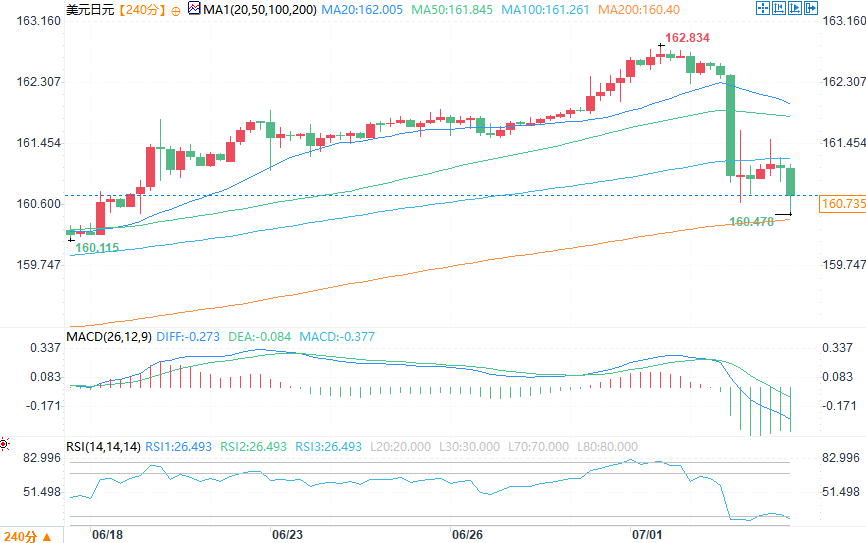
(USD/JPY 4-hour chart, source: EasyForex)
At 15:33 Beijing time on July 3, the USD/JPY exchange rate was 160.86/87.
On Thursday, the dollar fell 0.9% against the yen, marking its biggest drop in more than a month.
Foreign exchange market intervention warning: Maintain deterrence and close communication
Japan issued another warning to the foreign exchange market on Friday after the yen gradually recovered from a 40-year low.
Finance Minister Satsuki Katayama stated at a regular press conference that Tokyo maintains regular contact with Washington regarding the exchange rate issue. "Our position remains unchanged, and we will take appropriate measures if necessary," she said. She emphasized that the Japanese government maintained close communication with US authorities even during US holidays.
The weak U.S. jobs report released on Thursday delayed market expectations of an imminent Federal Reserve rate hike, causing the dollar to weaken across the board and giving the yen some breathing room.
The dollar plunged against the yen on Thursday as traders grew uneasy about a possible new yen-buying strategy by the authorities and remained highly vigilant about the possibility of intervention.
However, traders believe the volatility was too small to prove any actual intervention. The yen is currently trading below 161 against the dollar, after hitting a 40-year low of 162.84 earlier this week.
Real-world impact: Bankruptcy cases surge 32.3%
The continued weakening of the yen has become an increasingly troublesome issue for policymakers. A weak yen has driven up the cost of imported raw materials and exacerbated the operating pressure on households and businesses.
This week, new signs of pressure on Japanese companies emerged: a report from the think tank Tokyo Shoko Research showed that there were 45 bankruptcies related to the yen's depreciation in the first half of this year, an increase of 32.3% compared to the same period last year.
The report also points out that the number of such bankruptcy cases is likely to remain high in the foreseeable future.
When asked about this issue, Katayama stated that the government plans to fully implement measures to revitalize private sector activities.
Policy Dilemma: Fiscal Stimulus and Bond Volatility
However, increasing fiscal stimulus may come at a high cost.
Investors remained cautious about Prime Minister Sanae Takaichi's spending plans, causing continued volatility in the bond market. The benchmark 10-year Japanese government bond yield hit a 30-year high on Friday as investors perceived Takaichi's economic blueprint as leading to massive new spending and signaling that the Bank of Japan would resist further interest rate hikes.
The blueprint emphasizes the government's view that close coordination with the central bank is crucial, noting that it is "very important" for the Bank of Japan to keep its policy decisions aligned with efforts to boost the economy.
Katayama dismissed speculation about a policy shift, arguing that the blueprint merely reiterated "the government's long-standing position," adding that the government remains committed to maintaining market confidence in Japan's fiscal health.
Internal voices: The central bank should raise interest rates appropriately.
With the yen and Japanese government bonds facing pressure, signs of unease are emerging within the government.
Toshihiro Nagahama, a private member of the Council on Economic and Fiscal Policy, said on Thursday that the Bank of Japan should continue to raise interest rates at a moderate pace to correct the excessive depreciation of the yen.
It is worth noting that Toshihiro Nagahama is considered an economic advisor to dovish Prime Minister Sanae Takaichi, a position that carries more weight for his hawkish remarks and reflects growing concerns within the government about the weakness of the yen.
Technical Analysis
From the 4-hour chart, the USD/JPY pair has reversed its gains and entered a deep correction phase. After previously surging to 162.83, a large bearish candlestick broke down, and short-term moving averages have turned downwards, forming bearish resistance: the 20-day moving average (MA20) (162.00), 50-day moving average (MA50) (161.84), and 100-day moving average (MA100) are all acting as resistance above the price, with only the 200-day moving average (MA200) (160.40) providing short-term support below. The previous low of 160.12 is a key support level.
In terms of indicators, the MACD lines have fallen rapidly below the zero axis, the DIFF line at -0.273 is significantly lower than the DEA line at -0.084, and the bearish green bars continue to expand, indicating strong short-term downward momentum. The RSI value is 26.49, falling into the oversold zone below 30, suggesting a short-term technical rebound, but no signs of a turnaround or stabilization have appeared.
(USD/JPY 4-hour chart, source: EasyForex)
At 15:33 Beijing time on July 3, the USD/JPY exchange rate was 160.86/87.
- Risk Warning and Disclaimer
- The market involves risk, and trading may not be suitable for all investors. This article is for reference only and does not constitute personal investment advice, nor does it take into account certain users’ specific investment objectives, financial situation, or other needs. Any investment decisions made based on this information are at your own risk.