The US dollar index fell back to 100.60 but remains supported by an upward channel, awaiting stabilization.
2026-07-03 15:42:58
The US dollar index (DXY) continued its pullback in early European trading, trading around 100.60 . It fell for the second consecutive trading day, but overall it remains within the medium-term upward channel structure and has not changed its bullish trend.

From a fundamental perspective, the recent performance of the US dollar has been primarily driven by a significant slowdown in US macroeconomic data. The latest non-farm payroll data showed that the US added only about 57,000 jobs in June, far below market expectations of 110,000, indicating a significant slowdown in the labor market's expansion momentum. Meanwhile, the unemployment rate fell slightly to 4.2% , but this did not change the overall assessment of a slowdown in employment. This combination of data reinforced market expectations of a slowdown in US economic momentum and prompted investors to reassess the Federal Reserve's future policy path.
As a result, expectations for further rate hikes by the Federal Reserve have cooled significantly in the interest rate market, with some funds beginning to price in a longer policy pause period, putting short-term pressure on the dollar. However, in the medium term, uncertainty remains regarding the path of US inflation, and Federal Reserve officials continue to emphasize that inflation remains a core policy constraint, preventing the dollar from experiencing a trend of decline.
Meanwhile, geopolitical risks continue to provide some support for the US dollar. Persistent uncertainty in the Middle East and concerns about the stability of the energy supply chain have led to a temporary rebound in safe-haven demand, limiting the dollar's downside. Furthermore, compared to other major economies, US interest rates remain relatively high, making the dollar still attractive in the medium term due to its interest rate differential structure.
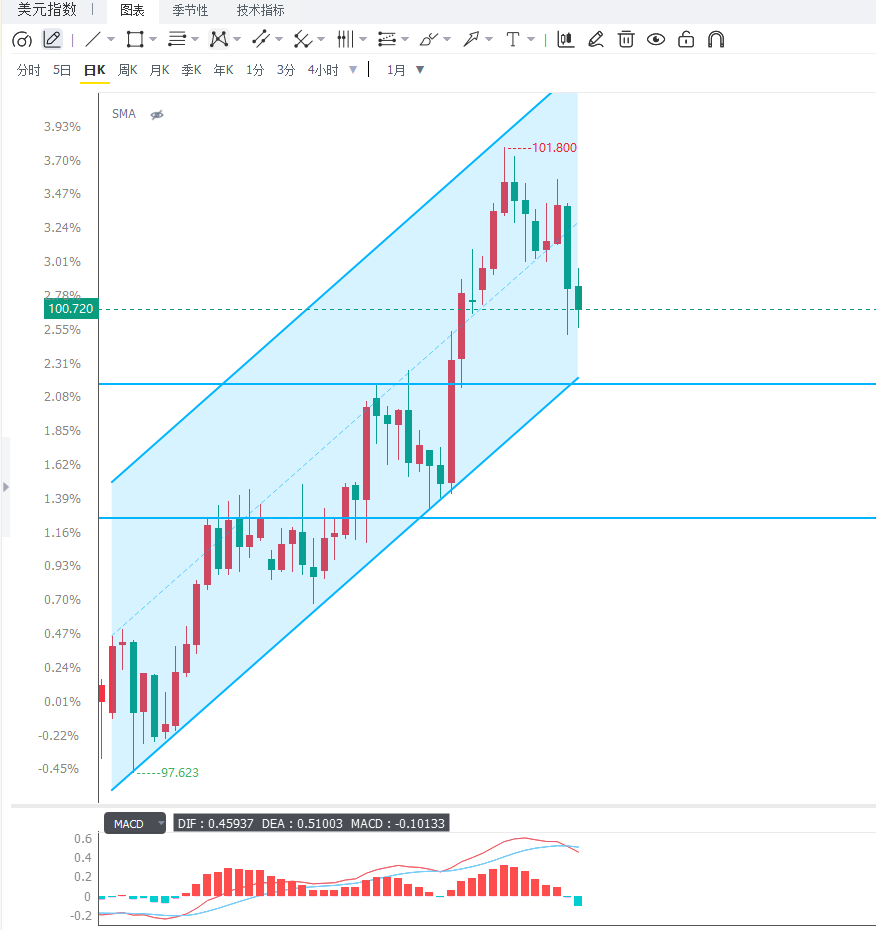
From a technical perspective, the US dollar index remains within an upward channel, maintaining a generally mildly bullish trend. In the short term, it is pressured by the 9-day moving average, but the 50-day moving average provides solid support, forming a typical consolidation structure. Regarding momentum indicators, the 14-day RSI is around 54.2 , slightly above the midline, indicating that bullish momentum still dominates but has not entered overbought territory, suggesting the market is in a consolidation phase before a trend continues.
On the upside, short-term resistance is at 100.99 (near the 9-day moving average). A break above this level would strengthen bullish momentum and could push the index to retest the previous high of 101.80 , further targeting the upper channel line area of 102.30 . On the downside, primary support is around 100.30 , corresponding to the lower trendline of the ascending channel. A break below this level could lead to a retest of 99.93 (the 50-day moving average) and weaken the current upward structure. A further break below the channel could open up room for a medium-term correction towards the 97.62 area.
Overall, the US dollar index is currently in a phase of "coexistence of cooling fundamentals and structural support." In the short term, it has experienced a pullback due to employment data, but the medium-term trend is still supported by the high-interest-rate environment and safe-haven demand, maintaining an overall volatile but slightly upward trend.
Editor's Summary:
The US dollar index is currently experiencing a temporary pullback due to weaker US employment data and rising expectations of interest rate cuts, but it remains supported in the medium term by the high-interest-rate environment and safe-haven demand. Technically, the upward channel structure remains intact, and the index is maintaining a consolidation pattern. Future movements will depend on US inflation data and Federal Reserve policy signals. If the data weakens further, the dollar may continue its correction; however, if inflation remains resilient, the dollar index still has the potential to retest previous highs.
From a fundamental perspective, the recent performance of the US dollar has been primarily driven by a significant slowdown in US macroeconomic data. The latest non-farm payroll data showed that the US added only about 57,000 jobs in June, far below market expectations of 110,000, indicating a significant slowdown in the labor market's expansion momentum. Meanwhile, the unemployment rate fell slightly to 4.2% , but this did not change the overall assessment of a slowdown in employment. This combination of data reinforced market expectations of a slowdown in US economic momentum and prompted investors to reassess the Federal Reserve's future policy path.
As a result, expectations for further rate hikes by the Federal Reserve have cooled significantly in the interest rate market, with some funds beginning to price in a longer policy pause period, putting short-term pressure on the dollar. However, in the medium term, uncertainty remains regarding the path of US inflation, and Federal Reserve officials continue to emphasize that inflation remains a core policy constraint, preventing the dollar from experiencing a trend of decline.
Meanwhile, geopolitical risks continue to provide some support for the US dollar. Persistent uncertainty in the Middle East and concerns about the stability of the energy supply chain have led to a temporary rebound in safe-haven demand, limiting the dollar's downside. Furthermore, compared to other major economies, US interest rates remain relatively high, making the dollar still attractive in the medium term due to its interest rate differential structure.
From a technical perspective, the US dollar index remains within an upward channel, maintaining a generally mildly bullish trend. In the short term, it is pressured by the 9-day moving average, but the 50-day moving average provides solid support, forming a typical consolidation structure. Regarding momentum indicators, the 14-day RSI is around 54.2 , slightly above the midline, indicating that bullish momentum still dominates but has not entered overbought territory, suggesting the market is in a consolidation phase before a trend continues.
On the upside, short-term resistance is at 100.99 (near the 9-day moving average). A break above this level would strengthen bullish momentum and could push the index to retest the previous high of 101.80 , further targeting the upper channel line area of 102.30 . On the downside, primary support is around 100.30 , corresponding to the lower trendline of the ascending channel. A break below this level could lead to a retest of 99.93 (the 50-day moving average) and weaken the current upward structure. A further break below the channel could open up room for a medium-term correction towards the 97.62 area.
Overall, the US dollar index is currently in a phase of "coexistence of cooling fundamentals and structural support." In the short term, it has experienced a pullback due to employment data, but the medium-term trend is still supported by the high-interest-rate environment and safe-haven demand, maintaining an overall volatile but slightly upward trend.
Editor's Summary:
The US dollar index is currently experiencing a temporary pullback due to weaker US employment data and rising expectations of interest rate cuts, but it remains supported in the medium term by the high-interest-rate environment and safe-haven demand. Technically, the upward channel structure remains intact, and the index is maintaining a consolidation pattern. Future movements will depend on US inflation data and Federal Reserve policy signals. If the data weakens further, the dollar may continue its correction; however, if inflation remains resilient, the dollar index still has the potential to retest previous highs.
- Risk Warning and Disclaimer
- The market involves risk, and trading may not be suitable for all investors. This article is for reference only and does not constitute personal investment advice, nor does it take into account certain users’ specific investment objectives, financial situation, or other needs. Any investment decisions made based on this information are at your own risk.