The UK service sector contracted for the second consecutive day, hitting a more than two-year low, with the PMI falling to 48.8, exacerbating concerns about an economic slowdown.
2026-07-03 16:40:11
The UK service sector continued its significant contraction in June, with the latest final data showing the services PMI falling to 48.8 , marking the second consecutive month below the 50-point threshold separating expansion from contraction. This indicates that the sector as a whole remains in contraction territory and represents the lowest level since the beginning of 2023, reflecting continued cooling pressures on UK economic activity.
Looking at the breakdown, the contraction in new business accelerated further, recording the most significant decline since November 2022, indicating that weak demand is spreading to a wider range of business operations. Businesses generally reported that reduced orders and insufficient customer confidence were the main drags, significantly limiting the recovery momentum of the service sector.
From a macroeconomic perspective, the ongoing escalation of geopolitical tensions is considered a significant factor affecting business confidence. Uncertainty surrounding the Middle East conflict has increased the risk of global energy and inflation volatility, leading businesses to remain cautious about the future cost environment. Meanwhile, global inflationary pressures have not yet fully subsided, also constraining corporate pricing and investment decisions.
Furthermore, uncertainty surrounding domestic political and fiscal policies in the UK is also weighing on economic expectations. Markets remain focused on the change of prime minister and the future direction of fiscal policy, concerned that potential changes in public spending could impact long-term fiscal discipline, thereby affecting business investment and hiring decisions. This policy uncertainty further weakens market confidence.
From the perspective of the overall economic structure, the continued contraction of the service sector, a core pillar of the UK economy, indicates a weakening of overall growth momentum. Current PMI data, consistently below the 50-point threshold, suggests the economy may be entering a period of slow growth or even temporary stagnation, posing a complex challenge to the Bank of England's future monetary policy. Despite the continued weakness in economic data, inflation has not yet fully returned to the target level, maintaining high uncertainty regarding the policy path. This "stagflationary equilibrium" leaves the pound lacking a clear trend driver.
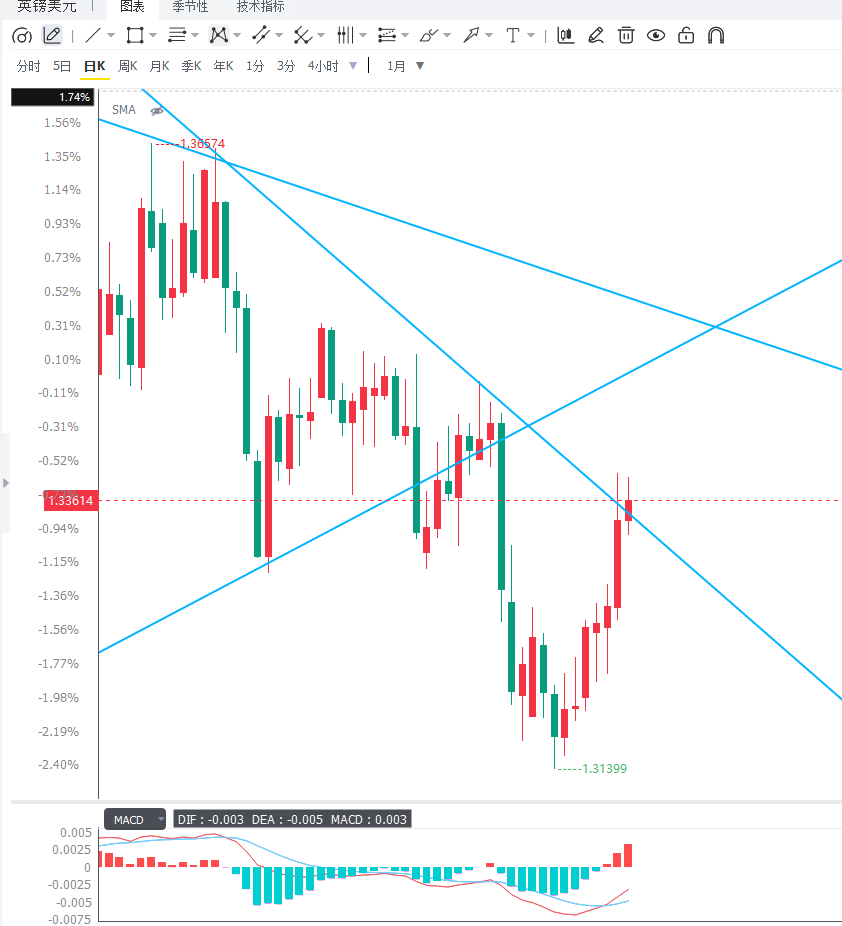
Against this backdrop, GBP/USD maintained its overall range-bound structure. The US dollar was also affected by weak US employment data, limiting the pound's decline and causing the exchange rate to fluctuate more in both directions. Technically, the GBP/USD daily chart remains within a low-level consolidation range, with the overall trend still weak but momentum slowing. After the previous decline, the price entered a sideways consolidation phase, and the short-term moving average system is gradually flattening, indicating a lack of a clear trend in the market.
The 4-hour chart shows the exchange rate fluctuating repeatedly within the 1.3300-1.3380 range, forming a clear consolidation platform. The upper resistance level to watch is the 1.3420 area, which is the previous rebound high and a short-term moving average resistance zone. A break above this level could open up room for a correction towards the 1.3500 area. The lower support level to watch is 1.3270 ; a break below this level could lead to a retest of the 1.3200 level. In terms of momentum indicators, the RSI remains in a neutral to weak range, and the MACD momentum is converging, indicating that bearish pressure is weakening but a reversal signal has not yet formed. In the short term, the price is more likely to remain within a range.
Editor's Summary:
The continued contraction of the UK service sector has exacerbated concerns about an economic slowdown, with the PMI falling to 48.8 indicating a significant weakening in demand. Fiscal and geopolitical uncertainties are further suppressing business confidence, putting pressure on the pound in the medium term. However, because the US dollar also weakened due to US employment data, GBP/USD did not experience a one-sided decline but instead maintained a low-level consolidation pattern. In the short term, the exchange rate will likely continue to consolidate around 1.33, with its direction depending on further macroeconomic data.
Looking at the breakdown, the contraction in new business accelerated further, recording the most significant decline since November 2022, indicating that weak demand is spreading to a wider range of business operations. Businesses generally reported that reduced orders and insufficient customer confidence were the main drags, significantly limiting the recovery momentum of the service sector.
From a macroeconomic perspective, the ongoing escalation of geopolitical tensions is considered a significant factor affecting business confidence. Uncertainty surrounding the Middle East conflict has increased the risk of global energy and inflation volatility, leading businesses to remain cautious about the future cost environment. Meanwhile, global inflationary pressures have not yet fully subsided, also constraining corporate pricing and investment decisions.
Furthermore, uncertainty surrounding domestic political and fiscal policies in the UK is also weighing on economic expectations. Markets remain focused on the change of prime minister and the future direction of fiscal policy, concerned that potential changes in public spending could impact long-term fiscal discipline, thereby affecting business investment and hiring decisions. This policy uncertainty further weakens market confidence.
From the perspective of the overall economic structure, the continued contraction of the service sector, a core pillar of the UK economy, indicates a weakening of overall growth momentum. Current PMI data, consistently below the 50-point threshold, suggests the economy may be entering a period of slow growth or even temporary stagnation, posing a complex challenge to the Bank of England's future monetary policy. Despite the continued weakness in economic data, inflation has not yet fully returned to the target level, maintaining high uncertainty regarding the policy path. This "stagflationary equilibrium" leaves the pound lacking a clear trend driver.
Against this backdrop, GBP/USD maintained its overall range-bound structure. The US dollar was also affected by weak US employment data, limiting the pound's decline and causing the exchange rate to fluctuate more in both directions. Technically, the GBP/USD daily chart remains within a low-level consolidation range, with the overall trend still weak but momentum slowing. After the previous decline, the price entered a sideways consolidation phase, and the short-term moving average system is gradually flattening, indicating a lack of a clear trend in the market.
The 4-hour chart shows the exchange rate fluctuating repeatedly within the 1.3300-1.3380 range, forming a clear consolidation platform. The upper resistance level to watch is the 1.3420 area, which is the previous rebound high and a short-term moving average resistance zone. A break above this level could open up room for a correction towards the 1.3500 area. The lower support level to watch is 1.3270 ; a break below this level could lead to a retest of the 1.3200 level. In terms of momentum indicators, the RSI remains in a neutral to weak range, and the MACD momentum is converging, indicating that bearish pressure is weakening but a reversal signal has not yet formed. In the short term, the price is more likely to remain within a range.
Editor's Summary:
The continued contraction of the UK service sector has exacerbated concerns about an economic slowdown, with the PMI falling to 48.8 indicating a significant weakening in demand. Fiscal and geopolitical uncertainties are further suppressing business confidence, putting pressure on the pound in the medium term. However, because the US dollar also weakened due to US employment data, GBP/USD did not experience a one-sided decline but instead maintained a low-level consolidation pattern. In the short term, the exchange rate will likely continue to consolidate around 1.33, with its direction depending on further macroeconomic data.
- Risk Warning and Disclaimer
- The market involves risk, and trading may not be suitable for all investors. This article is for reference only and does not constitute personal investment advice, nor does it take into account certain users’ specific investment objectives, financial situation, or other needs. Any investment decisions made based on this information are at your own risk.