Is the script of the mid-2000s repeating itself? Why is the Bank of England hesitant to cut interest rates?
2026-07-03 16:32:17
On Friday (July 3), during the European session, the pound continued its upward trend against the dollar, currently trading around 1.3365. The exchange rate had previously recorded six consecutive days of gains. Supported by both data and policy factors, the pound performed strongly.

The latest non-farm payroll data shows that the U.S. added only about 57,000 jobs in June, far below the market expectation of 110,000, indicating a significant slowdown in the expansion of the labor market. Although the unemployment rate unexpectedly fell to 4.2%, a slight improvement from the previous value of 4.3%, the weakness in the overall employment structure is more prominent, reinforcing the market's judgment that the U.S. economic momentum is slowing down.
In addition, Bank of England (BoE) policymaker Catherine Mann recently signaled a hawkish stance in a speech, warning that "aggressive measures" may be needed to guide inflation back to the 2% target if inflation expectations and actual data deteriorate.
She particularly emphasized the importance of the data for the second half of the year, and believed that the upside risks to inflation outweighed the downside risks to economic activity. Currently, persistently sticky inflation in the UK services sector (4.5%) and high wage growth (5.1%) are putting market expectations for an interest rate cut in 2026 to the test.
This stance echoes historical experience—after a major inflationary shock, central banks tend to keep interest rates unchanged for a longer period of time.
In her prepared remarks for a Natixis-hosted event, Bank of England Policy Committee member Catherine Mann noted that if inflation expectations and actual results change adversely, "aggressive measures" may be needed to guide market expectations and inflation back to the 2% target. She explicitly stated that greater weight would be given to data in the second half of the year, and pointed out that at the June meeting, she judged that the upside risks to inflation outweighed the downside risks to economic activity.
Mann added that while cost-driven inflationary pressures are being offset by domestic monetary tightening, sub-labor signals suggest that some sectors are not performing as weakly as the overall unemployment rate implies. Notably, her speech received a score of 8.2/10 on FXS Speechtracker, significantly higher than the historical benchmark of 7.2/10, indicating that her policy signals are more hawkish than average.
The market is receiving a clear signal that the Bank of England is inclined to keep interest rates unchanged for a longer period of time.
Mann's mention of "aggressive measures" suggests that a rate hike remains a real possibility if upcoming inflation data is disappointing. This means investors should remain cautious about expectations of rate cuts for the remainder of 2026.
This hawkish view is strongly supported by recent data. UK services inflation remains at 4.5%, well above the overall CPI of 2.4%. This persistent stickiness of a key domestic price indicator suggests that underlying inflationary pressures have not yet been contained.
Therefore, the Monetary Policy Committee (MPC) is expected to want to see several consecutive months of improvement before considering any easing measures.
The latest labor market data also support this cautious stance.
Despite a recent slight rise in the overall unemployment rate to 4.5%, wage growth remains high at 5.1%, reflecting continued labor shortages and bargaining power in key industries.
These strong wage agreements are the main driver of inflation in the services sector, which is a key focus of the Bank of England's attention.
The current situation is quite similar to that of the mid-2000s, when the Bank of England kept interest rates unchanged for an extended period after experiencing price pressures in order to ensure that inflation expectations were fully anchored.
History shows that central banks tend to be cautious after a major inflationary shock. With the second half of the year approaching, the market should expect the Bank of England to demonstrate similar patience.
Based on the above outlook, going long on the pound is attractive for currencies of central banks with more dovish stances. The potential for "higher and longer" UK interest rates creates a positive interest rate differential. We favor a strategy of positioning for a stronger pound through currency futures and options before the end of the third quarter.
At the same time, it is necessary to adjust positions in UK interest rate derivatives, which means reducing bets on an impending rate cut and considering positions that would benefit if rates remained near current levels.
Mann's close attention to data in the second half of the year means that volatility in the interest rate market may increase significantly in the weeks leading up to and following the release of key data.
According to the daily chart, the euro/dollar pair is dominated by a medium-term downtrend, but has seen a slight rebound in the short term. After reaching a high of 1.1848, it continued to decline, with the moving average system providing resistance: the 20-day moving average (MA20) (1.1470), 50-day moving average (MA50) (1.1588), 100-day moving average (MA100) (1.1622), and 200-day moving average (MA200) (1.1652) are all above the price, forming a multi-layered resistance zone. The previous low of 1.1324 is the key short-term support level.
In terms of indicators, the MACD lines are running below the zero axis, and the DIFF line at -0.0053 has slightly crossed the DEA line at -0.0057 to form a golden cross at a low level. A small amount of red bars have appeared, indicating that the bearish momentum has somewhat subsided, but no strong reversal signal has been formed. The RSI value is 44.95, which is in the neutral range. There is no obvious overbought or oversold condition, and the battle between bulls and bears is tending to be balanced.
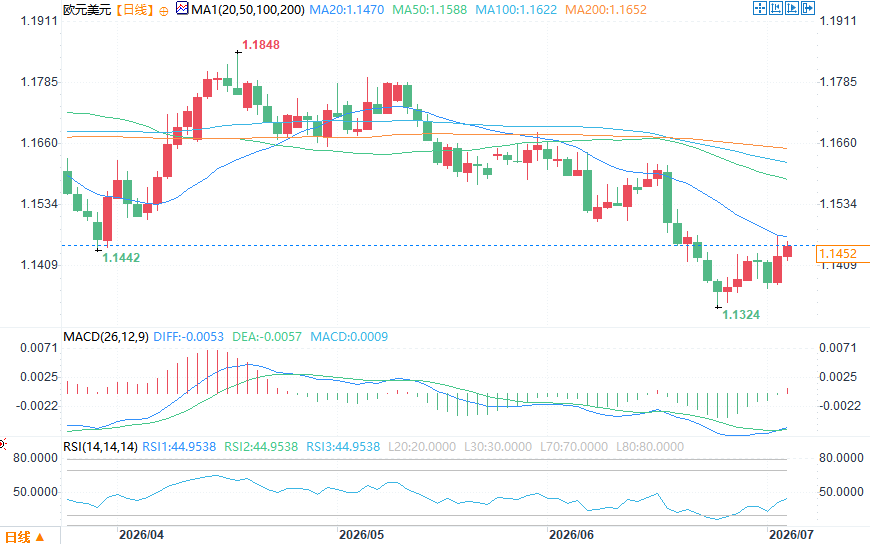
(Euro/USD daily chart, source: FX678)
At 16:12 Beijing time on July 3, the euro was trading at 1.1453/54 against the US dollar.
The latest non-farm payroll data shows that the U.S. added only about 57,000 jobs in June, far below the market expectation of 110,000, indicating a significant slowdown in the expansion of the labor market. Although the unemployment rate unexpectedly fell to 4.2%, a slight improvement from the previous value of 4.3%, the weakness in the overall employment structure is more prominent, reinforcing the market's judgment that the U.S. economic momentum is slowing down.
In addition, Bank of England (BoE) policymaker Catherine Mann recently signaled a hawkish stance in a speech, warning that "aggressive measures" may be needed to guide inflation back to the 2% target if inflation expectations and actual data deteriorate.
She particularly emphasized the importance of the data for the second half of the year, and believed that the upside risks to inflation outweighed the downside risks to economic activity. Currently, persistently sticky inflation in the UK services sector (4.5%) and high wage growth (5.1%) are putting market expectations for an interest rate cut in 2026 to the test.
This stance echoes historical experience—after a major inflationary shock, central banks tend to keep interest rates unchanged for a longer period of time.
Mann sends hawkish signals: the possibility of radical measures
In her prepared remarks for a Natixis-hosted event, Bank of England Policy Committee member Catherine Mann noted that if inflation expectations and actual results change adversely, "aggressive measures" may be needed to guide market expectations and inflation back to the 2% target. She explicitly stated that greater weight would be given to data in the second half of the year, and pointed out that at the June meeting, she judged that the upside risks to inflation outweighed the downside risks to economic activity.
Mann added that while cost-driven inflationary pressures are being offset by domestic monetary tightening, sub-labor signals suggest that some sectors are not performing as weakly as the overall unemployment rate implies. Notably, her speech received a score of 8.2/10 on FXS Speechtracker, significantly higher than the historical benchmark of 7.2/10, indicating that her policy signals are more hawkish than average.
The Bank of England is inclined to hold rates steady: sticky inflation in the services sector is key.
The market is receiving a clear signal that the Bank of England is inclined to keep interest rates unchanged for a longer period of time.
Mann's mention of "aggressive measures" suggests that a rate hike remains a real possibility if upcoming inflation data is disappointing. This means investors should remain cautious about expectations of rate cuts for the remainder of 2026.
This hawkish view is strongly supported by recent data. UK services inflation remains at 4.5%, well above the overall CPI of 2.4%. This persistent stickiness of a key domestic price indicator suggests that underlying inflationary pressures have not yet been contained.
Therefore, the Monetary Policy Committee (MPC) is expected to want to see several consecutive months of improvement before considering any easing measures.
Labor Market: Wage Growth Remains Under Tightening Pressure
The latest labor market data also support this cautious stance.
Despite a recent slight rise in the overall unemployment rate to 4.5%, wage growth remains high at 5.1%, reflecting continued labor shortages and bargaining power in key industries.
These strong wage agreements are the main driver of inflation in the services sector, which is a key focus of the Bank of England's attention.
Historical Lessons: The Experiences of the Mid-2000s
The current situation is quite similar to that of the mid-2000s, when the Bank of England kept interest rates unchanged for an extended period after experiencing price pressures in order to ensure that inflation expectations were fully anchored.
History shows that central banks tend to be cautious after a major inflationary shock. With the second half of the year approaching, the market should expect the Bank of England to demonstrate similar patience.
Implications for the foreign exchange and interest rate markets
Based on the above outlook, going long on the pound is attractive for currencies of central banks with more dovish stances. The potential for "higher and longer" UK interest rates creates a positive interest rate differential. We favor a strategy of positioning for a stronger pound through currency futures and options before the end of the third quarter.
At the same time, it is necessary to adjust positions in UK interest rate derivatives, which means reducing bets on an impending rate cut and considering positions that would benefit if rates remained near current levels.
Mann's close attention to data in the second half of the year means that volatility in the interest rate market may increase significantly in the weeks leading up to and following the release of key data.
Technical Analysis
According to the daily chart, the euro/dollar pair is dominated by a medium-term downtrend, but has seen a slight rebound in the short term. After reaching a high of 1.1848, it continued to decline, with the moving average system providing resistance: the 20-day moving average (MA20) (1.1470), 50-day moving average (MA50) (1.1588), 100-day moving average (MA100) (1.1622), and 200-day moving average (MA200) (1.1652) are all above the price, forming a multi-layered resistance zone. The previous low of 1.1324 is the key short-term support level.
In terms of indicators, the MACD lines are running below the zero axis, and the DIFF line at -0.0053 has slightly crossed the DEA line at -0.0057 to form a golden cross at a low level. A small amount of red bars have appeared, indicating that the bearish momentum has somewhat subsided, but no strong reversal signal has been formed. The RSI value is 44.95, which is in the neutral range. There is no obvious overbought or oversold condition, and the battle between bulls and bears is tending to be balanced.
(Euro/USD daily chart, source: FX678)
At 16:12 Beijing time on July 3, the euro was trading at 1.1453/54 against the US dollar.
- Risk Warning and Disclaimer
- The market involves risk, and trading may not be suitable for all investors. This article is for reference only and does not constitute personal investment advice, nor does it take into account certain users’ specific investment objectives, financial situation, or other needs. Any investment decisions made based on this information are at your own risk.