Iran imposes additional tolls on the Strait of Hormuz, causing the dollar to rebound—how much further can the pound sterling go?
2026-07-06 10:34:05
On Monday (July 6) during Asian trading hours, the pound fluctuated around 1.3340 against the dollar, failing to continue last week's strong rebound. Previously, the pound had recorded seven consecutive days of gains against the dollar.
Iran's threat to impose additional service fees on ships passing through the Strait of Hormuz has reignited geopolitical risk premiums, providing support for the safe-haven dollar and limiting the upside potential of the pound.
Meanwhile, weak US jobs data and falling oil prices have dampened expectations for a Fed rate hike this year, while while there are positive political developments in the UK, signs of a slowdown in the service sector have kept pound bulls cautious.
The market is awaiting the UK construction PMI and the US ISM services PMI for direction.
The dollar strengthened modestly in early Asian trading this week, mainly driven by renewed tensions in the Strait of Hormuz.
The Iranian ambassador to China said on Saturday that Tehran plans to introduce new service fees for ships passing through the strategic waterway. Despite the United States’ explicit rejection of the idea, the move has fueled geopolitical risk premiums and boosted safe-haven demand for the dollar.
Against this backdrop, the pound traded in a narrow range around 1.3340 against the dollar, still below the key 200-day simple moving average (1.3397).
Analysts point out that this moving average forms an important resistance level, and investors should not bet too early on whether the rebound from the year's low (around 1.3140) reached in June can be sustained before confirming whether the exchange rate can break through effectively.
The U.S. monthly jobs report released last Thursday was lackluster, indicating a softening labor market and prompting traders to reduce their bets on a Federal Reserve rate hike.
Meanwhile, the recent sharp drop in crude oil prices has eased inflation concerns, and market expectations for "longer and higher" interest rates have cooled accordingly.
As a result, the market's expectation for the number of Fed rate hikes in 2026 has been adjusted from 1 to 2 times to the current view that there may only be 0 to 1 times. This change in expectation makes it difficult for dollar bulls to make large bets, thus providing bottom support for the pound against the dollar.
Regarding the pound, Andy Burnham, a leading candidate for the next British prime minister, pledged to strictly adhere to lending rules, which provided some support to the pound.
However, pound bulls remained hesitant as last week's mixed UK composite PMI data showed a significant slowdown in service sector-led economic activity, limiting further upside potential for the pound.
Investors are currently focused on the upcoming UK construction PMI and US ISM services PMI, both of which are expected to provide new short-term direction for exchange rates during the North American trading session.
Before the data is released, the pound/dollar exchange rate will likely remain range-bound, awaiting clearer fundamental signals.
From a technical perspective, according to the daily chart, the British pound against the US dollar has recently rebounded from a low of 1.3139. The key resistance levels above are 1.3437 (0.500), 1.3539 (0.618), and the previous high of 1.3657; the support levels below are 1.3211 and the recent low of 1.3139.
The MACD indicator shows that the DIFF line (-0.0027) has crossed above the DEA line (-0.0044), and the histogram has turned red to 0.0035, forming a golden cross at a low level, releasing a short-term bullish momentum signal, indicating that the downward momentum has weakened and the rebound momentum is strengthening.
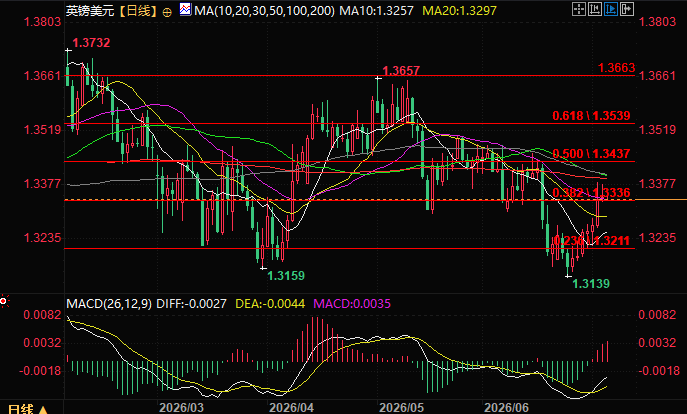
(GBP/USD daily chart, source: FX678)
At 10:33 Beijing time on July 6, the British pound was trading at 1.3340/41 against the US dollar.
Iran's threat to impose additional service fees on ships passing through the Strait of Hormuz has reignited geopolitical risk premiums, providing support for the safe-haven dollar and limiting the upside potential of the pound.
Meanwhile, weak US jobs data and falling oil prices have dampened expectations for a Fed rate hike this year, while while there are positive political developments in the UK, signs of a slowdown in the service sector have kept pound bulls cautious.
The market is awaiting the UK construction PMI and the US ISM services PMI for direction.
Geopolitical risks boosted the dollar, while the pound was capped by key moving averages.
The dollar strengthened modestly in early Asian trading this week, mainly driven by renewed tensions in the Strait of Hormuz.
The Iranian ambassador to China said on Saturday that Tehran plans to introduce new service fees for ships passing through the strategic waterway. Despite the United States’ explicit rejection of the idea, the move has fueled geopolitical risk premiums and boosted safe-haven demand for the dollar.
Against this backdrop, the pound traded in a narrow range around 1.3340 against the dollar, still below the key 200-day simple moving average (1.3397).
Analysts point out that this moving average forms an important resistance level, and investors should not bet too early on whether the rebound from the year's low (around 1.3140) reached in June can be sustained before confirming whether the exchange rate can break through effectively.
Declining US data and oil prices weaken bets on a Federal Reserve rate hike.
The U.S. monthly jobs report released last Thursday was lackluster, indicating a softening labor market and prompting traders to reduce their bets on a Federal Reserve rate hike.
Meanwhile, the recent sharp drop in crude oil prices has eased inflation concerns, and market expectations for "longer and higher" interest rates have cooled accordingly.
As a result, the market's expectation for the number of Fed rate hikes in 2026 has been adjusted from 1 to 2 times to the current view that there may only be 0 to 1 times. This change in expectation makes it difficult for dollar bulls to make large bets, thus providing bottom support for the pound against the dollar.
The pound's upside is limited by a mix of political advantages and concerns about the service sector in the UK.
Regarding the pound, Andy Burnham, a leading candidate for the next British prime minister, pledged to strictly adhere to lending rules, which provided some support to the pound.
However, pound bulls remained hesitant as last week's mixed UK composite PMI data showed a significant slowdown in service sector-led economic activity, limiting further upside potential for the pound.
Key data releases are pending this week; the market awaits new catalysts.
Investors are currently focused on the upcoming UK construction PMI and US ISM services PMI, both of which are expected to provide new short-term direction for exchange rates during the North American trading session.
Before the data is released, the pound/dollar exchange rate will likely remain range-bound, awaiting clearer fundamental signals.
From a technical perspective, according to the daily chart, the British pound against the US dollar has recently rebounded from a low of 1.3139. The key resistance levels above are 1.3437 (0.500), 1.3539 (0.618), and the previous high of 1.3657; the support levels below are 1.3211 and the recent low of 1.3139.
The MACD indicator shows that the DIFF line (-0.0027) has crossed above the DEA line (-0.0044), and the histogram has turned red to 0.0035, forming a golden cross at a low level, releasing a short-term bullish momentum signal, indicating that the downward momentum has weakened and the rebound momentum is strengthening.
(GBP/USD daily chart, source: FX678)
At 10:33 Beijing time on July 6, the British pound was trading at 1.3340/41 against the US dollar.
- Risk Warning and Disclaimer
- The market involves risk, and trading may not be suitable for all investors. This article is for reference only and does not constitute personal investment advice, nor does it take into account certain users’ specific investment objectives, financial situation, or other needs. Any investment decisions made based on this information are at your own risk.