Why is the US dollar still rising against the Japanese yen despite the collapse in US employment and the decline in expectations for interest rate hikes?
2026-07-06 10:53:59
On Monday (July 6) during the Asian session, the US dollar continued its upward trend against the Japanese yen to around 161.80, and is on track to rise for the second consecutive day.
Despite the yield on Japanese 10-year government bonds rising to a 30-year high of 2.79%, the yen continued to weaken under pressure from high import costs. The US dollar, meanwhile, remained strong due to market expectations of multiple interest rate hikes by the Federal Reserve this year.
The deep divergence between the Bank of Japan and the market has traders on high alert that Tokyo may intervene verbally at any time.
Meanwhile, U.S. employment data fell far short of expectations, but market bets on interest rate hikes have not completely subsided, and investors are awaiting clearer clues from the Fed's June meeting minutes.

Despite the yield on Japan's 10-year government bonds hitting a 30-year high of 2.79% on Monday, the yen failed to gain a boost and continued to weaken under the pressure of high import costs.
This seemingly contradictory phenomenon reveals the deep-seated doubts in the market about the credibility of the Bank of Japan's policies. Even with rising domestic interest rates, Japan's structural disadvantage as a resource importer continues to put pressure on the yen. Traders generally believe that the Bank of Japan will find it difficult to reverse the yen's decline in the short term by raising interest rates, as excessively tightening monetary policy could impact the fragile economic recovery.
The rise in the USD/JPY exchange rate is mainly due to the overall strength of the US dollar.
The market is still pricing in multiple interest rate hikes by the Federal Reserve this year, with the CME FedWatch tool showing a 77.3% probability of a rate hike before the end of the year. Even though recent global inflation concerns have eased somewhat due to the gradual normalization of oil shipments through the Strait of Hormuz, the US dollar remains strong.
However, the US non-farm payrolls report released last Thursday showed an increase of only 57,000 jobs in June, far below the expected 110,000, which eased Wall Street's expectations for aggressive interest rate hikes by the Federal Reserve. Although the unemployment rate unexpectedly fell from 4.3% to 4.2%, the sharp slowdown in hiring strongly suggests that the overall economy is cooling down.
This data has led the market to adjust its expectations for the number of interest rate hikes this year from 1-2 to possibly only 0-1, limiting further upside potential for the US dollar.
Federal Reserve Chairman Kevin Warsh last week reiterated the central bank’s independent commitment to the 2% inflation target and made the rare admission that inflation risks and expectations have finally begun to ease over the past month.
This statement contrasts subtly with the Fed's previous stance emphasizing persistent inflation, further complicating investors' expectations regarding the policy path.
The market's focus has now shifted to the release of the minutes from the Federal Reserve's June policy meeting on Wednesday. Investors are looking for detailed discussions among policymakers on the slowdown in employment, cooling inflation, and the pace of future interest rate hikes in order to determine the policy direction for the year.
As the USD/JPY exchange rate approaches the 162 mark, market vigilance has increased significantly regarding potential verbal intervention or even direct market intervention by the Japanese Ministry of Finance and the Bank of Japan.
Japanese officials have previously stated on multiple occasions that they are closely monitoring exchange rate fluctuations and have emphasized their readiness to take "decisive action" if necessary.
Analysts point out that although Japanese authorities prefer verbal warnings to actual intervention, the threshold for substantive intervention is lowering given the continued deviation of the exchange rate from fundamentals and the erosion of household and business purchasing power by import costs.
According to the daily chart, the USD/JPY pair is in a long-term upward channel, with the price steadily rising based on multiple moving averages. Recently, it surged to a high of 162.83 before experiencing a slight pullback.
The moving average system is in a typical bullish alignment, with the price consistently trading above the 10-day, 20-day, 30-day, 50-day, 100-day, and 200-day moving averages, indicating a complete medium-term uptrend structure. Key support lies near the previous support level of 156.91 and the 20-day moving average (161.23), while resistance is at the historical high of 162.83. A break above this level could open up further upside potential.
The MACD indicator shows that the DIFF line (0.593) has crossed below the DEA line (0.653), and the histogram has turned green, forming a death cross, indicating that the short-term upward momentum is weakening and there is a need for a pullback.
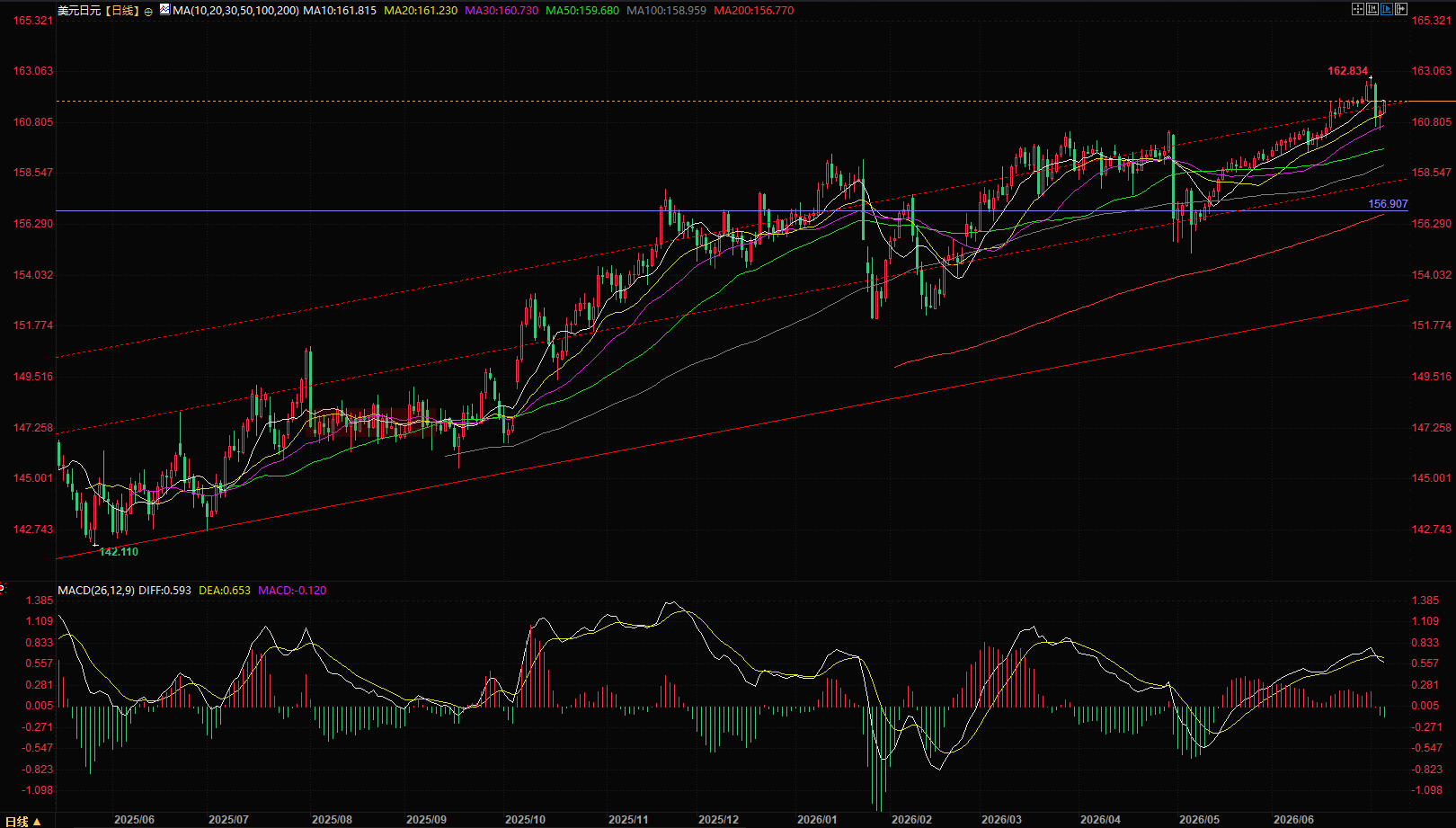
(USD/JPY daily chart, source: FX678)
At 10:53 Beijing time on July 6, the USD/JPY exchange rate was 101.76/77.
Despite the yield on Japanese 10-year government bonds rising to a 30-year high of 2.79%, the yen continued to weaken under pressure from high import costs. The US dollar, meanwhile, remained strong due to market expectations of multiple interest rate hikes by the Federal Reserve this year.
The deep divergence between the Bank of Japan and the market has traders on high alert that Tokyo may intervene verbally at any time.
Meanwhile, U.S. employment data fell far short of expectations, but market bets on interest rate hikes have not completely subsided, and investors are awaiting clearer clues from the Fed's June meeting minutes.
Japanese bond yields hit record highs, keeping the yen under pressure.
Despite the yield on Japan's 10-year government bonds hitting a 30-year high of 2.79% on Monday, the yen failed to gain a boost and continued to weaken under the pressure of high import costs.
This seemingly contradictory phenomenon reveals the deep-seated doubts in the market about the credibility of the Bank of Japan's policies. Even with rising domestic interest rates, Japan's structural disadvantage as a resource importer continues to put pressure on the yen. Traders generally believe that the Bank of Japan will find it difficult to reverse the yen's decline in the short term by raising interest rates, as excessively tightening monetary policy could impact the fragile economic recovery.
Expectations of a Fed rate hike supported the dollar, while falling oil prices eased inflation concerns.
The rise in the USD/JPY exchange rate is mainly due to the overall strength of the US dollar.
The market is still pricing in multiple interest rate hikes by the Federal Reserve this year, with the CME FedWatch tool showing a 77.3% probability of a rate hike before the end of the year. Even though recent global inflation concerns have eased somewhat due to the gradual normalization of oil shipments through the Strait of Hormuz, the US dollar remains strong.
However, the US non-farm payrolls report released last Thursday showed an increase of only 57,000 jobs in June, far below the expected 110,000, which eased Wall Street's expectations for aggressive interest rate hikes by the Federal Reserve. Although the unemployment rate unexpectedly fell from 4.3% to 4.2%, the sharp slowdown in hiring strongly suggests that the overall economy is cooling down.
This data has led the market to adjust its expectations for the number of interest rate hikes this year from 1-2 to possibly only 0-1, limiting further upside potential for the US dollar.
Federal Reserve Chairman reiterated inflation target; markets await guidance from meeting minutes.
Federal Reserve Chairman Kevin Warsh last week reiterated the central bank’s independent commitment to the 2% inflation target and made the rare admission that inflation risks and expectations have finally begun to ease over the past month.
This statement contrasts subtly with the Fed's previous stance emphasizing persistent inflation, further complicating investors' expectations regarding the policy path.
The market's focus has now shifted to the release of the minutes from the Federal Reserve's June policy meeting on Wednesday. Investors are looking for detailed discussions among policymakers on the slowdown in employment, cooling inflation, and the pace of future interest rate hikes in order to determine the policy direction for the year.
Intervention risks are ever-present, and the market is highly vigilant about the actions of the Japanese authorities.
As the USD/JPY exchange rate approaches the 162 mark, market vigilance has increased significantly regarding potential verbal intervention or even direct market intervention by the Japanese Ministry of Finance and the Bank of Japan.
Japanese officials have previously stated on multiple occasions that they are closely monitoring exchange rate fluctuations and have emphasized their readiness to take "decisive action" if necessary.
Analysts point out that although Japanese authorities prefer verbal warnings to actual intervention, the threshold for substantive intervention is lowering given the continued deviation of the exchange rate from fundamentals and the erosion of household and business purchasing power by import costs.
Technical Analysis
According to the daily chart, the USD/JPY pair is in a long-term upward channel, with the price steadily rising based on multiple moving averages. Recently, it surged to a high of 162.83 before experiencing a slight pullback.
The moving average system is in a typical bullish alignment, with the price consistently trading above the 10-day, 20-day, 30-day, 50-day, 100-day, and 200-day moving averages, indicating a complete medium-term uptrend structure. Key support lies near the previous support level of 156.91 and the 20-day moving average (161.23), while resistance is at the historical high of 162.83. A break above this level could open up further upside potential.
The MACD indicator shows that the DIFF line (0.593) has crossed below the DEA line (0.653), and the histogram has turned green, forming a death cross, indicating that the short-term upward momentum is weakening and there is a need for a pullback.
(USD/JPY daily chart, source: FX678)
At 10:53 Beijing time on July 6, the USD/JPY exchange rate was 101.76/77.
- Risk Warning and Disclaimer
- The market involves risk, and trading may not be suitable for all investors. This article is for reference only and does not constitute personal investment advice, nor does it take into account certain users’ specific investment objectives, financial situation, or other needs. Any investment decisions made based on this information are at your own risk.