On one hand, Iran is charging tolls to support the dollar, while on the other hand, central banks are frantically hoarding gold—what will happen to gold in the future?
2026-07-06 14:13:45
On Monday (July 6) during Asian trading hours, gold prices briefly surged above $4,200 per ounce, hitting a two-week high, before encountering renewed selling pressure and appearing to have ended a three-day winning streak.
The US dollar attracted some safe-haven funds due to tensions in the Strait of Hormuz, becoming a major factor suppressing gold prices.
However, the cooling of expectations for a Fed rate hike limited the willingness of dollar bulls to bet, while continued demand for gold from global central banks provided solid support for this non-interest-bearing asset, making the downside for gold prices relatively limited.
Despite the fragile nature of the interim US-Iran agreement, tensions remain high around the Strait of Hormuz as Iran seeks to strengthen its control over this strategic waterway. Iran's ambassador to China stated last Saturday that Tehran plans to impose new service fees on vessels transiting the strategic waterway.
The United States has explicitly rejected Iran's idea of charging passing ships.
This standoff has perpetuated geopolitical risk premiums and helped the dollar regain positive traction at the start of the new week, thus putting downward pressure on gold.
Meanwhile, the lackluster U.S. monthly jobs data released last Thursday pointed to a softening labor market, prompting traders to reduce their bets on further rate hikes by the Federal Reserve.
In addition, the recent sharp drop in oil prices has eased inflation concerns, which may allow the Federal Reserve to adopt a more patient policy stance, thereby weakening market expectations that interest rates will remain high for an extended period.
This slight adjustment in the interest rate outlook limited aggressive bets by dollar bulls and also constrained any meaningful pullback in gold prices.
A survey conducted by the World Gold Council last week showed that central banks are increasingly viewing gold as a tool to hedge against financial crises, inflation, and geopolitical risks, with nearly 90% of respondents expecting global central bank gold reserves to increase in the coming year.
Meanwhile, the European Central Bank's latest reserve report shows that gold has officially surpassed US Treasury bonds to occupy a higher position in global reserve allocations. Furthermore, China added another 320,000 ounces of gold in May, marking its 19th consecutive month of increasing its gold reserves.
Traders are currently focused on upcoming U.S. economic data, including the ISM Services Purchasing Managers' Index.
In addition, influential Federal Open Market Committee members will speak during the North American trading session, which will provide new impetus for dollar demand and offer new trading guidance for precious metals.
Overall, the aforementioned fundamental background suggests that the path of least resistance for gold remains upward.
Therefore, intraday pullbacks are likely to be seen as buying opportunities with limited downside. Investors should remain cautious until it is confirmed that the recent rebound from the year's lows has lost momentum.
The World Gold Council’s “Gold Medium-Term Outlook 2026” report, released on July 1, points out that although gold prices will experience a significant correction in the first half of 2026 (falling from a high of $5,405 in January to around $4,100 at the end of June), the medium- to long-term fundamentals remain strong.
The association predicts that if the macroeconomic environment remains stable, gold prices may fluctuate within a range of around $4,100 per ounce ± 5% in the second half of 2026; if the economy deteriorates, geopolitical shocks intensify, or interest rate expectations shift to easing, prices are expected to return to $4,500 per ounce or even higher.
The report emphasizes that continued gold purchases by central banks, the potential for ETF fund inflows, and safe-haven demand are the main supporting factors.
Goldman Sachs lowered its year-end 2026 gold price target to $4,900 per ounce at the end of June 2026 (from $5,400 previously), mainly due to rising expectations of a Fed rate hike leading to slower ETF outflows and cooling investor interest.
Despite the downward revision, Goldman Sachs maintains a constructive outlook on gold, believing that central bank purchases and long-term safe-haven demand will continue to provide support.
Goldman Sachs points out that the current price pullback reflects more short-term macroeconomic factors than a fundamental reversal, and advises investors to view the pullback as a buying opportunity.
From the 4-hour chart, gold previously surged to a high of 4382.04 before undergoing a deep pullback, reaching a low of 3943.65. It then stabilized and rebounded strongly, currently trading around 4150. In terms of moving averages, the short-term MA20 and MA50 (4094.32, 4056.05) are below the current price, forming a near-term support level. The MA100 and MA200 are at 4146.68 and 4294.4 respectively. The price has just slightly broken above the MA100. The first resistance level is at the recent rebound high of 4202.09, while higher-level resistance is concentrated at the MA200 around 4294. The medium- and long-term moving averages are still trending downwards, indicating that the major downtrend has not yet completely reversed. The current movement is a corrective rebound after a significant drop.
The MACD parameter DIFF is 35.60, which is higher than DEA 26.63. The MACD histogram remains positive, indicating that the bullish momentum continues to be released and there is sufficient momentum for medium-term recovery. The RSI is 59.01, which is in the neutral range of 30-70 and has not touched the overbought line of 70. The short-term upward trend is healthy, and there is no obvious pressure for overheating and pullback.
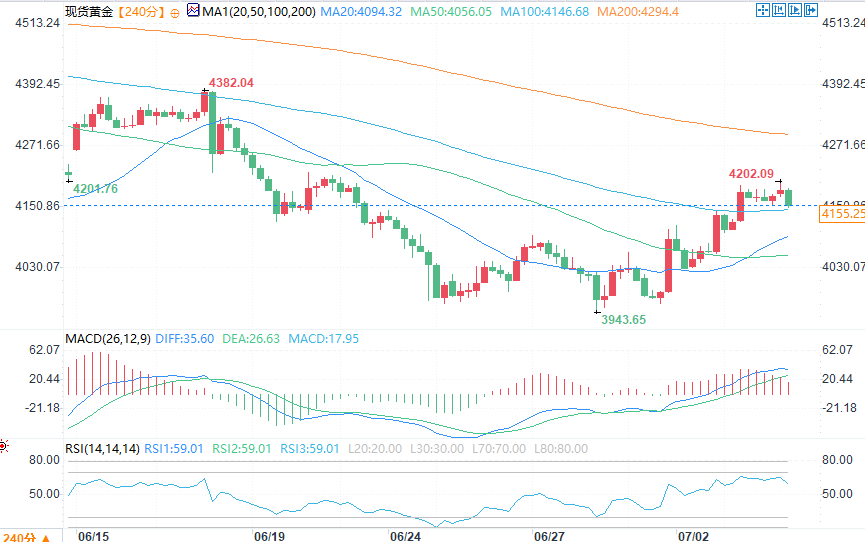
(4-hour chart of spot gold, source: FX678)
At 14:13 Beijing time on July 6, spot gold was trading at $4156.54 per ounce.
The US dollar attracted some safe-haven funds due to tensions in the Strait of Hormuz, becoming a major factor suppressing gold prices.
However, the cooling of expectations for a Fed rate hike limited the willingness of dollar bulls to bet, while continued demand for gold from global central banks provided solid support for this non-interest-bearing asset, making the downside for gold prices relatively limited.
Hormuz risk reignites; Iran plans to impose tolls.
Despite the fragile nature of the interim US-Iran agreement, tensions remain high around the Strait of Hormuz as Iran seeks to strengthen its control over this strategic waterway. Iran's ambassador to China stated last Saturday that Tehran plans to impose new service fees on vessels transiting the strategic waterway.
The United States has explicitly rejected Iran's idea of charging passing ships.
This standoff has perpetuated geopolitical risk premiums and helped the dollar regain positive traction at the start of the new week, thus putting downward pressure on gold.
Weak nonfarm payroll data dampened expectations of interest rate hikes and eased inflation concerns.
Meanwhile, the lackluster U.S. monthly jobs data released last Thursday pointed to a softening labor market, prompting traders to reduce their bets on further rate hikes by the Federal Reserve.
In addition, the recent sharp drop in oil prices has eased inflation concerns, which may allow the Federal Reserve to adopt a more patient policy stance, thereby weakening market expectations that interest rates will remain high for an extended period.
This slight adjustment in the interest rate outlook limited aggressive bets by dollar bulls and also constrained any meaningful pullback in gold prices.
Central bank gold purchases continue, and gold's status as a reserve asset rises.
A survey conducted by the World Gold Council last week showed that central banks are increasingly viewing gold as a tool to hedge against financial crises, inflation, and geopolitical risks, with nearly 90% of respondents expecting global central bank gold reserves to increase in the coming year.
Meanwhile, the European Central Bank's latest reserve report shows that gold has officially surpassed US Treasury bonds to occupy a higher position in global reserve allocations. Furthermore, China added another 320,000 ounces of gold in May, marking its 19th consecutive month of increasing its gold reserves.
Focus on US economic data and speeches by Federal Reserve officials
Traders are currently focused on upcoming U.S. economic data, including the ISM Services Purchasing Managers' Index.
In addition, influential Federal Open Market Committee members will speak during the North American trading session, which will provide new impetus for dollar demand and offer new trading guidance for precious metals.
Overall, the aforementioned fundamental background suggests that the path of least resistance for gold remains upward.
Therefore, intraday pullbacks are likely to be seen as buying opportunities with limited downside. Investors should remain cautious until it is confirmed that the recent rebound from the year's lows has lost momentum.
Institutional Views
The World Gold Council’s “Gold Medium-Term Outlook 2026” report, released on July 1, points out that although gold prices will experience a significant correction in the first half of 2026 (falling from a high of $5,405 in January to around $4,100 at the end of June), the medium- to long-term fundamentals remain strong.
The association predicts that if the macroeconomic environment remains stable, gold prices may fluctuate within a range of around $4,100 per ounce ± 5% in the second half of 2026; if the economy deteriorates, geopolitical shocks intensify, or interest rate expectations shift to easing, prices are expected to return to $4,500 per ounce or even higher.
The report emphasizes that continued gold purchases by central banks, the potential for ETF fund inflows, and safe-haven demand are the main supporting factors.
Goldman Sachs lowered its year-end 2026 gold price target to $4,900 per ounce at the end of June 2026 (from $5,400 previously), mainly due to rising expectations of a Fed rate hike leading to slower ETF outflows and cooling investor interest.
Despite the downward revision, Goldman Sachs maintains a constructive outlook on gold, believing that central bank purchases and long-term safe-haven demand will continue to provide support.
Goldman Sachs points out that the current price pullback reflects more short-term macroeconomic factors than a fundamental reversal, and advises investors to view the pullback as a buying opportunity.
Technical Analysis
From the 4-hour chart, gold previously surged to a high of 4382.04 before undergoing a deep pullback, reaching a low of 3943.65. It then stabilized and rebounded strongly, currently trading around 4150. In terms of moving averages, the short-term MA20 and MA50 (4094.32, 4056.05) are below the current price, forming a near-term support level. The MA100 and MA200 are at 4146.68 and 4294.4 respectively. The price has just slightly broken above the MA100. The first resistance level is at the recent rebound high of 4202.09, while higher-level resistance is concentrated at the MA200 around 4294. The medium- and long-term moving averages are still trending downwards, indicating that the major downtrend has not yet completely reversed. The current movement is a corrective rebound after a significant drop.
The MACD parameter DIFF is 35.60, which is higher than DEA 26.63. The MACD histogram remains positive, indicating that the bullish momentum continues to be released and there is sufficient momentum for medium-term recovery. The RSI is 59.01, which is in the neutral range of 30-70 and has not touched the overbought line of 70. The short-term upward trend is healthy, and there is no obvious pressure for overheating and pullback.
(4-hour chart of spot gold, source: FX678)
At 14:13 Beijing time on July 6, spot gold was trading at $4156.54 per ounce.
- Risk Warning and Disclaimer
- The market involves risk, and trading may not be suitable for all investors. This article is for reference only and does not constitute personal investment advice, nor does it take into account certain users’ specific investment objectives, financial situation, or other needs. Any investment decisions made based on this information are at your own risk.