With global policy narratives diverging and the Federal Reserve entering a wait-and-see phase, gold prices have remained volatile at high levels amid a struggle between safe-haven demand and interest rate expectations.
2026-07-06 14:17:13
Jeff, senior macro strategist at BNY Mellon, pointed out that softening U.S. labor market data and continued improvement in inflation have significantly reduced the urgency for the Federal Reserve to further tighten its policies. However, he also emphasized that the market has not yet clearly resolved two key questions: whether the slowdown in U.S. economic growth remains within a manageable range, and whether current market expectations for a more accommodative policy path have been over-priced in.

He further stated that the global macroeconomic narrative is becoming increasingly divergent. In the United States, the focus of policy discussions is shifting from "curbing inflation" to "maintaining policy patience amid slowing growth," while in Europe, the policy focus is shifting from emergency inflation responses to more complex structural issues such as economic growth, fiscal sustainability, and defense financing. This divergence is undermining the unified logic of global asset pricing.
This change has had a significant impact on the gold market. On the one hand, the slowdown in the US economy reinforces the market's judgment that the interest rate cycle is nearing its end, reducing the holding cost of gold, a non-interest-bearing asset, and thus providing medium-term support. On the other hand, the divergence in global policy paths has exacerbated uncertainty, making gold's safe-haven attributes continue to attract capital attention.
In the current environment, gold benefits from two major supporting factors: firstly, the cooling of expectations for Fed rate hikes limits the upside potential of real interest rates; secondly, the rebound in risk premiums due to the divergence in global economic narratives. Especially against the backdrop of slowing US growth and fiscal constraints in Europe, the demand for gold as a cross-cycle hedging asset has strengthened.
However, the US dollar still possesses some resilience in the short term, thus limiting the upward momentum of gold. The US dollar index has rebounded in stages, supported by safe-haven demand and interest rate expectations, putting downward pressure on gold prices. Therefore, gold as a whole exhibits a structural characteristic of "high-level consolidation rather than a one-sided breakout."
Overall, gold is currently in a phase of mixed macroeconomic drivers: cooling interest rate expectations are providing support, while the temporary safe-haven demand for the US dollar is putting downward pressure on the market, leaving it in a state of directional waiting.
From a daily chart perspective, gold is still maintaining its overall rebound structure, with prices entering a consolidation phase at higher levels after a rapid rise in the previous period. The moving average system remains in a bullish alignment, but short-term momentum has clearly slowed, indicating that the upward trend is entering a digestion phase rather than a reversal phase.
From a 4-hour chart perspective, gold entered a sideways consolidation phase after breaking out of its previous trading range, with prices fluctuating repeatedly within the high range, indicating increasing divergence between bulls and bears. The MACD histogram is gradually converging, indicating weakening upward momentum but still remaining in positive territory; the RSI is hovering around 60, suggesting that the market is still in a relatively strong zone but has not entered an extremely overbought state.
Short-term key support is concentrated around $4200; a break below this level could trigger a technical pullback to the $4120-$4080 range. Resistance is seen around $4300; a decisive break and hold above this level could reopen upward potential, targeting higher levels. Overall, gold's technical structure remains in a high-level consolidation phase within an uptrend, with the market awaiting new macroeconomic catalysts to determine its next direction.
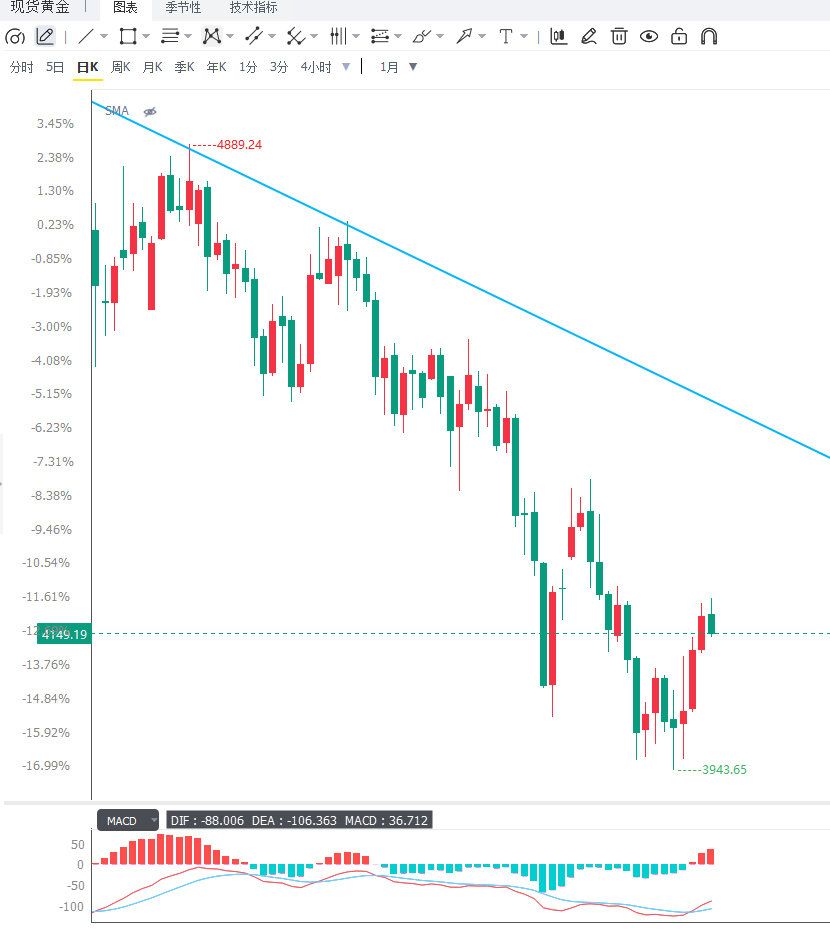
Editor's Summary : The current gold price movement is essentially a direct reflection of the divergence in global macroeconomic narratives. A slowing US economy is cooling interest rate expectations, providing medium-term support for gold, while the divergence in global growth paths and policy uncertainty are strengthening safe-haven demand. In the short term, gold is more likely to maintain a high-level consolidation structure, fluctuating between a period of dollar strength and declining interest rate expectations. In the medium term, if the Federal Reserve enters a clearer wait-and-see period while global growth pressures persist, gold still has room for further upside; however, if the dollar continues to strengthen due to safe-haven demand, gold prices may maintain a range-bound consolidation pattern. The overall market is currently in a phase of high-level repricing and trend digestion.
He further stated that the global macroeconomic narrative is becoming increasingly divergent. In the United States, the focus of policy discussions is shifting from "curbing inflation" to "maintaining policy patience amid slowing growth," while in Europe, the policy focus is shifting from emergency inflation responses to more complex structural issues such as economic growth, fiscal sustainability, and defense financing. This divergence is undermining the unified logic of global asset pricing.
This change has had a significant impact on the gold market. On the one hand, the slowdown in the US economy reinforces the market's judgment that the interest rate cycle is nearing its end, reducing the holding cost of gold, a non-interest-bearing asset, and thus providing medium-term support. On the other hand, the divergence in global policy paths has exacerbated uncertainty, making gold's safe-haven attributes continue to attract capital attention.
In the current environment, gold benefits from two major supporting factors: firstly, the cooling of expectations for Fed rate hikes limits the upside potential of real interest rates; secondly, the rebound in risk premiums due to the divergence in global economic narratives. Especially against the backdrop of slowing US growth and fiscal constraints in Europe, the demand for gold as a cross-cycle hedging asset has strengthened.
However, the US dollar still possesses some resilience in the short term, thus limiting the upward momentum of gold. The US dollar index has rebounded in stages, supported by safe-haven demand and interest rate expectations, putting downward pressure on gold prices. Therefore, gold as a whole exhibits a structural characteristic of "high-level consolidation rather than a one-sided breakout."
Overall, gold is currently in a phase of mixed macroeconomic drivers: cooling interest rate expectations are providing support, while the temporary safe-haven demand for the US dollar is putting downward pressure on the market, leaving it in a state of directional waiting.
From a daily chart perspective, gold is still maintaining its overall rebound structure, with prices entering a consolidation phase at higher levels after a rapid rise in the previous period. The moving average system remains in a bullish alignment, but short-term momentum has clearly slowed, indicating that the upward trend is entering a digestion phase rather than a reversal phase.
From a 4-hour chart perspective, gold entered a sideways consolidation phase after breaking out of its previous trading range, with prices fluctuating repeatedly within the high range, indicating increasing divergence between bulls and bears. The MACD histogram is gradually converging, indicating weakening upward momentum but still remaining in positive territory; the RSI is hovering around 60, suggesting that the market is still in a relatively strong zone but has not entered an extremely overbought state.
Short-term key support is concentrated around $4200; a break below this level could trigger a technical pullback to the $4120-$4080 range. Resistance is seen around $4300; a decisive break and hold above this level could reopen upward potential, targeting higher levels. Overall, gold's technical structure remains in a high-level consolidation phase within an uptrend, with the market awaiting new macroeconomic catalysts to determine its next direction.
Editor's Summary : The current gold price movement is essentially a direct reflection of the divergence in global macroeconomic narratives. A slowing US economy is cooling interest rate expectations, providing medium-term support for gold, while the divergence in global growth paths and policy uncertainty are strengthening safe-haven demand. In the short term, gold is more likely to maintain a high-level consolidation structure, fluctuating between a period of dollar strength and declining interest rate expectations. In the medium term, if the Federal Reserve enters a clearer wait-and-see period while global growth pressures persist, gold still has room for further upside; however, if the dollar continues to strengthen due to safe-haven demand, gold prices may maintain a range-bound consolidation pattern. The overall market is currently in a phase of high-level repricing and trend digestion.
- Risk Warning and Disclaimer
- The market involves risk, and trading may not be suitable for all investors. This article is for reference only and does not constitute personal investment advice, nor does it take into account certain users’ specific investment objectives, financial situation, or other needs. Any investment decisions made based on this information are at your own risk.