A stronger-than-expected rebound in German factory orders, coupled with a slight strengthening of the US dollar, put downward pressure on the EUR/USD exchange rate.
2026-07-06 14:47:35
Newly released German factory orders data showed a 1.9% month-on-month increase in May, significantly higher than the market expectation of 1.2%, indicating a certain degree of recovery in demand in the manufacturing sector. Meanwhile, the April figure was revised upward from -3.8% to -3.2%, reflecting a slight easing of previous downward pressure. Year-on-year, factory orders grew by 6.2% , a significant acceleration from the previous 2.1%, and the previous figure was also revised upward, indicating a clear overall improvement trend.

This data alleviated market concerns about the continued contraction of European manufacturing to some extent, theoretically providing support for the euro. However, judging from the exchange rate reaction, EUR/USD did not continue its upward momentum, but instead fell slightly to around 1.1425 after the data release, indicating that the market's focus remains more on the dollar's performance than on the improvement in European data alone.
Regarding the US dollar, a slight strengthening became the main factor suppressing the euro. Although the momentum of US economic growth has slowed marginally, market expectations that the Federal Reserve will maintain a tight monetary policy remain, allowing the dollar to remain resilient in the short term. Without a clear new catalyst negatively impacting the dollar, the upside potential of EUR/USD is significantly limited.
Overall, the German data this time falls into the category of "marginal improvement but insufficient to change the trend," and the market remains cautious about the sustainability of the European economic recovery. The uneven growth structure within the Eurozone makes it difficult for the euro to form an independent upward trend.
The short-term market focus remains on US economic data and the trajectory of interest rate expectations. If the US ISM services data continues its slowdown, the US dollar may experience a temporary pullback, thus providing support for the euro; conversely, if the data remains resilient, EUR/USD may continue its low-volatility, range-bound trading pattern.
From a daily chart perspective, EUR/USD is generally trading within a consolidation range above 1.1300. While there have been some rebounds, the price has not yet broken through the key resistance area of 1.1450, indicating that selling pressure remains. The moving average system is flat, and the trend direction is not yet fully clear.
From a 4-hour chart perspective, the exchange rate has formed a short-term consolidation platform around 1.1400, with narrowing fluctuations, indicating that the market has entered a wait-and-see phase. The MACD indicator is repeatedly entangled around the zero line, indicating insufficient momentum; the RSI remains in the neutral range, without showing a clear trend signal.
The upside resistance level to watch is the 1.1450–1.1480 area; a decisive break above this level could open up further upside potential. Support lies around 1.1350; a breach of this level could lead to a retest of the 1.1300 psychological level. Overall, EUR/USD remains in a low-volatility consolidation phase, awaiting macroeconomic data to determine its direction.
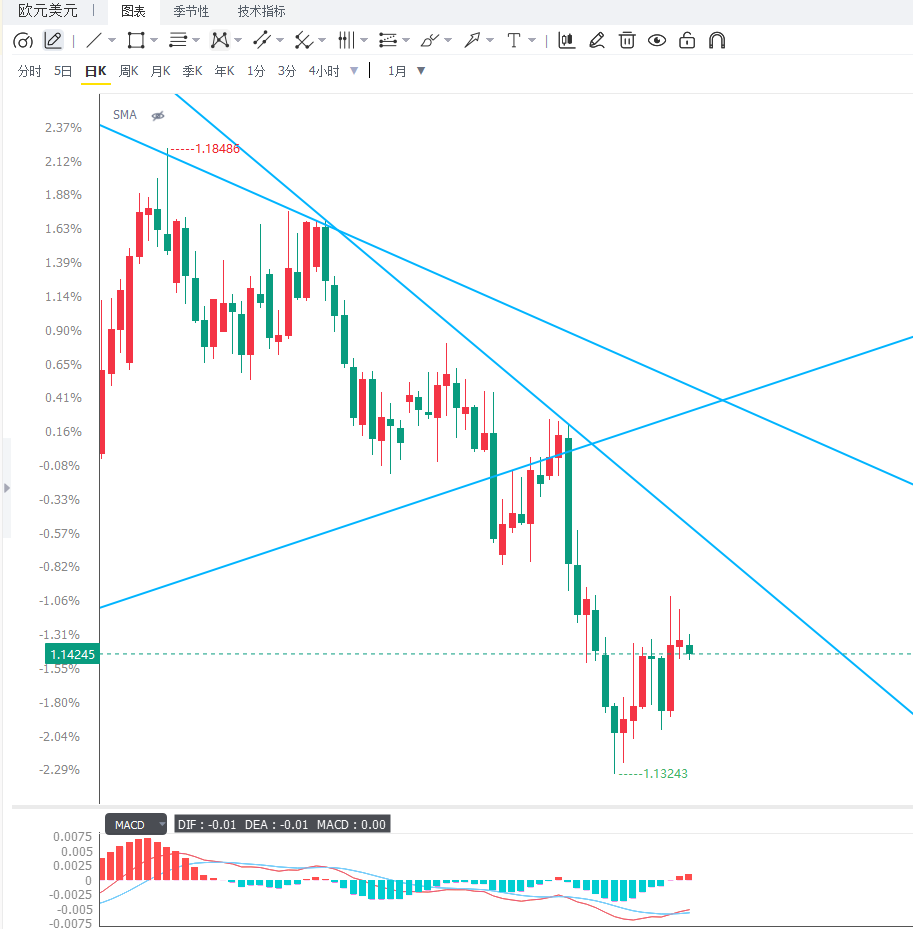
Editor's Summary : The better-than-expected rebound in German factory orders improved European manufacturing expectations to some extent, but its boost to the euro was limited. This is because the US dollar remains relatively resilient in the short term, and the market is more focused on the US macroeconomic and interest rate path. In the short term, EUR/USD will likely maintain its 1.13-1.15 range-bound structure, lacking momentum for a trend breakout. In the medium term, if European economic data continues to improve and the US economy further slows, the euro may see a period of rebound; however, if the US dollar maintains its interest rate support advantage, the exchange rate will remain in a range-bound trading pattern.
This data alleviated market concerns about the continued contraction of European manufacturing to some extent, theoretically providing support for the euro. However, judging from the exchange rate reaction, EUR/USD did not continue its upward momentum, but instead fell slightly to around 1.1425 after the data release, indicating that the market's focus remains more on the dollar's performance than on the improvement in European data alone.
Regarding the US dollar, a slight strengthening became the main factor suppressing the euro. Although the momentum of US economic growth has slowed marginally, market expectations that the Federal Reserve will maintain a tight monetary policy remain, allowing the dollar to remain resilient in the short term. Without a clear new catalyst negatively impacting the dollar, the upside potential of EUR/USD is significantly limited.
Overall, the German data this time falls into the category of "marginal improvement but insufficient to change the trend," and the market remains cautious about the sustainability of the European economic recovery. The uneven growth structure within the Eurozone makes it difficult for the euro to form an independent upward trend.
The short-term market focus remains on US economic data and the trajectory of interest rate expectations. If the US ISM services data continues its slowdown, the US dollar may experience a temporary pullback, thus providing support for the euro; conversely, if the data remains resilient, EUR/USD may continue its low-volatility, range-bound trading pattern.
From a daily chart perspective, EUR/USD is generally trading within a consolidation range above 1.1300. While there have been some rebounds, the price has not yet broken through the key resistance area of 1.1450, indicating that selling pressure remains. The moving average system is flat, and the trend direction is not yet fully clear.
From a 4-hour chart perspective, the exchange rate has formed a short-term consolidation platform around 1.1400, with narrowing fluctuations, indicating that the market has entered a wait-and-see phase. The MACD indicator is repeatedly entangled around the zero line, indicating insufficient momentum; the RSI remains in the neutral range, without showing a clear trend signal.
The upside resistance level to watch is the 1.1450–1.1480 area; a decisive break above this level could open up further upside potential. Support lies around 1.1350; a breach of this level could lead to a retest of the 1.1300 psychological level. Overall, EUR/USD remains in a low-volatility consolidation phase, awaiting macroeconomic data to determine its direction.
Editor's Summary : The better-than-expected rebound in German factory orders improved European manufacturing expectations to some extent, but its boost to the euro was limited. This is because the US dollar remains relatively resilient in the short term, and the market is more focused on the US macroeconomic and interest rate path. In the short term, EUR/USD will likely maintain its 1.13-1.15 range-bound structure, lacking momentum for a trend breakout. In the medium term, if European economic data continues to improve and the US economy further slows, the euro may see a period of rebound; however, if the US dollar maintains its interest rate support advantage, the exchange rate will remain in a range-bound trading pattern.
- Risk Warning and Disclaimer
- The market involves risk, and trading may not be suitable for all investors. This article is for reference only and does not constitute personal investment advice, nor does it take into account certain users’ specific investment objectives, financial situation, or other needs. Any investment decisions made based on this information are at your own risk.