The real test has just begun on the first day of 24-hour trading of the Korean won.
2026-07-06 15:54:11
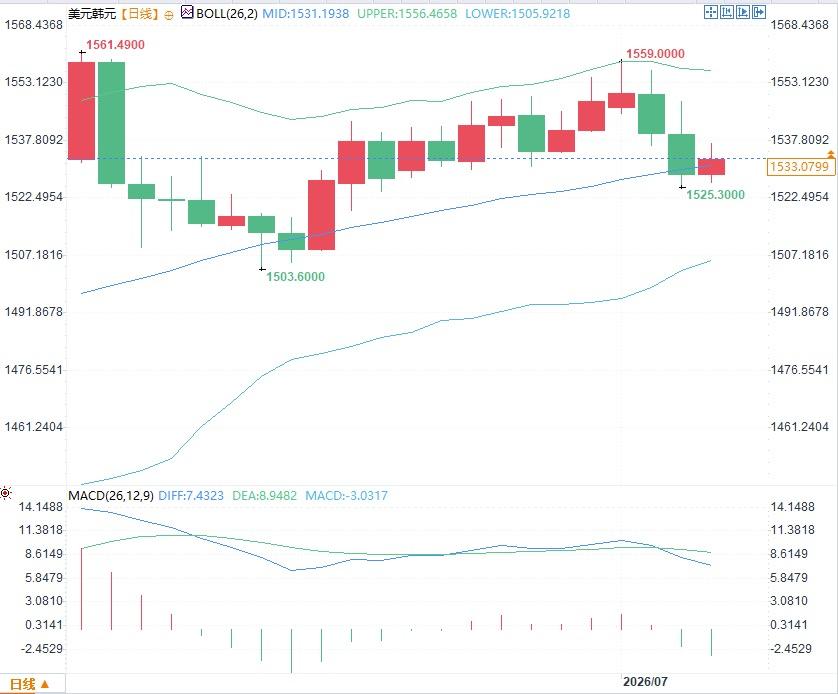
On Monday, July 6, the South Korean foreign exchange market reached a systemic turning point, with the USD/KRW exchange rate fluctuating around 1533 in the first 24-hour trading day, weakening slightly from the official closing price of 1525.6 on July 3. South Korea is attempting to transform its currency trading from a local timezone asset into a market infrastructure that can be executed, hedged, and valued by global institutions around the clock.
The new mechanism runs from 6 a.m. Monday to 6 a.m. Saturday, meaning that spot trading of the Korean won covers major trading hours in Seoul, London, and New York. For traders, the real variable is not "whether they can trade," but whether the night session can generate continuous quotes, stable order books, and manageable impact costs.
Previously, the South Korean market had extended its trading hours to 2:00 AM, but this still couldn't fully cover the portfolio rebalancing, index tracking, and after-hours risk management needs of overseas institutions. While 24-hour trading fills the time gap, it also exposes liquidity risk to a thinner timeframe. If night trading orders are mainly concentrated in a few banks and leading companies, insufficient price depth will amplify price jumps, and the market may exhibit a transitional characteristic of "globalized trading hours, localized actual market depth."
In its 2026 market classification assessment, international index providers clearly pointed out that the non-deliverable offshore Korean won, insufficient onshore liquidity during extended trading hours, and whether spreads can approach daytime trading standards remain key obstacles. However, index upgrades will not only be based on regulatory announcements but also on the execution experience of overseas institutions in actual trading.
This explains why South Korea chose to push forward with reforms when its currency was under pressure. If the system were only opened when the local currency was strong and less volatile, the market would find it difficult to test its resilience. Currently, the Korean won remains relatively weak this year, foreign investors are reducing their holdings of local stocks in stages, and fluctuations in energy prices and semiconductor stocks are jointly increasing the demand for foreign exchange. The first day of the reform was essentially a stress test.
Traditional logic holds that a widening current account surplus usually supports the local currency. However, the current dilemma in South Korea is that the dollar supply generated by trade and the current account has not been fully translated into buying interest in the won in the spot market. Data from the Bank of Korea shows that the current account surplus for January to November 2025 is $101.8 billion, while overseas securities investment by residents is $129.4 billion and outward direct investment is $26.8 billion. Capital outflow demand has largely offset the surplus supply.
The latest fundamentals aren't bad. The current account surplus was $28.29 billion in April, exports reached $102.25 billion in June, imports were $66.1 billion, resulting in a trade surplus of $36.15 billion, and a cumulative trade surplus of $138.3 billion from January to June. Semiconductor exports reached $44.82 billion in June, a year-on-year increase of nearly 200%. The problem is that the relationship between strong exports and a strong currency is no longer linear. Corporate foreign exchange reserves, residents' overseas asset allocation, and institutional global portfolio adjustments are changing the pricing function of the Korean won.
24-hour trading reduces execution friction for overseas investors, but it also increases regulatory difficulty. Previously, regulators primarily focused on the Seoul trading session; now they need to cover liquidity contractions during European and American trading sessions, algorithmic trading triggers, cross-asset rebalancing, and large-scale corporate foreign exchange transactions. South Korean finance officials stated that the government will continue to monitor the market and support smooth 24-hour trading, meaning that the authorities do not intend to completely relinquish price discovery during night trading hours, but rather will maintain a balance between excessive volatility and the credibility of reforms.
Interest rates also pose a constraint. As of July 4, the Bank of Korea's benchmark interest rate was 2.5%, the 3-month KORIBOR was 3.05%, and the 3-year government bond yield was 3.748%. If the pressure on the won to depreciate and expectations of imported inflation both intensify, the room for monetary policy easing will be limited. In May, the Bank of Korea projected economic growth of 2.6% and CPI of 2.7% for 2026, while also noting that the semiconductor cycle and the Middle East conflict continue to bring high levels of uncertainty.
The core of 24-hour trading is not time, but liquidity verification.
The new mechanism runs from 6 a.m. Monday to 6 a.m. Saturday, meaning that spot trading of the Korean won covers major trading hours in Seoul, London, and New York. For traders, the real variable is not "whether they can trade," but whether the night session can generate continuous quotes, stable order books, and manageable impact costs.
Previously, the South Korean market had extended its trading hours to 2:00 AM, but this still couldn't fully cover the portfolio rebalancing, index tracking, and after-hours risk management needs of overseas institutions. While 24-hour trading fills the time gap, it also exposes liquidity risk to a thinner timeframe. If night trading orders are mainly concentrated in a few banks and leading companies, insufficient price depth will amplify price jumps, and the market may exhibit a transitional characteristic of "globalized trading hours, localized actual market depth."
The narrative of index upgrade enters the testing phase.
In its 2026 market classification assessment, international index providers clearly pointed out that the non-deliverable offshore Korean won, insufficient onshore liquidity during extended trading hours, and whether spreads can approach daytime trading standards remain key obstacles. However, index upgrades will not only be based on regulatory announcements but also on the execution experience of overseas institutions in actual trading.
This explains why South Korea chose to push forward with reforms when its currency was under pressure. If the system were only opened when the local currency was strong and less volatile, the market would find it difficult to test its resilience. Currently, the Korean won remains relatively weak this year, foreign investors are reducing their holdings of local stocks in stages, and fluctuations in energy prices and semiconductor stocks are jointly increasing the demand for foreign exchange. The first day of the reform was essentially a stress test.
Despite a large trade surplus, the Korean won remains weak; the key lies in how the funds are used.
Traditional logic holds that a widening current account surplus usually supports the local currency. However, the current dilemma in South Korea is that the dollar supply generated by trade and the current account has not been fully translated into buying interest in the won in the spot market. Data from the Bank of Korea shows that the current account surplus for January to November 2025 is $101.8 billion, while overseas securities investment by residents is $129.4 billion and outward direct investment is $26.8 billion. Capital outflow demand has largely offset the surplus supply.
The latest fundamentals aren't bad. The current account surplus was $28.29 billion in April, exports reached $102.25 billion in June, imports were $66.1 billion, resulting in a trade surplus of $36.15 billion, and a cumulative trade surplus of $138.3 billion from January to June. Semiconductor exports reached $44.82 billion in June, a year-on-year increase of nearly 200%. The problem is that the relationship between strong exports and a strong currency is no longer linear. Corporate foreign exchange reserves, residents' overseas asset allocation, and institutional global portfolio adjustments are changing the pricing function of the Korean won.
The challenge of regulation lies in balancing openness with curbing disorderly fluctuations.
24-hour trading reduces execution friction for overseas investors, but it also increases regulatory difficulty. Previously, regulators primarily focused on the Seoul trading session; now they need to cover liquidity contractions during European and American trading sessions, algorithmic trading triggers, cross-asset rebalancing, and large-scale corporate foreign exchange transactions. South Korean finance officials stated that the government will continue to monitor the market and support smooth 24-hour trading, meaning that the authorities do not intend to completely relinquish price discovery during night trading hours, but rather will maintain a balance between excessive volatility and the credibility of reforms.
Interest rates also pose a constraint. As of July 4, the Bank of Korea's benchmark interest rate was 2.5%, the 3-month KORIBOR was 3.05%, and the 3-year government bond yield was 3.748%. If the pressure on the won to depreciate and expectations of imported inflation both intensify, the room for monetary policy easing will be limited. In May, the Bank of Korea projected economic growth of 2.6% and CPI of 2.7% for 2026, while also noting that the semiconductor cycle and the Middle East conflict continue to bring high levels of uncertainty.
- Risk Warning and Disclaimer
- The market involves risk, and trading may not be suitable for all investors. This article is for reference only and does not constitute personal investment advice, nor does it take into account certain users’ specific investment objectives, financial situation, or other needs. Any investment decisions made based on this information are at your own risk.