Is the most crowded short position on the British pound failing?
2026-07-06 15:29:52
On Monday, July 6th, the British pound was trading around 1.3330 against the US dollar; the US dollar index hovered around 101.08. The short-term exchange rate movement is not solely driven by the pound, but rather by the combined effects of the US dollar, UK interest rates, and the repricing of political risks.
For the past few years, the trading logic for the pound has been suppressed by political uncertainty, fiscal credibility, and the aftermath of Brexit. Following the shock of the 2022 fiscal package, the market developed a strong conditioned reflex to UK assets; whenever political noise intensified, the pound was easily sold off first. However, recent price action suggests that this reflex is weakening. The pound ranked second among G10 currencies in the last quarter and fourth year-to-date, indicating that the market is no longer mechanically translating UK political fluctuations into a currency discount.
More importantly, key British politicians have not yet signaled any policy disruptions that would undermine fiscal discipline. The market's real concern is not the change of leadership itself, but whether fiscal rules will be rewritten afterward. As long as borrowing and spending constraints remain recognized, the political discount facing the pound is unlikely to continue to widen. Some analysts believe that while there has been a long-standing bias against the pound, some long-term structural problems have improved. This assessment highlights the core support for the pound: not a sudden strengthening of British fundamentals, but rather the excessive pessimism previously embedded in the exchange rate.
The Bank of England kept its interest rate at 3.75% in June, while the Federal Reserve maintained its target range for the federal funds rate at 3.50% to 3.75%. This limited the short-term interest rate differential pressure between the pound and the dollar, while increasing the cost of shorting the pound.
From a macroeconomic perspective, the UK is not without pressure. The UK's May CPI was 2.8% year-on-year, unchanged from April; April's real GDP fell 0.1% month-on-month, the first monthly decline in several months; and the latest quarterly unemployment rate was 4.9%. This combination of data suggests that the Bank of England is unlikely to shift to aggressive easing too soon, but economic momentum is also insufficient to support a unilateral upward movement of the pound outside its current range.
This is precisely why the pound has been "stable but not strong" recently. Inflation remains above target, requiring the Bank of England to remain cautious; slowing growth limits market expectations for a higher interest rate path. For traders, the pound's support comes from interest rate stickiness, rather than a growth premium.
Another variable underestimated by the market is cross-border mergers and acquisitions. Foreign acquisitions of British companies will bring temporary demand for the pound. While this is not enough to drive a sustained appreciation of the pound, it can alleviate downward pressure on the exchange rate when political noise intensifies. Some analysts believe that the M&A boom may help offset the UK's structural current account deficit in the short term.
The characteristic of this type of fund flow is its uneven pace, which can alter the market's microstructure. If speculative accounts habitually short the pound, while there is sustained buying pressure from the real money supply, the price can easily reach a point where it "cannot fall further." This state does not equate to strong fundamentals, but rather a deterioration in the risk-reward ratio of short positions. The exit of some institutions from bullish positions in euro/pound reflects the difficulty in realizing the bearish narrative when catalysts are insufficient.
The daily chart shows that the GBP/USD pair is near the middle Bollinger Band, which is around 1.3321, with the upper band around 1.3505 and the lower band around 1.3137. After rebounding from around 1.3139, the price has returned to the vicinity of the middle band and is consolidating, indicating that the previous downward channel has been partially repaired, but a valid test of the upper band has not yet been formed.
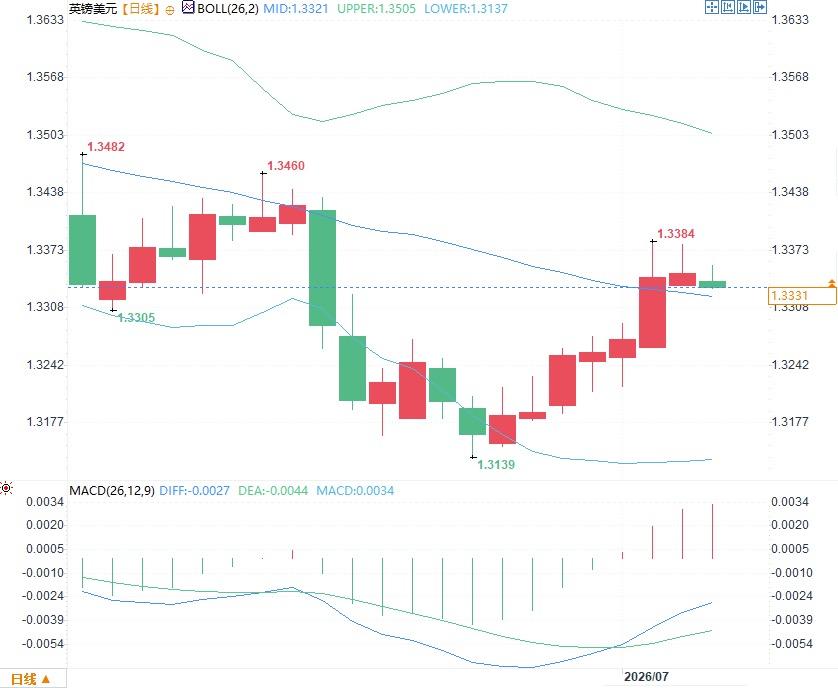
In terms of MACD, the DIFF line is still below the zero line, but the histogram has turned positive, reflecting a contraction in downward momentum rather than a complete trend reversal. In other words, the current chart pattern is closer to a "neutral correction after short covering" rather than a clear trend breakout. If the price continues to oscillate around 1.3330, the market will continue to await stronger macroeconomic catalysts, including UK fiscal arrangements, the Bank of England's statements, the direction of the US dollar index, and subsequent inflation data.
Therefore, the most important factor for the pound against the dollar right now is whether the market continues to accept the main theme that "British political risks are manageable, fiscal discipline remains, and interest rate differentials still provide support." If this main theme remains intact, the pound's downside potential may be stronger than estimated by traditional political risk models.
Key changes in the pound: from political discount to pricing based on interest rate differentials and capital flows.
For the past few years, the trading logic for the pound has been suppressed by political uncertainty, fiscal credibility, and the aftermath of Brexit. Following the shock of the 2022 fiscal package, the market developed a strong conditioned reflex to UK assets; whenever political noise intensified, the pound was easily sold off first. However, recent price action suggests that this reflex is weakening. The pound ranked second among G10 currencies in the last quarter and fourth year-to-date, indicating that the market is no longer mechanically translating UK political fluctuations into a currency discount.
More importantly, key British politicians have not yet signaled any policy disruptions that would undermine fiscal discipline. The market's real concern is not the change of leadership itself, but whether fiscal rules will be rewritten afterward. As long as borrowing and spending constraints remain recognized, the political discount facing the pound is unlikely to continue to widen. Some analysts believe that while there has been a long-standing bias against the pound, some long-term structural problems have improved. This assessment highlights the core support for the pound: not a sudden strengthening of British fundamentals, but rather the excessive pessimism previously embedded in the exchange rate.
Interest rates: The Bank of England maintained its rate at 3.75%, increasing the cost of shorting the pound.
The Bank of England kept its interest rate at 3.75% in June, while the Federal Reserve maintained its target range for the federal funds rate at 3.50% to 3.75%. This limited the short-term interest rate differential pressure between the pound and the dollar, while increasing the cost of shorting the pound.
From a macroeconomic perspective, the UK is not without pressure. The UK's May CPI was 2.8% year-on-year, unchanged from April; April's real GDP fell 0.1% month-on-month, the first monthly decline in several months; and the latest quarterly unemployment rate was 4.9%. This combination of data suggests that the Bank of England is unlikely to shift to aggressive easing too soon, but economic momentum is also insufficient to support a unilateral upward movement of the pound outside its current range.
This is precisely why the pound has been "stable but not strong" recently. Inflation remains above target, requiring the Bank of England to remain cautious; slowing growth limits market expectations for a higher interest rate path. For traders, the pound's support comes from interest rate stickiness, rather than a growth premium.
Cash Flow: Mergers and Acquisitions Demand Buffer Current Account Gap
Another variable underestimated by the market is cross-border mergers and acquisitions. Foreign acquisitions of British companies will bring temporary demand for the pound. While this is not enough to drive a sustained appreciation of the pound, it can alleviate downward pressure on the exchange rate when political noise intensifies. Some analysts believe that the M&A boom may help offset the UK's structural current account deficit in the short term.
The characteristic of this type of fund flow is its uneven pace, which can alter the market's microstructure. If speculative accounts habitually short the pound, while there is sustained buying pressure from the real money supply, the price can easily reach a point where it "cannot fall further." This state does not equate to strong fundamentals, but rather a deterioration in the risk-reward ratio of short positions. The exit of some institutions from bullish positions in euro/pound reflects the difficulty in realizing the bearish narrative when catalysts are insufficient.
Technical analysis: The area around 1.3320 has become a short-term watershed.
The daily chart shows that the GBP/USD pair is near the middle Bollinger Band, which is around 1.3321, with the upper band around 1.3505 and the lower band around 1.3137. After rebounding from around 1.3139, the price has returned to the vicinity of the middle band and is consolidating, indicating that the previous downward channel has been partially repaired, but a valid test of the upper band has not yet been formed.
In terms of MACD, the DIFF line is still below the zero line, but the histogram has turned positive, reflecting a contraction in downward momentum rather than a complete trend reversal. In other words, the current chart pattern is closer to a "neutral correction after short covering" rather than a clear trend breakout. If the price continues to oscillate around 1.3330, the market will continue to await stronger macroeconomic catalysts, including UK fiscal arrangements, the Bank of England's statements, the direction of the US dollar index, and subsequent inflation data.
Therefore, the most important factor for the pound against the dollar right now is whether the market continues to accept the main theme that "British political risks are manageable, fiscal discipline remains, and interest rate differentials still provide support." If this main theme remains intact, the pound's downside potential may be stronger than estimated by traditional political risk models.
- Risk Warning and Disclaimer
- The market involves risk, and trading may not be suitable for all investors. This article is for reference only and does not constitute personal investment advice, nor does it take into account certain users’ specific investment objectives, financial situation, or other needs. Any investment decisions made based on this information are at your own risk.