The rift between the US and Israel limits the expansion of the war, and gold is freed from the shackles of interest rate hikes.
2026-07-06 16:05:59
The rift between the US and Israel limits the expansion of the war, and gold is freed from the shackles of interest rate hikes.
On Monday (July 6), spot gold experienced a surge followed by a pullback during the Asian and European sessions, currently trading around 4156, down 0.43%. Recent geopolitical shifts provided an opportunity for a rebound, and the weaker-than-expected non-farm payroll data further fueled the rally.
On May 5, the Israeli cabinet voted to reject a Supreme Court ruling concerning media regulation, marking the first time it has publicly defied the Supreme Court.
This action drew criticism from the president, several former prime ministers, Netanyahu's election opponents, the opposition party, and journalists' associations, who accused Netanyahu's government of "crossing the red line."
Meanwhile, the rift in the US-Israel alliance continues to widen, and Israeli Prime Minister Netanyahu has long lost the room to maneuver in escalating the war in Lebanon. Multiple internal and external constraints are limiting his ability to further escalate military actions.
Domestically, Netanyahu is embroiled in corruption lawsuits and faces the risk of imprisonment at any time. With the general election approaching this year, the opposition is focusing its criticism on his diplomatic missteps and overdrawing the support of US allies.
The ongoing war continues to escalate military spending and casualties, while anti-war sentiment among the local population continues to grow. The marginal benefits of relying on a hardline military to consolidate the ruling base have long since turned negative, and further escalation of military action will only accelerate its own political collapse.

Externally, the United States has undergone a fundamental shift in its attitude. Recently, a recording of a phone call between Trump and Netanyahu was leaked, in which Trump publicly criticized Netanyahu for insisting on war. Vice President Vance directly pointed out that two-thirds of Israel's defense equipment relies on US financial support, and continued to pressure Israel to stop its offensive in Lebanon.
Iran made a comprehensive ceasefire between Lebanon and Israel a hard precondition for peace talks with the United States. In order to gain diplomatic achievements in the Middle East and avoid large-scale regional conflict that would drive up energy inflation, the Trump administration no longer condoned Israel's unlimited military expansion, thus cutting off Israel's core external support for escalating the war.
From Netanyahu's perspective, the current Lebanese conflict has already missed the golden window of opportunity to take profits at the high levels of April and May. At present, increasing positions and expanding troops is a contrarian gamble with heavy leverage, which will infinitely amplify the risk of unrealized losses.
Passively holding out and waiting for the situation to rebound will only continue to accumulate costs. The best option is to shrink the front lines, lock in existing tactical advantages, and no longer seek full-scale war expansion.
Israel is unable to launch a large-scale ground offensive on its own despite US pressure, the intensity of regional conflicts continues to decline, and the tail risk of a full-scale war in the Middle East has significantly diminished.
The easing of geopolitical risks has cleared a key obstacle for the US-Iran negotiations, and market expectations for a phase-one agreement between the two sides continue to rise.
Once the conflict between Lebanon and Israel de-escalates and Iran’s core demands are met, the US and Iran can proceed with substantive consultations on issues such as nuclear restrictions, navigation in the Strait of Hormuz, and the unfreezing of overseas assets.
With the risk of blockades on energy transportation routes lifted, the international crude oil price level continued to decline, and global inflationary pressures driven by energy converged. The core logic behind the Federal Reserve's continued interest rate hikes was weakened, and expectations of a shift in monetary policy were gradually priced in.
The number of ships passing through the Oman shipping lane has decreased significantly recently. Between Friday and Saturday, at least eight vessels suddenly turned around while crossing the Oman shipping lane, four of which subsequently changed course and left via the Iranian side of the lane.
There is no official explanation yet, but Iran has repeatedly stated that ships can only pass through the waterways it has designated and authorized.
According to Kpler data, a total of 19 vessels transited the strait in both directions on Saturday, but only one openly indicated that it entered via the Oman shipping lane, compared to 13 vessels that passed through the lane on Friday. This situation, where Iran continues to control the strait, may be challenged by the United States.
At the same time, the easing of local conflicts in the Middle East only represents a decline in risk in a single region. Globally, the military expansion of major powers and the regional arms race have not stopped, and the underlying logic of geopolitical hedging has not disappeared.
On the one hand, Middle Eastern countries continue to expand their air defense and long-range strike equipment due to their own security needs, and countries such as Iran and Saudi Arabia are accelerating their self-developed and foreign-purchased weapons, keeping regional arms spending at a high level.
On the other hand, major global economies continue to increase investment in conventional military equipment, AI military technology, and missile defense systems. Central banks and governments around the world are also diversifying their foreign exchange reserves due to geopolitical needs, reducing dollar assets and increasing gold holdings as strategic safe-haven reserves.
Regional conflicts are only cooling down in stages. Great power rivalry and regional arms competition are medium- to long-term structural trends. Sporadic frictions, targeted strikes, and shipping disruptions will continue to occur. Geopolitical risk premiums will not completely disappear from the market, and gold will continue to retain its underlying value in response to conflicts and geopolitical crises.
In the past, escalating conflicts in the Middle East have created a negative transmission chain that suppresses gold prices: war pushes up oil prices → energy inflation soars → the market strengthens expectations of continued interest rate hikes by the Federal Reserve → the real interest rate on US Treasury bonds rises, increasing the holding cost of gold as a non-interest-bearing asset, and the safe-haven logic is offset by tightening expectations.
With Israel currently unable to escalate the conflict and the positive progress in US-Iran negotiations completely reversing this pricing mechanism, gold is experiencing a logical rebound.
Firstly, gold has temporarily escaped the dual pressure of global inflation and interest rate hikes. Secondly, the easing of the Lebanon-Israel conflict has led to a decline in crude oil prices, significantly weakening the stickiness of energy inflation. The market has lowered its expectations for continued interest rate hikes by the Federal Reserve and the long-term maintenance of high interest rates, resulting in a decline in the central level of US Treasury real interest rates and greatly easing the valuation pressure on gold.
Previously, the biggest constraint on gold prices was the opportunity cost issue, which has been improved, and gold is no longer being continuously suppressed by the tightening cycle.
Gold currently retains its two core upward drivers.
One is the geopolitical hedging dividend: the global arms race has become the norm, and various sporadic geopolitical frictions in the Middle East and Eurasia repeatedly disturb the market. Once there are sudden events such as waterway blockades or military attacks, safe-haven funds will quickly flow into gold, causing a pulse-like rise.
Secondly, it offers a hedging advantage against economic recession. The US labor market has weakened more than expected, and the risk of economic downturn is gradually emerging. Global debt is high and consumption is weak. The market is trading in advance for an interest rate cut cycle. As a hard currency that resists recessions across cycles, gold can fully absorb safe-haven and allocation funds.
Israel's internal and external constraints make it difficult for regional wars to escalate further; optimistic expectations for US-Iran peace negotiations continue to rise; easing energy inflation pressures alleviate the constraints on the Fed's interest rate hikes; and gold has broken free from the predicament of being suppressed by both inflation and high interest rates.
Coupled with the persistent geopolitical safe-haven demand stemming from the long-standing global arms race, and the recession hedging demand fueled by weaker-than-expected US non-farm payrolls and expectations of a global economic downturn, gold prices are supported by a triple positive factor: easing interest rate pressures, a geopolitical premium as a floor, and recessionary fund allocation. In the medium to long term, gold has the potential for a sustained upward structural trend.
From a technical perspective, gold prices are currently oscillating in the resistance zone between the downtrend line and the upper channel line, which completely coincides with the resistance zone mentioned in previous articles. Gold prices are currently in a downtrend, and a pullback is likely after any rise. Pay attention to more opportunities for long positions in the future.
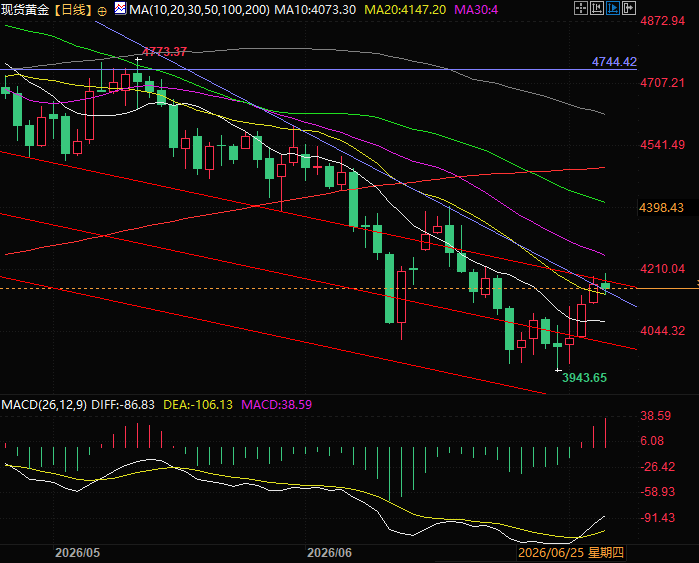
(Spot gold daily chart, source: FX678)
At 16:02 Beijing time, spot gold was trading at $4,162 per ounce.
On Monday (July 6), spot gold experienced a surge followed by a pullback during the Asian and European sessions, currently trading around 4156, down 0.43%. Recent geopolitical shifts provided an opportunity for a rebound, and the weaker-than-expected non-farm payroll data further fueled the rally.
On May 5, the Israeli cabinet voted to reject a Supreme Court ruling concerning media regulation, marking the first time it has publicly defied the Supreme Court.
This action drew criticism from the president, several former prime ministers, Netanyahu's election opponents, the opposition party, and journalists' associations, who accused Netanyahu's government of "crossing the red line."
Meanwhile, the rift in the US-Israel alliance continues to widen, and Israeli Prime Minister Netanyahu has long lost the room to maneuver in escalating the war in Lebanon. Multiple internal and external constraints are limiting his ability to further escalate military actions.
Domestically, Netanyahu is embroiled in corruption lawsuits and faces the risk of imprisonment at any time. With the general election approaching this year, the opposition is focusing its criticism on his diplomatic missteps and overdrawing the support of US allies.
The ongoing war continues to escalate military spending and casualties, while anti-war sentiment among the local population continues to grow. The marginal benefits of relying on a hardline military to consolidate the ruling base have long since turned negative, and further escalation of military action will only accelerate its own political collapse.
The US shifts towards peace talks with Iran in order to support the midterm elections.
Externally, the United States has undergone a fundamental shift in its attitude. Recently, a recording of a phone call between Trump and Netanyahu was leaked, in which Trump publicly criticized Netanyahu for insisting on war. Vice President Vance directly pointed out that two-thirds of Israel's defense equipment relies on US financial support, and continued to pressure Israel to stop its offensive in Lebanon.
Iran made a comprehensive ceasefire between Lebanon and Israel a hard precondition for peace talks with the United States. In order to gain diplomatic achievements in the Middle East and avoid large-scale regional conflict that would drive up energy inflation, the Trump administration no longer condoned Israel's unlimited military expansion, thus cutting off Israel's core external support for escalating the war.
From Netanyahu's perspective, the current Lebanese conflict has already missed the golden window of opportunity to take profits at the high levels of April and May. At present, increasing positions and expanding troops is a contrarian gamble with heavy leverage, which will infinitely amplify the risk of unrealized losses.
Passively holding out and waiting for the situation to rebound will only continue to accumulate costs. The best option is to shrink the front lines, lock in existing tactical advantages, and no longer seek full-scale war expansion.
Israel is unable to launch a large-scale ground offensive on its own despite US pressure, the intensity of regional conflicts continues to decline, and the tail risk of a full-scale war in the Middle East has significantly diminished.
The easing of geopolitical risks has cleared a key obstacle for the US-Iran negotiations, and market expectations for a phase-one agreement between the two sides continue to rise.
Once the conflict between Lebanon and Israel de-escalates and Iran’s core demands are met, the US and Iran can proceed with substantive consultations on issues such as nuclear restrictions, navigation in the Strait of Hormuz, and the unfreezing of overseas assets.
With the risk of blockades on energy transportation routes lifted, the international crude oil price level continued to decline, and global inflationary pressures driven by energy converged. The core logic behind the Federal Reserve's continued interest rate hikes was weakened, and expectations of a shift in monetary policy were gradually priced in.
Regional conflicts have cooled but risks remain; the global arms race is likely to continue for a long time.
The number of ships passing through the Oman shipping lane has decreased significantly recently. Between Friday and Saturday, at least eight vessels suddenly turned around while crossing the Oman shipping lane, four of which subsequently changed course and left via the Iranian side of the lane.
There is no official explanation yet, but Iran has repeatedly stated that ships can only pass through the waterways it has designated and authorized.
According to Kpler data, a total of 19 vessels transited the strait in both directions on Saturday, but only one openly indicated that it entered via the Oman shipping lane, compared to 13 vessels that passed through the lane on Friday. This situation, where Iran continues to control the strait, may be challenged by the United States.
At the same time, the easing of local conflicts in the Middle East only represents a decline in risk in a single region. Globally, the military expansion of major powers and the regional arms race have not stopped, and the underlying logic of geopolitical hedging has not disappeared.
On the one hand, Middle Eastern countries continue to expand their air defense and long-range strike equipment due to their own security needs, and countries such as Iran and Saudi Arabia are accelerating their self-developed and foreign-purchased weapons, keeping regional arms spending at a high level.
On the other hand, major global economies continue to increase investment in conventional military equipment, AI military technology, and missile defense systems. Central banks and governments around the world are also diversifying their foreign exchange reserves due to geopolitical needs, reducing dollar assets and increasing gold holdings as strategic safe-haven reserves.
Regional conflicts are only cooling down in stages. Great power rivalry and regional arms competition are medium- to long-term structural trends. Sporadic frictions, targeted strikes, and shipping disruptions will continue to occur. Geopolitical risk premiums will not completely disappear from the market, and gold will continue to retain its underlying value in response to conflicts and geopolitical crises.
Macroeconomic logic restructured: Gold escapes the pressure of inflation and interest rate hikes, with dual benefits continuing to support prices.
In the past, escalating conflicts in the Middle East have created a negative transmission chain that suppresses gold prices: war pushes up oil prices → energy inflation soars → the market strengthens expectations of continued interest rate hikes by the Federal Reserve → the real interest rate on US Treasury bonds rises, increasing the holding cost of gold as a non-interest-bearing asset, and the safe-haven logic is offset by tightening expectations.
With Israel currently unable to escalate the conflict and the positive progress in US-Iran negotiations completely reversing this pricing mechanism, gold is experiencing a logical rebound.
Firstly, gold has temporarily escaped the dual pressure of global inflation and interest rate hikes. Secondly, the easing of the Lebanon-Israel conflict has led to a decline in crude oil prices, significantly weakening the stickiness of energy inflation. The market has lowered its expectations for continued interest rate hikes by the Federal Reserve and the long-term maintenance of high interest rates, resulting in a decline in the central level of US Treasury real interest rates and greatly easing the valuation pressure on gold.
Previously, the biggest constraint on gold prices was the opportunity cost issue, which has been improved, and gold is no longer being continuously suppressed by the tightening cycle.
Gold currently retains its two core upward drivers.
One is the geopolitical hedging dividend: the global arms race has become the norm, and various sporadic geopolitical frictions in the Middle East and Eurasia repeatedly disturb the market. Once there are sudden events such as waterway blockades or military attacks, safe-haven funds will quickly flow into gold, causing a pulse-like rise.
Secondly, it offers a hedging advantage against economic recession. The US labor market has weakened more than expected, and the risk of economic downturn is gradually emerging. Global debt is high and consumption is weak. The market is trading in advance for an interest rate cut cycle. As a hard currency that resists recessions across cycles, gold can fully absorb safe-haven and allocation funds.
Summary and Technical Analysis:
Israel's internal and external constraints make it difficult for regional wars to escalate further; optimistic expectations for US-Iran peace negotiations continue to rise; easing energy inflation pressures alleviate the constraints on the Fed's interest rate hikes; and gold has broken free from the predicament of being suppressed by both inflation and high interest rates.
Coupled with the persistent geopolitical safe-haven demand stemming from the long-standing global arms race, and the recession hedging demand fueled by weaker-than-expected US non-farm payrolls and expectations of a global economic downturn, gold prices are supported by a triple positive factor: easing interest rate pressures, a geopolitical premium as a floor, and recessionary fund allocation. In the medium to long term, gold has the potential for a sustained upward structural trend.
From a technical perspective, gold prices are currently oscillating in the resistance zone between the downtrend line and the upper channel line, which completely coincides with the resistance zone mentioned in previous articles. Gold prices are currently in a downtrend, and a pullback is likely after any rise. Pay attention to more opportunities for long positions in the future.
(Spot gold daily chart, source: FX678)
At 16:02 Beijing time, spot gold was trading at $4,162 per ounce.
- Risk Warning and Disclaimer
- The market involves risk, and trading may not be suitable for all investors. This article is for reference only and does not constitute personal investment advice, nor does it take into account certain users’ specific investment objectives, financial situation, or other needs. Any investment decisions made based on this information are at your own risk.