The pound has risen for nine consecutive days against the dollar and is approaching a dense resistance zone, awaiting a breakout.
2026-07-07 11:09:30
The British pound extended its strength against the US dollar in Asian trading on Tuesday, rising for the ninth consecutive session and currently trading around 1.3390. The dollar has been under pressure recently, primarily due to the market gradually reducing its bets on further interest rate hikes by the Federal Reserve, especially after cooling US jobs data, prompting investors to reassess the path of US monetary policy.
The latest employment data shows that the number of new jobs added in the United States in April, May, and June was lower than previously expected by the market, indicating that the labor market is gradually cooling. This change has weakened investors' confidence in the Federal Reserve maintaining high interest rates or even raising rates further, putting some selling pressure on the dollar and driving the pound sterling to continue its rebound against the dollar.
Furthermore, the recent decline in international crude oil prices has altered market assessments of inflation risks. With OPEC+ increasing production and expectations of easing tensions between the US and Iran rising, energy prices are under pressure, easing global inflationary pressures. This reduces the need for the Federal Reserve to adopt more aggressive tightening policies, further weakening the upward momentum of the US dollar.
However, the dollar has not completely lost support. Federal Reserve official Christopher Waller recently delivered a hawkish speech, emphasizing the need for flexible monetary policy communication while reiterating the importance of maintaining the 2% inflation target. He stated that forward guidance is an important tool, but excessive rigidity could limit policy adjustment space.
Following Waller's speech, market sentiment indicators leaned further towards a hawkish stance. Analysts believe that his emphasis on the credibility of the inflation target and his opposition to using low interest rates to finance fiscal policy still reflect a focus on controlling inflation, which may provide some support for the US dollar.
Regarding US economic data, while service sector activity slowed somewhat compared to previous periods, it remained in expansion territory. The June ISM Services Purchasing Managers' Index (PMI) came in at 54.0, in line with market expectations. The price index fell from 71.3 to 67.7, indicating some easing of cost pressures; the employment index, however, rebounded from 47.9 to 51.2, returning to expansion territory, reflecting an improvement in employment in the US service sector.
While the US dollar is under pressure, the pound itself is also facing pressure from changing policy expectations. The market has lowered its expectations for further tightening by the Bank of England, with investors now predicting only about a 70% chance of one rate hike this year, compared to expectations of two hikes just a few weeks ago.
Bank of England Governor Andrew Bailey recently stated that UK inflation is still expected to fall back to the 2% target level, but this process may be slower than previously anticipated, while explicitly ruling out the possibility of a near-term interest rate cut. This means that while the Bank of England maintains a cautious stance, its policy space remains constrained by both economic growth and inflationary pressures.
The Bank of England kept its benchmark interest rate unchanged at 3.75% at its policy meeting on June 18, with a 7-2 vote in favor of holding the rate steady. However, compared to April, the number of members supporting a rate hike increased, with two members advocating for an immediate increase to 4.00%, indicating that there are still disagreements within the Bank of England regarding inflation risks.
Currently, the UK inflation rate is around 2.8%, a significant drop from its peak. However, internal forecasts from the Bank of England indicate that inflation may rebound to above 3% in the autumn due to the delayed transmission of the impact of energy costs. Therefore, some large financial institutions predict that the next UK interest rate hike may not occur until late 2026.
Overall, the recent rise in the pound against the dollar has been primarily driven by a weaker dollar, rather than a significant improvement in the UK's economic fundamentals. In the short term, if the Federal Reserve's policy expectations continue to shift towards easing, the pound may still find support; however, a slowdown in the Bank of England's tightening cycle could limit further gains for the pound.
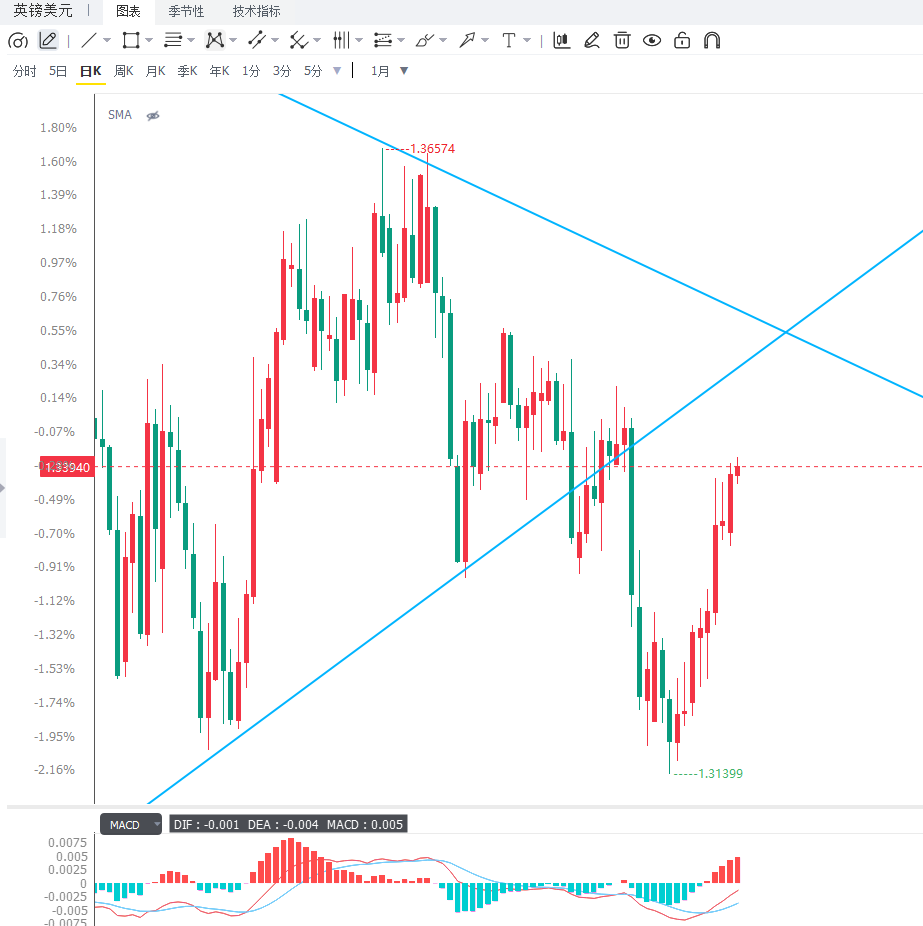
From a daily chart perspective, the British pound has risen against the US dollar for nine consecutive trading days, forming a clear short-term bullish trend. The price continues to trade above short-term moving averages, indicating strong market momentum. Currently, the exchange rate is approaching the key psychological level of 1.3400 . A decisive break above this level could target 1.3450 or even 1.3500. On the downside, the first support level to watch is 1.3300. A break below this level could trigger profit-taking, further testing the support around 1.3250. Given that technical indicators are gradually entering overbought territory after the continuous rise, the market should be wary of short-term volatility.
From a 4-hour chart perspective, the GBP/USD pair maintains an upward trend with fluctuations, gradually rising along the moving average system, indicating that short-term buying pressure remains dominant. However, momentum indicators such as the RSI are already in high territory, suggesting a rapid upward movement and a potential short-term correction. If the exchange rate breaks through and holds above 1.3400, it will further confirm the continuation of the upward trend; if the breakout fails, it may fall back to test the 1.3350 to 1.3300 area for support. The current short-term trend still depends on the movement of the US dollar and market adjustments in expectations regarding the policies of the Federal Reserve and the Bank of England.
Editor's Summary : The recent sustained rise in the British pound against the US dollar is primarily driven by a weaker dollar and a shift in expectations regarding Federal Reserve policy. A cooling US job market and falling energy prices have reduced market concerns about further tightening, putting pressure on the dollar and creating conditions for a pound rebound. However, the pound's rise is not without its obstacles. Expectations for a Bank of England rate hike have cooled significantly, while the risk of a rebound in UK inflation remains, potentially limiting further gains. Going forward, the market will focus on US economic data, Fed policy signals, and changes in UK inflation. In the short term, the pound/dollar pair remains bullish, but the 1.3400-1.3500 area will be key for further breakthroughs. If the dollar continues to weaken, the pound is likely to continue its upward trend; if the Fed's hawkish stance intensifies, it could push the exchange rate into a period of consolidation.
The latest employment data shows that the number of new jobs added in the United States in April, May, and June was lower than previously expected by the market, indicating that the labor market is gradually cooling. This change has weakened investors' confidence in the Federal Reserve maintaining high interest rates or even raising rates further, putting some selling pressure on the dollar and driving the pound sterling to continue its rebound against the dollar.
Furthermore, the recent decline in international crude oil prices has altered market assessments of inflation risks. With OPEC+ increasing production and expectations of easing tensions between the US and Iran rising, energy prices are under pressure, easing global inflationary pressures. This reduces the need for the Federal Reserve to adopt more aggressive tightening policies, further weakening the upward momentum of the US dollar.
However, the dollar has not completely lost support. Federal Reserve official Christopher Waller recently delivered a hawkish speech, emphasizing the need for flexible monetary policy communication while reiterating the importance of maintaining the 2% inflation target. He stated that forward guidance is an important tool, but excessive rigidity could limit policy adjustment space.
Following Waller's speech, market sentiment indicators leaned further towards a hawkish stance. Analysts believe that his emphasis on the credibility of the inflation target and his opposition to using low interest rates to finance fiscal policy still reflect a focus on controlling inflation, which may provide some support for the US dollar.
Regarding US economic data, while service sector activity slowed somewhat compared to previous periods, it remained in expansion territory. The June ISM Services Purchasing Managers' Index (PMI) came in at 54.0, in line with market expectations. The price index fell from 71.3 to 67.7, indicating some easing of cost pressures; the employment index, however, rebounded from 47.9 to 51.2, returning to expansion territory, reflecting an improvement in employment in the US service sector.
While the US dollar is under pressure, the pound itself is also facing pressure from changing policy expectations. The market has lowered its expectations for further tightening by the Bank of England, with investors now predicting only about a 70% chance of one rate hike this year, compared to expectations of two hikes just a few weeks ago.
Bank of England Governor Andrew Bailey recently stated that UK inflation is still expected to fall back to the 2% target level, but this process may be slower than previously anticipated, while explicitly ruling out the possibility of a near-term interest rate cut. This means that while the Bank of England maintains a cautious stance, its policy space remains constrained by both economic growth and inflationary pressures.
The Bank of England kept its benchmark interest rate unchanged at 3.75% at its policy meeting on June 18, with a 7-2 vote in favor of holding the rate steady. However, compared to April, the number of members supporting a rate hike increased, with two members advocating for an immediate increase to 4.00%, indicating that there are still disagreements within the Bank of England regarding inflation risks.
Currently, the UK inflation rate is around 2.8%, a significant drop from its peak. However, internal forecasts from the Bank of England indicate that inflation may rebound to above 3% in the autumn due to the delayed transmission of the impact of energy costs. Therefore, some large financial institutions predict that the next UK interest rate hike may not occur until late 2026.
Overall, the recent rise in the pound against the dollar has been primarily driven by a weaker dollar, rather than a significant improvement in the UK's economic fundamentals. In the short term, if the Federal Reserve's policy expectations continue to shift towards easing, the pound may still find support; however, a slowdown in the Bank of England's tightening cycle could limit further gains for the pound.
From a daily chart perspective, the British pound has risen against the US dollar for nine consecutive trading days, forming a clear short-term bullish trend. The price continues to trade above short-term moving averages, indicating strong market momentum. Currently, the exchange rate is approaching the key psychological level of 1.3400 . A decisive break above this level could target 1.3450 or even 1.3500. On the downside, the first support level to watch is 1.3300. A break below this level could trigger profit-taking, further testing the support around 1.3250. Given that technical indicators are gradually entering overbought territory after the continuous rise, the market should be wary of short-term volatility.
From a 4-hour chart perspective, the GBP/USD pair maintains an upward trend with fluctuations, gradually rising along the moving average system, indicating that short-term buying pressure remains dominant. However, momentum indicators such as the RSI are already in high territory, suggesting a rapid upward movement and a potential short-term correction. If the exchange rate breaks through and holds above 1.3400, it will further confirm the continuation of the upward trend; if the breakout fails, it may fall back to test the 1.3350 to 1.3300 area for support. The current short-term trend still depends on the movement of the US dollar and market adjustments in expectations regarding the policies of the Federal Reserve and the Bank of England.
Editor's Summary : The recent sustained rise in the British pound against the US dollar is primarily driven by a weaker dollar and a shift in expectations regarding Federal Reserve policy. A cooling US job market and falling energy prices have reduced market concerns about further tightening, putting pressure on the dollar and creating conditions for a pound rebound. However, the pound's rise is not without its obstacles. Expectations for a Bank of England rate hike have cooled significantly, while the risk of a rebound in UK inflation remains, potentially limiting further gains. Going forward, the market will focus on US economic data, Fed policy signals, and changes in UK inflation. In the short term, the pound/dollar pair remains bullish, but the 1.3400-1.3500 area will be key for further breakthroughs. If the dollar continues to weaken, the pound is likely to continue its upward trend; if the Fed's hawkish stance intensifies, it could push the exchange rate into a period of consolidation.
- Risk Warning and Disclaimer
- The market involves risk, and trading may not be suitable for all investors. This article is for reference only and does not constitute personal investment advice, nor does it take into account certain users’ specific investment objectives, financial situation, or other needs. Any investment decisions made based on this information are at your own risk.