Oil from the Persian Gulf is coming out, but orders from Asia are dwindling: JPMorgan Chase warns of a accumulating "temporary surplus."
2026-07-07 12:09:57
On Tuesday (July 7) during Asian trading hours, Brent crude oil futures fluctuated higher, currently up about 0.7% to around $72.45 per barrel.
Shipping traffic in the Strait of Hormuz is recovering, with more and more oil that was previously unable to be exported flowing into the global market.
However, JPMorgan's commodities strategists warn that this supply surge has coincided with a market that had adapted to shortages, and whose largest buyer—Asia—has suddenly withdrawn. Asian oil demand experienced a structural plunge during the conflict, and it remains to be seen whether this shift is a temporary adaptation or a systemic turning point in fossil fuel consumption. More importantly, oil flowing from the Strait of Hormuz now "has virtually nowhere to go except Asia, but Asia is leaving."
Meanwhile, global oil demand is projected to decline by 1.1 million barrels per day in 2026, and the supply surplus will continue into 2027. The market is undergoing a "system reboot," and the chaos and delays in this process mean that the risk of short-term oversupply is accumulating.
As the Middle East conflict gradually subsides and negotiations between the US and Iran continue, shipping activity in the Strait of Hormuz is showing a significant recovery. Millions of barrels of oil that were previously locked in the Persian Gulf due to geopolitical conflicts are now gradually gaining export channels and flowing back into a global market that has been forced to restructure its supply chains in recent months due to supply disruptions.
In their latest research report, the team led by JPMorgan's head of commodities research, Kaneva, issued a clear warning: "Regardless of the timing, one thing is certain—a wave of oil is about to flood the market."
But there is a fundamental contradiction here: "The surge in oil supply will just happen to hit a market that doesn't need it, at least not for now."
The dramatic shift in demand stemmed from an unexpected turning point – Asia.
During the conflict, Asia's role was the complete opposite of other major consuming countries: Asia continued to buy oil in large quantities far exceeding its actual domestic demand, providing a floor for oil prices when the world faced a massive supply glut.
In a sense, Asia played the role of "buyer of last resort," absorbing the supply that other buyers had given up due to sanctions or risk aversion.
However, this pattern has been fundamentally reversed. The sudden drop in Asian imports has instead freed up purchasing space in the international market for countries whose supplies were disrupted during the conflict, enabling them to find the energy supplies needed to keep their economies running.
In other words, the "retreat" from Asia and the "reopening" of the Strait of Hormuz coincided in the worst possible timeframe—supply was being released while demand was contracting.
What worries the market even more is the uncertainty. The JPMorgan team points out that the decline in domestic oil demand in Asia has been "extremely sharp," to the point that officials can no longer simply attribute it to short-term factors. If the latter scenario holds true, the fundamentals of global oil demand will face a long-term reassessment.
A JPMorgan strategist succinctly pinpointed the core dilemma facing the current market: "The oil flowing out of the Strait of Hormuz has virtually nowhere to go except Asia. But Asia isn't buying it."
This statement reveals the crux of the problem. Over the past few months, global refineries, traders, and end-users have completed a grueling supply chain adjustment—new sourcing routes, new alternative sources of supply, and new inventory management models. They spent months learning how to operate without Persian Gulf oil. Now, these "trapped" supplies are suddenly released back into a restructured system that lacks the immediate capacity to absorb the new influx.
"The immediate consequence is clear: the market is facing the risk of a short-term oversupply—because the trapped oil has finally re-entered a system that has spent months learning how to function without it."
Despite a bearish short-term outlook, the JPMorgan team does not believe that oil prices will experience a precipitous drop as a result. Three buffering factors are at play:
First, Asian refineries will eventually return. Strategists believe that as prices correct to a certain level, Asian refineries will re-enter the market and begin purchasing. The question is timing—this takes time and depends on Asia's assessment of demand trends.
Second, the inventory replenishment cycle will provide buying support. During the conflict, governments and private companies consumed large amounts of inventory to fill supply gaps. With the reopening of the Straits, these inventories will enter a replenishment cycle, drawing some of the new supply from the market.
Third, both of the aforementioned factors require time to fully materialize. The market needs time to assess the supply and demand dynamics of 2027. The International Energy Agency (IEA) projects that global oil demand will decline by 1.1 million barrels per day in 2026, and the oversupply situation will continue into 2027. This means that even if the buffering factors eventually take effect, short- to medium-term oversupply pressure will remain the dominant narrative in the market.
The JPMorgan team concluded their report with a vivid technical metaphor: "Like a computer after a major crash, the oil market is attempting a system reboot. But rebooting a complex system is rarely instantaneous—residual memories remain, processes restart unevenly, and temporary files accumulate. Before a stable return to normalcy, the system must first sort out the residual chaos left by the shock."
This metaphor accurately summarizes three characteristics of the current market:
Residual memory: Market participants' pricing of geopolitical risks has not completely subsided; although the risk premium has decreased, it has not disappeared.
Uneven progress: The recovery speed of supply and demand varies in different regions and for different products, and market clearing takes time.
Accumulated temporary documents: Previously accumulated inventory, unfulfilled contracts, and unclear demand trends constitute the noise source of short-term price fluctuations.
In summary, the supply surge brought about by the reopening of the Strait of Hormuz has created a mismatch that is difficult to reconcile in the short term with the sharp drop in demand in Asia. JPMorgan Chase's assessment points to a market pattern of "short-term temporary surplus"—the surplus may be temporary because Asia will eventually return and inventories will eventually be replenished, but before this return, the market must first go through a painful period of digesting the new supply.
Key observed variables include:
Monthly changes in Asian oil import data are the most direct window for judging whether it is a "temporary adjustment" or a "structural inflection point".
Global inventory change data – if inventories accumulate at a faster-than-expected rate, it will validate the narrative of short-term surplus; if the increase in inventories is moderate, the resilience of the supply chain will exceed market expectations.
The follow-up developments in the US-Iran negotiations: If a comprehensive agreement is reached, the full return of Iranian oil will exacerbate supply pressures; if negotiations stall, the release of supply may be lower than currently expected.
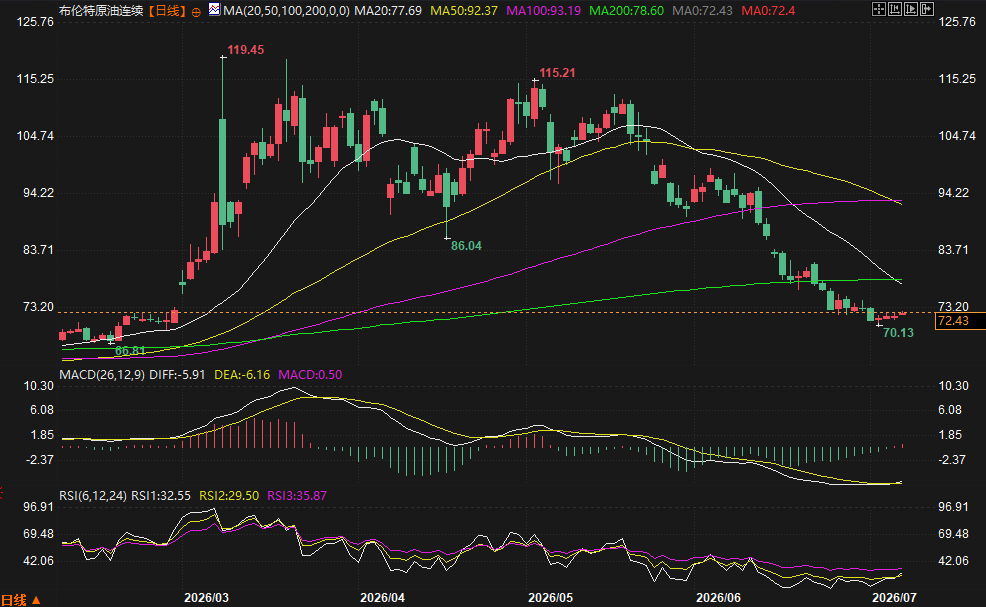
(Brent crude oil futures daily chart, source: FX678)
At 12:09 Beijing time on July 7, Brent crude oil futures were trading at $72.47 per barrel.
Shipping traffic in the Strait of Hormuz is recovering, with more and more oil that was previously unable to be exported flowing into the global market.
However, JPMorgan's commodities strategists warn that this supply surge has coincided with a market that had adapted to shortages, and whose largest buyer—Asia—has suddenly withdrawn. Asian oil demand experienced a structural plunge during the conflict, and it remains to be seen whether this shift is a temporary adaptation or a systemic turning point in fossil fuel consumption. More importantly, oil flowing from the Strait of Hormuz now "has virtually nowhere to go except Asia, but Asia is leaving."
Meanwhile, global oil demand is projected to decline by 1.1 million barrels per day in 2026, and the supply surplus will continue into 2027. The market is undergoing a "system reboot," and the chaos and delays in this process mean that the risk of short-term oversupply is accumulating.
The Strait of Hormuz reopens: The trapped "oil flood" is about to surge out.
As the Middle East conflict gradually subsides and negotiations between the US and Iran continue, shipping activity in the Strait of Hormuz is showing a significant recovery. Millions of barrels of oil that were previously locked in the Persian Gulf due to geopolitical conflicts are now gradually gaining export channels and flowing back into a global market that has been forced to restructure its supply chains in recent months due to supply disruptions.
In their latest research report, the team led by JPMorgan's head of commodities research, Kaneva, issued a clear warning: "Regardless of the timing, one thing is certain—a wave of oil is about to flood the market."
But there is a fundamental contradiction here: "The surge in oil supply will just happen to hit a market that doesn't need it, at least not for now."
The Truth Behind Collapsed Demand: Asia – From “Buyer of Last Resort” to “Biggest Variable”
The dramatic shift in demand stemmed from an unexpected turning point – Asia.
During the conflict, Asia's role was the complete opposite of other major consuming countries: Asia continued to buy oil in large quantities far exceeding its actual domestic demand, providing a floor for oil prices when the world faced a massive supply glut.
In a sense, Asia played the role of "buyer of last resort," absorbing the supply that other buyers had given up due to sanctions or risk aversion.
However, this pattern has been fundamentally reversed. The sudden drop in Asian imports has instead freed up purchasing space in the international market for countries whose supplies were disrupted during the conflict, enabling them to find the energy supplies needed to keep their economies running.
In other words, the "retreat" from Asia and the "reopening" of the Strait of Hormuz coincided in the worst possible timeframe—supply was being released while demand was contracting.
What worries the market even more is the uncertainty. The JPMorgan team points out that the decline in domestic oil demand in Asia has been "extremely sharp," to the point that officials can no longer simply attribute it to short-term factors. If the latter scenario holds true, the fundamentals of global oil demand will face a long-term reassessment.
A hard landing due to supply and demand mismatch: Supply returns, but buyers have already left.
A JPMorgan strategist succinctly pinpointed the core dilemma facing the current market: "The oil flowing out of the Strait of Hormuz has virtually nowhere to go except Asia. But Asia isn't buying it."
This statement reveals the crux of the problem. Over the past few months, global refineries, traders, and end-users have completed a grueling supply chain adjustment—new sourcing routes, new alternative sources of supply, and new inventory management models. They spent months learning how to operate without Persian Gulf oil. Now, these "trapped" supplies are suddenly released back into a restructured system that lacks the immediate capacity to absorb the new influx.
"The immediate consequence is clear: the market is facing the risk of a short-term oversupply—because the trapped oil has finally re-entered a system that has spent months learning how to function without it."
Three buffer factors that prevent prices from plummeting
Despite a bearish short-term outlook, the JPMorgan team does not believe that oil prices will experience a precipitous drop as a result. Three buffering factors are at play:
First, Asian refineries will eventually return. Strategists believe that as prices correct to a certain level, Asian refineries will re-enter the market and begin purchasing. The question is timing—this takes time and depends on Asia's assessment of demand trends.
Second, the inventory replenishment cycle will provide buying support. During the conflict, governments and private companies consumed large amounts of inventory to fill supply gaps. With the reopening of the Straits, these inventories will enter a replenishment cycle, drawing some of the new supply from the market.
Third, both of the aforementioned factors require time to fully materialize. The market needs time to assess the supply and demand dynamics of 2027. The International Energy Agency (IEA) projects that global oil demand will decline by 1.1 million barrels per day in 2026, and the oversupply situation will continue into 2027. This means that even if the buffering factors eventually take effect, short- to medium-term oversupply pressure will remain the dominant narrative in the market.
The metaphor of a "system reboot" suggests that the path to recovery is never linear.
The JPMorgan team concluded their report with a vivid technical metaphor: "Like a computer after a major crash, the oil market is attempting a system reboot. But rebooting a complex system is rarely instantaneous—residual memories remain, processes restart unevenly, and temporary files accumulate. Before a stable return to normalcy, the system must first sort out the residual chaos left by the shock."
This metaphor accurately summarizes three characteristics of the current market:
Residual memory: Market participants' pricing of geopolitical risks has not completely subsided; although the risk premium has decreased, it has not disappeared.
Uneven progress: The recovery speed of supply and demand varies in different regions and for different products, and market clearing takes time.
Accumulated temporary documents: Previously accumulated inventory, unfulfilled contracts, and unclear demand trends constitute the noise source of short-term price fluctuations.
Outlook: The Struggle Between Short-Term Overcapacity and Long-Term Restructuring
In summary, the supply surge brought about by the reopening of the Strait of Hormuz has created a mismatch that is difficult to reconcile in the short term with the sharp drop in demand in Asia. JPMorgan Chase's assessment points to a market pattern of "short-term temporary surplus"—the surplus may be temporary because Asia will eventually return and inventories will eventually be replenished, but before this return, the market must first go through a painful period of digesting the new supply.
Key observed variables include:
Monthly changes in Asian oil import data are the most direct window for judging whether it is a "temporary adjustment" or a "structural inflection point".
Global inventory change data – if inventories accumulate at a faster-than-expected rate, it will validate the narrative of short-term surplus; if the increase in inventories is moderate, the resilience of the supply chain will exceed market expectations.
The follow-up developments in the US-Iran negotiations: If a comprehensive agreement is reached, the full return of Iranian oil will exacerbate supply pressures; if negotiations stall, the release of supply may be lower than currently expected.
(Brent crude oil futures daily chart, source: FX678)
At 12:09 Beijing time on July 7, Brent crude oil futures were trading at $72.47 per barrel.
- Risk Warning and Disclaimer
- The market involves risk, and trading may not be suitable for all investors. This article is for reference only and does not constitute personal investment advice, nor does it take into account certain users’ specific investment objectives, financial situation, or other needs. Any investment decisions made based on this information are at your own risk.