The Reserve Bank of Australia wants to raise interest rates, but the data doesn't allow it—what's next for the Australian dollar?
2026-07-07 11:30:37
The Australian dollar edged lower against the US dollar in Asian trading on Tuesday (July 7), currently trading around 0.6950, after rising for two consecutive days.
Australian job advertisements fell 0.2% month-on-month in June, marking the third monthly decline this year, indicating that high borrowing costs are weighing on the job market.
Meanwhile, the Melbourne Institute's monthly inflation gauge fell for the second consecutive month, indicating that domestic cost pressures are beginning to ease.
Despite weak domestic data, the overall weakening of the US dollar and market expectations for further interest rate hikes by the Reserve Bank of Australia may provide some support for the Australian dollar.
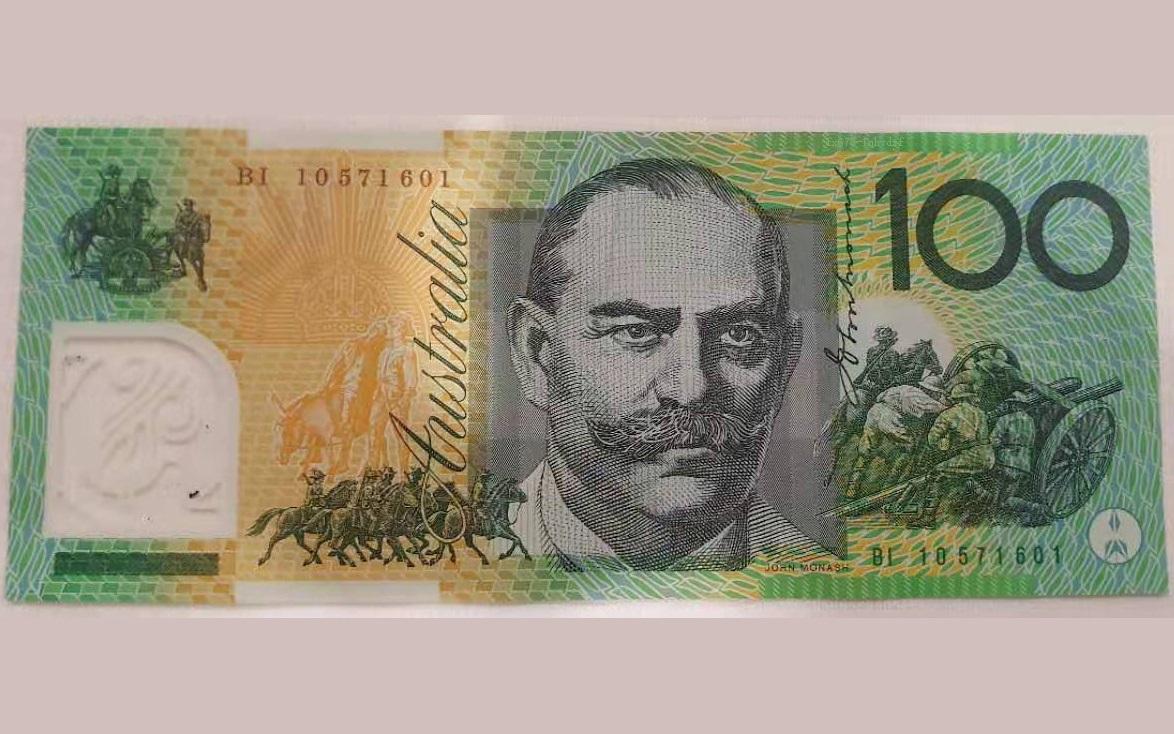
Australian job advertisements fell 0.2% month-on-month in June, reversing the upwardly revised 2.0% increase in May, marking the third monthly decline this year.
ANZ economist Aaron Luk noted that job advertisements have fallen by about 28% from their peak at the end of 2022, but are still significantly higher than pre-pandemic levels.
Luk predicts that hiring will weaken further and the unemployment rate will gradually rise as high interest rates, a housing slowdown, and geopolitical tensions drag down economic activity.
The Melbourne Institute's monthly inflation gauge fell 0.3% in May and then further declined by 0.4% in June, marking the second consecutive month-on-month decrease.
This trend indicates that domestic cost pressures are gradually easing, giving the Reserve Bank of Australia more room to maneuver in its monetary policy.
However, whether inflation has formed a downward trend still needs to be verified by more comprehensive quarterly inflation data.
Despite weak domestic economic data, the Australian dollar may still recover some lost ground, mainly due to two factors: firstly, the overall weakening of the US dollar provides external support for the Australian dollar; and secondly, market expectations for further interest rate hikes by the Reserve Bank of Australia have not yet subsided.
Investors are still digesting the Reserve Bank of Australia's June meeting minutes and hawkish comments from Governor Michele Bullock, both of which highlighted deep concerns about sticky inflation, excess demand, and tight economic capacity.
This means that if subsequent inflation data exceeds expectations again, the Reserve Bank of Australia may further tighten its policy.
In its July outlook, Mitsubishi UFJ Financial Group (MUFG) predicted that the Australian dollar would gradually strengthen against the backdrop of a generally weakening US dollar.
The agency projects a further decline of approximately 5% in the US Dollar Index (DXY) by 2026, providing support for commodity currencies. A recovery in Australian economic growth, improved commodity prices (particularly energy and metals), and the Reserve Bank of Australia's (RBA) likely interest rate hike path will collectively boost the Australian dollar.
Mitsubishi UFJ predicts that the Australian dollar will gradually rise to the 0.70-0.73 range against the US dollar in 2026, with a year-end target of around 0.71.
The agency emphasized that a moderate global economic recovery and stable Asian economies will benefit Australia's terms of trade, while further easing by the Federal Reserve and the divergence in policy between the Federal Reserve and the RBA will widen the interest rate advantage. However, geopolitical risks and volatility in global risk appetite remain the main downside risks. If the RBA implements additional rate hikes in the first half of 2026, the Australian dollar may break through the psychological level of 0.70 more quickly.
Overall, MUFG believes the Australian dollar will outperform other G10 currencies, but caution is warranted regarding short-term pressure from a US dollar rebound.
According to the daily chart, the Australian dollar against the US dollar shows a generally weak medium-term trend. The price is trading below multiple moving averages (MA20, MA50, MA100), finding support only at the long-term MA200. The moving averages above form layers of resistance, with short-term resistance concentrated at 0.6966 (MA20) and 0.7084 (MA50). The previous high of 0.7277 represents a temporary top, while the recent low of 0.6864 forms key short-term support. The previous low of 0.6832 is the medium-term dividing line between bullish and bearish sentiment.
The MACD indicator DIFF (-0.0045) has slightly crossed above DEA (-0.0051) to form a weak golden cross, with the red bar at only 0.0012, indicating a significant weakening of bearish momentum. However, both lines are still below the zero axis, and the medium-term weak trend has not yet been reversed, so the rebound strength is limited.
In terms of price structure, the price has been declining continuously since the high of 0.7277 in May. After hitting a low of 0.6864 in June, it found support and made a slight recovery, which is a technical rebound after the decline. The first resistance level in the short term is the 20-day moving average at 0.6966. If it fails to break through, the rebound is likely to end and the price will resume its downward trend. The support level below is 0.6864. Once it is effectively broken, it will open up a new round of downward space.
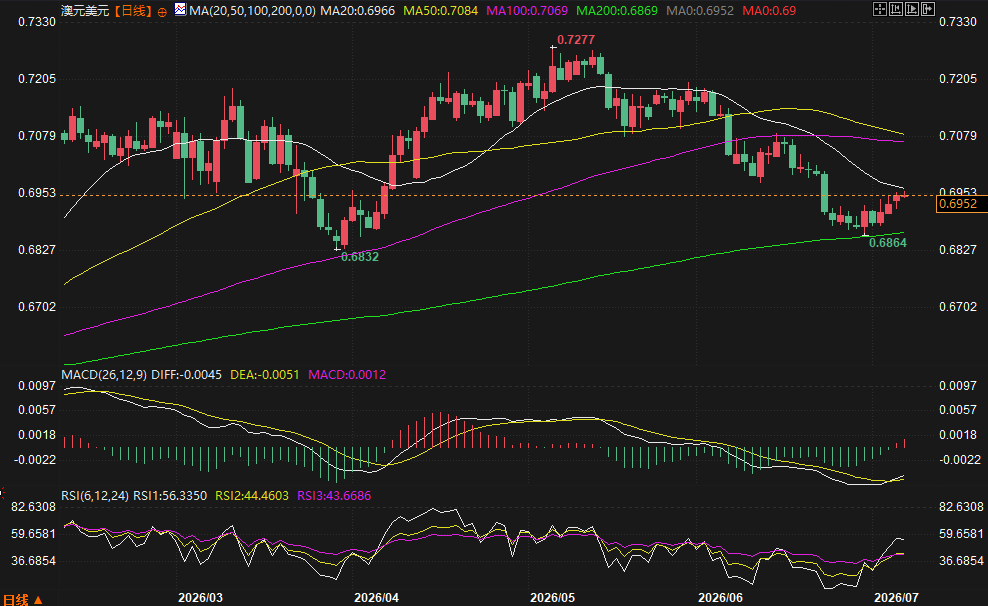
(AUD/USD daily chart, source: FX678)
At 11:30 AM Beijing time on July 7, the Australian dollar was trading at 0.6945/46 against the US dollar.
Australian job advertisements fell 0.2% month-on-month in June, marking the third monthly decline this year, indicating that high borrowing costs are weighing on the job market.
Meanwhile, the Melbourne Institute's monthly inflation gauge fell for the second consecutive month, indicating that domestic cost pressures are beginning to ease.
Despite weak domestic data, the overall weakening of the US dollar and market expectations for further interest rate hikes by the Reserve Bank of Australia may provide some support for the Australian dollar.
Job Market: Job Advertisements Continue to Cool Down
Australian job advertisements fell 0.2% month-on-month in June, reversing the upwardly revised 2.0% increase in May, marking the third monthly decline this year.
ANZ economist Aaron Luk noted that job advertisements have fallen by about 28% from their peak at the end of 2022, but are still significantly higher than pre-pandemic levels.
Luk predicts that hiring will weaken further and the unemployment rate will gradually rise as high interest rates, a housing slowdown, and geopolitical tensions drag down economic activity.
Inflation indicators: Cost pressures continue to ease
The Melbourne Institute's monthly inflation gauge fell 0.3% in May and then further declined by 0.4% in June, marking the second consecutive month-on-month decrease.
This trend indicates that domestic cost pressures are gradually easing, giving the Reserve Bank of Australia more room to maneuver in its monetary policy.
However, whether inflation has formed a downward trend still needs to be verified by more comprehensive quarterly inflation data.
Australian Dollar Outlook: Data is slightly weak but still provides support
Despite weak domestic economic data, the Australian dollar may still recover some lost ground, mainly due to two factors: firstly, the overall weakening of the US dollar provides external support for the Australian dollar; and secondly, market expectations for further interest rate hikes by the Reserve Bank of Australia have not yet subsided.
Investors are still digesting the Reserve Bank of Australia's June meeting minutes and hawkish comments from Governor Michele Bullock, both of which highlighted deep concerns about sticky inflation, excess demand, and tight economic capacity.
This means that if subsequent inflation data exceeds expectations again, the Reserve Bank of Australia may further tighten its policy.
Institutional Views
In its July outlook, Mitsubishi UFJ Financial Group (MUFG) predicted that the Australian dollar would gradually strengthen against the backdrop of a generally weakening US dollar.
The agency projects a further decline of approximately 5% in the US Dollar Index (DXY) by 2026, providing support for commodity currencies. A recovery in Australian economic growth, improved commodity prices (particularly energy and metals), and the Reserve Bank of Australia's (RBA) likely interest rate hike path will collectively boost the Australian dollar.
Mitsubishi UFJ predicts that the Australian dollar will gradually rise to the 0.70-0.73 range against the US dollar in 2026, with a year-end target of around 0.71.
The agency emphasized that a moderate global economic recovery and stable Asian economies will benefit Australia's terms of trade, while further easing by the Federal Reserve and the divergence in policy between the Federal Reserve and the RBA will widen the interest rate advantage. However, geopolitical risks and volatility in global risk appetite remain the main downside risks. If the RBA implements additional rate hikes in the first half of 2026, the Australian dollar may break through the psychological level of 0.70 more quickly.
Overall, MUFG believes the Australian dollar will outperform other G10 currencies, but caution is warranted regarding short-term pressure from a US dollar rebound.
Technical Analysis
According to the daily chart, the Australian dollar against the US dollar shows a generally weak medium-term trend. The price is trading below multiple moving averages (MA20, MA50, MA100), finding support only at the long-term MA200. The moving averages above form layers of resistance, with short-term resistance concentrated at 0.6966 (MA20) and 0.7084 (MA50). The previous high of 0.7277 represents a temporary top, while the recent low of 0.6864 forms key short-term support. The previous low of 0.6832 is the medium-term dividing line between bullish and bearish sentiment.
The MACD indicator DIFF (-0.0045) has slightly crossed above DEA (-0.0051) to form a weak golden cross, with the red bar at only 0.0012, indicating a significant weakening of bearish momentum. However, both lines are still below the zero axis, and the medium-term weak trend has not yet been reversed, so the rebound strength is limited.
In terms of price structure, the price has been declining continuously since the high of 0.7277 in May. After hitting a low of 0.6864 in June, it found support and made a slight recovery, which is a technical rebound after the decline. The first resistance level in the short term is the 20-day moving average at 0.6966. If it fails to break through, the rebound is likely to end and the price will resume its downward trend. The support level below is 0.6864. Once it is effectively broken, it will open up a new round of downward space.
(AUD/USD daily chart, source: FX678)
At 11:30 AM Beijing time on July 7, the Australian dollar was trading at 0.6945/46 against the US dollar.
- Risk Warning and Disclaimer
- The market involves risk, and trading may not be suitable for all investors. This article is for reference only and does not constitute personal investment advice, nor does it take into account certain users’ specific investment objectives, financial situation, or other needs. Any investment decisions made based on this information are at your own risk.