The US dollar index fluctuated around the 101 level, awaiting guidance from the Federal Reserve minutes.
2026-07-07 15:10:12
The US dollar index (DXY) continued its volatile trading session on Tuesday, lacking a clear direction for the third consecutive trading day and currently trading below the 101.00 level. The market is digesting multiple factors, including geopolitical risks, energy price changes, and adjustments to the Federal Reserve's future policy path, resulting in a short-term tug-of-war between bulls and bears for the dollar.
Recent developments in the US-Iran situation have become a significant factor influencing the US dollar. The previously agreed 60-day ceasefire is now facing uncertainty, tensions in the Strait of Hormuz are escalating, and market demand for safe-haven assets has increased. Furthermore, an oil tanker was attacked by an unidentified object while passing through this vital shipping route, raising concerns about the security of energy transportation.
Furthermore, Iran's attempts to strengthen its strategic control over the Strait of Hormuz and its plans to charge commercial vessels for related services have drawn external opposition and increased market concerns about further developments in the region. As the US dollar typically benefits from global risk events, safe-haven inflows have provided some support for the dollar.
In the energy market, geopolitical risks have driven a rebound in crude oil prices, and the market is once again focusing on inflationary pressures. If oil prices continue to rise, it could increase market concerns about a resurgence of inflation and limit the room for interest rate cuts by major central banks, which would also provide short-term support for the US dollar.
However, dollar bulls still face pressure from changing policy expectations. Following weaker-than-expected US non-farm payroll data in June, investors reduced their bets on future Fed rate hikes. The market had previously anticipated one or two rate hikes in 2026, but current expectations have been adjusted to zero to one rate hike.
On the US economic data front, the ISM Services Purchasing Managers' Index (PMI) fell to 54.0 in June from 54.5 in May, in line with market expectations, but failed to significantly boost dollar buying. The service sector continued to expand, but the growth rate slowed, indicating a weakening of the US economic resilience.
Despite receiving safe-haven support from multiple factors, the US dollar index has yet to generate new upward momentum. The market is currently focused on changes in Federal Reserve policy signals, with investors awaiting the release of the Fed meeting minutes on Wednesday to determine the future path of interest rates.
If the meeting minutes release a hawkish signal, the dollar may receive further impetus; conversely, if the policy leans towards greater easing, the dollar's recent rebound may face pressure. Currently, the market still needs to focus on whether the dollar index can break through key technical areas to confirm the direction of the next trend.
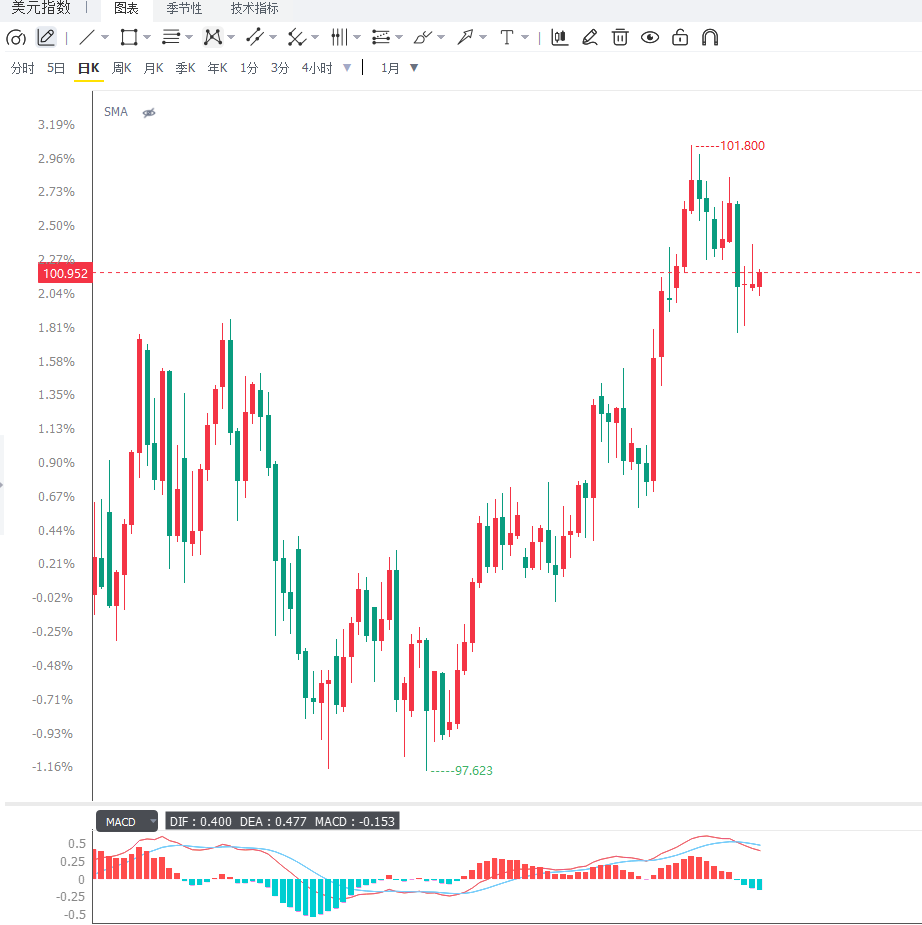
From a daily chart perspective, the US dollar index has maintained a consolidation and recovery trend recently. After finding support in the 97.45-97.40 area, it rebounded, but the current price has not yet broken through the key resistance area. In the short term, the 101.00 level is currently a significant resistance . If this level is broken effectively, the dollar index may further test the resistance near 102.00; if the rebound fails and the index weakens again, support near 99.80 should be watched, with further support at the 98.50 area. Overall market momentum has recovered somewhat, but the upward movement is still suppressed by expectations of Federal Reserve policy.
From a 4-hour chart perspective, the US dollar index has entered a sideways consolidation phase, fluctuating repeatedly around the 100-101 range, with the short-term direction remaining unclear. Technical indicators suggest that bullish momentum has weakened, but no clear reversal signal has yet formed. If the US dollar index regains its footing above 101.00, it may open up further upside potential; if it breaks below the psychological support level of 100.00, it may retest the previous lows. Short-term movements will largely depend on the Fed meeting minutes and changes in risk aversion.
Editor's Summary : The US dollar index is currently in a state of equilibrium between safe-haven support and policy pressure. Elevated risks in the Strait of Hormuz and rising oil prices are providing short-term support for the dollar, but a cooling US job market and declining expectations of a Fed rate hike are limiting further gains. The future direction of the dollar will largely depend on Fed policy signals and changes in global risk sentiment. If the Fed meeting minutes release a hawkish view, the dollar may continue its recovery; if the market further strengthens expectations of rate cuts, the dollar may come under renewed pressure. In the short term, the dollar index remains in a consolidation phase, with the 100.00 to 101.00 area becoming a key battleground between bulls and bears; the direction of the breakout may determine the dollar's next move.
Recent developments in the US-Iran situation have become a significant factor influencing the US dollar. The previously agreed 60-day ceasefire is now facing uncertainty, tensions in the Strait of Hormuz are escalating, and market demand for safe-haven assets has increased. Furthermore, an oil tanker was attacked by an unidentified object while passing through this vital shipping route, raising concerns about the security of energy transportation.
Furthermore, Iran's attempts to strengthen its strategic control over the Strait of Hormuz and its plans to charge commercial vessels for related services have drawn external opposition and increased market concerns about further developments in the region. As the US dollar typically benefits from global risk events, safe-haven inflows have provided some support for the dollar.
In the energy market, geopolitical risks have driven a rebound in crude oil prices, and the market is once again focusing on inflationary pressures. If oil prices continue to rise, it could increase market concerns about a resurgence of inflation and limit the room for interest rate cuts by major central banks, which would also provide short-term support for the US dollar.
However, dollar bulls still face pressure from changing policy expectations. Following weaker-than-expected US non-farm payroll data in June, investors reduced their bets on future Fed rate hikes. The market had previously anticipated one or two rate hikes in 2026, but current expectations have been adjusted to zero to one rate hike.
On the US economic data front, the ISM Services Purchasing Managers' Index (PMI) fell to 54.0 in June from 54.5 in May, in line with market expectations, but failed to significantly boost dollar buying. The service sector continued to expand, but the growth rate slowed, indicating a weakening of the US economic resilience.
Despite receiving safe-haven support from multiple factors, the US dollar index has yet to generate new upward momentum. The market is currently focused on changes in Federal Reserve policy signals, with investors awaiting the release of the Fed meeting minutes on Wednesday to determine the future path of interest rates.
If the meeting minutes release a hawkish signal, the dollar may receive further impetus; conversely, if the policy leans towards greater easing, the dollar's recent rebound may face pressure. Currently, the market still needs to focus on whether the dollar index can break through key technical areas to confirm the direction of the next trend.
From a daily chart perspective, the US dollar index has maintained a consolidation and recovery trend recently. After finding support in the 97.45-97.40 area, it rebounded, but the current price has not yet broken through the key resistance area. In the short term, the 101.00 level is currently a significant resistance . If this level is broken effectively, the dollar index may further test the resistance near 102.00; if the rebound fails and the index weakens again, support near 99.80 should be watched, with further support at the 98.50 area. Overall market momentum has recovered somewhat, but the upward movement is still suppressed by expectations of Federal Reserve policy.
From a 4-hour chart perspective, the US dollar index has entered a sideways consolidation phase, fluctuating repeatedly around the 100-101 range, with the short-term direction remaining unclear. Technical indicators suggest that bullish momentum has weakened, but no clear reversal signal has yet formed. If the US dollar index regains its footing above 101.00, it may open up further upside potential; if it breaks below the psychological support level of 100.00, it may retest the previous lows. Short-term movements will largely depend on the Fed meeting minutes and changes in risk aversion.
Editor's Summary : The US dollar index is currently in a state of equilibrium between safe-haven support and policy pressure. Elevated risks in the Strait of Hormuz and rising oil prices are providing short-term support for the dollar, but a cooling US job market and declining expectations of a Fed rate hike are limiting further gains. The future direction of the dollar will largely depend on Fed policy signals and changes in global risk sentiment. If the Fed meeting minutes release a hawkish view, the dollar may continue its recovery; if the market further strengthens expectations of rate cuts, the dollar may come under renewed pressure. In the short term, the dollar index remains in a consolidation phase, with the 100.00 to 101.00 area becoming a key battleground between bulls and bears; the direction of the breakout may determine the dollar's next move.
- Risk Warning and Disclaimer
- The market involves risk, and trading may not be suitable for all investors. This article is for reference only and does not constitute personal investment advice, nor does it take into account certain users’ specific investment objectives, financial situation, or other needs. Any investment decisions made based on this information are at your own risk.