Gold's rebound is stalled before reaching 4200; the real factors suppressing the market are emerging.
2026-07-07 15:32:02
On Tuesday, July 7th, spot gold prices fell for the second consecutive day despite escalating safe-haven demand. The core issue lies in the transmission of shipping risks in the Strait of Hormuz through oil prices and inflation expectations, which has renewed market sensitivity to interest rate paths. Spot gold is currently trading around $4130 per ounce, down approximately 0.8% on the day; silver has also fallen to around $61 per ounce, indicating a generally weak risk appetite within the precious metals sector.
On the surface, attacks on ships near the Strait of Hormuz should have strengthened safe-haven buying, but the gold market did not see a one-sided surge; instead, it fell back the following day. This indicates that the dominant variable in current gold trading is not simply geopolitical risk, but rather the secondary transmission of geopolitical risk to energy prices, inflation expectations, Treasury yields, and the US dollar index.
Shipping risks provided renewed support for oil prices, prompting market concerns about a potential return of pressure from energy imports. If inflation stickiness is repriced, gold's safe-haven appeal will be partially offset by higher interest rate expectations. The Federal Reserve's June meeting statement indicated that the target range for the federal funds rate remained at 3.50%-3.75%, while emphasizing that inflation is still relatively high compared to the 2% target, and that energy price shocks remain a policy consideration.
This explains the complex reaction in gold prices this time. Conflict risk isn't without a premium; rather, the premium is being swallowed up by the higher opportunity cost of holding. For traders, the current gold market isn't driven by a traditional single-factor safe-haven trend, but rather by a rebalancing effect of safe-haven demand, oil prices, inflation, interest rates, and the US dollar.
Recent reports indicate that a liquefied natural gas vessel was attacked in waters near Oman, and other commercial vessels were reportedly attacked while transiting the Strait of Hormuz, directly raising concerns about energy transport security.
Gold typically benefits from tail risks, but when risk events are concentrated in the energy transportation chain, the market may first trade on rising oil prices, rising inflation, and persistently high interest rates, rather than unconditionally buying gold. Especially before the release of the Federal Reserve meeting minutes, funds tend to reduce directional exposure, causing gold to fail to break through upper resistance levels despite news-driven stimuli.
From the daily chart, spot gold rebounded from around $3943.65 per ounce, reaching a high of $4202.09 per ounce, but the price is still trading below the Bollinger Band middle line at around $4197.16 per ounce. The upper Bollinger Band is at $4481.86 per ounce, and the lower Bollinger Band is at $3912.47 per ounce, indicating that the medium-term trading range remains relatively wide, but the short-term rebound has not yet regained the middle Bollinger Band.
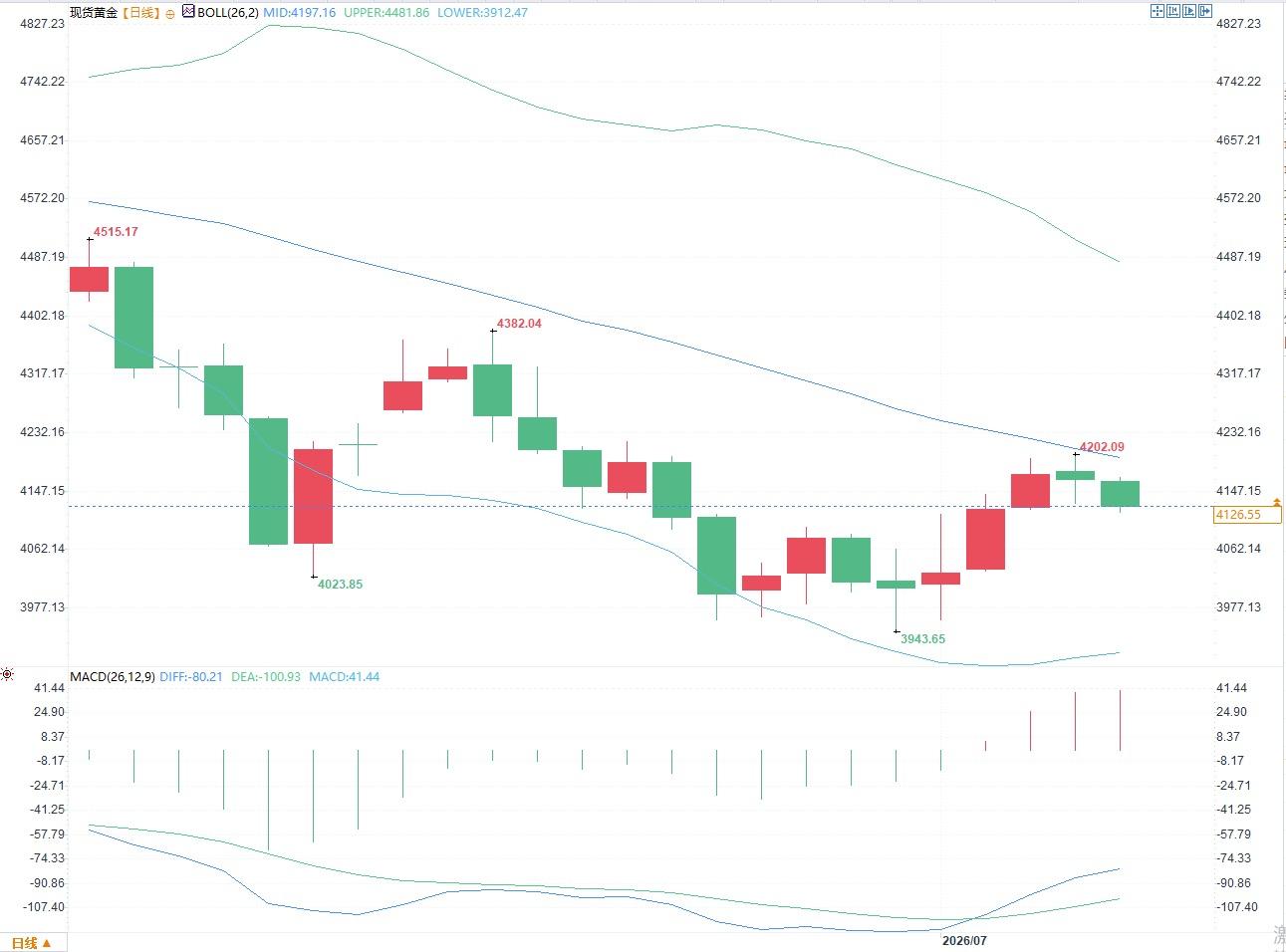
More importantly, a short-term supply zone has formed around $4,200 per ounce, and the daily candlestick chart shows insufficient continuation above this area. MACD data shows that the DIF is -80.21, the DEA is -100.93, and the histogram has turned positive to 41.44, indicating that the downward momentum has converged, but the trend indicators are still in negative territory. This structure usually represents a weakening of bearish momentum, rather than a resumption of the bullish trend.
Therefore, the current technical state of gold is more like a period of consolidation after a rapid decline. Frequent battles around $4130 per ounce indicate that the market is assessing whether there is room for repricing after the previous safe-haven premium has been priced back. If it cannot effectively regain the $4180-$4200 per ounce range, the technical rebound is still easily interpreted as a correction after the decline.
The key event this week is the release of the Federal Reserve's June meeting minutes. The market's current focus is not on whether interest rates will be adjusted immediately, but rather on how the minutes describe the trade-offs between the energy shock, slowing employment, and sticky inflation. Market reports indicate that the probability of a September rate hike has fallen from its previous higher level to around 56%, but this probability is still sufficient to suppress the valuation elasticity of non-interest-bearing assets.
The US dollar index is also exerting short-term pressure. Currently, the US dollar index is at 100.95, up 0.10% on the day. A stronger dollar will increase the cost of non-dollar funds allocating to gold, while rising US Treasury yields further amplify the opportunity cost of holding gold.
The future pricing of gold is likely to revolve around three key factors: first, whether the Hormuz event will continue to push up energy risk premiums; second, whether the Fed meeting minutes will reinforce the priority of inflation; and third, whether gold prices can recover to the $4,180-$4,200 per ounce range. As long as interest rate expectations do not ease significantly, even if gold attracts safe-haven buying, it is likely to exhibit high volatility rather than a smooth trend.
The real downward pressure on gold comes from the repricing of real interest rates.
On the surface, attacks on ships near the Strait of Hormuz should have strengthened safe-haven buying, but the gold market did not see a one-sided surge; instead, it fell back the following day. This indicates that the dominant variable in current gold trading is not simply geopolitical risk, but rather the secondary transmission of geopolitical risk to energy prices, inflation expectations, Treasury yields, and the US dollar index.
Shipping risks provided renewed support for oil prices, prompting market concerns about a potential return of pressure from energy imports. If inflation stickiness is repriced, gold's safe-haven appeal will be partially offset by higher interest rate expectations. The Federal Reserve's June meeting statement indicated that the target range for the federal funds rate remained at 3.50%-3.75%, while emphasizing that inflation is still relatively high compared to the 2% target, and that energy price shocks remain a policy consideration.
This explains the complex reaction in gold prices this time. Conflict risk isn't without a premium; rather, the premium is being swallowed up by the higher opportunity cost of holding. For traders, the current gold market isn't driven by a traditional single-factor safe-haven trend, but rather by a rebalancing effect of safe-haven demand, oil prices, inflation, interest rates, and the US dollar.
The Hormuz risk alters the inflation curve, not just risk aversion.
Recent reports indicate that a liquefied natural gas vessel was attacked in waters near Oman, and other commercial vessels were reportedly attacked while transiting the Strait of Hormuz, directly raising concerns about energy transport security.
Gold typically benefits from tail risks, but when risk events are concentrated in the energy transportation chain, the market may first trade on rising oil prices, rising inflation, and persistently high interest rates, rather than unconditionally buying gold. Especially before the release of the Federal Reserve meeting minutes, funds tend to reduce directional exposure, causing gold to fail to break through upper resistance levels despite news-driven stimuli.
Technical analysis indicates that the rebound has not yet completed the trend correction.
From the daily chart, spot gold rebounded from around $3943.65 per ounce, reaching a high of $4202.09 per ounce, but the price is still trading below the Bollinger Band middle line at around $4197.16 per ounce. The upper Bollinger Band is at $4481.86 per ounce, and the lower Bollinger Band is at $3912.47 per ounce, indicating that the medium-term trading range remains relatively wide, but the short-term rebound has not yet regained the middle Bollinger Band.
More importantly, a short-term supply zone has formed around $4,200 per ounce, and the daily candlestick chart shows insufficient continuation above this area. MACD data shows that the DIF is -80.21, the DEA is -100.93, and the histogram has turned positive to 41.44, indicating that the downward momentum has converged, but the trend indicators are still in negative territory. This structure usually represents a weakening of bearish momentum, rather than a resumption of the bullish trend.
Therefore, the current technical state of gold is more like a period of consolidation after a rapid decline. Frequent battles around $4130 per ounce indicate that the market is assessing whether there is room for repricing after the previous safe-haven premium has been priced back. If it cannot effectively regain the $4180-$4200 per ounce range, the technical rebound is still easily interpreted as a correction after the decline.
Short-term pricing focus shifts to the Fed meeting minutes
The key event this week is the release of the Federal Reserve's June meeting minutes. The market's current focus is not on whether interest rates will be adjusted immediately, but rather on how the minutes describe the trade-offs between the energy shock, slowing employment, and sticky inflation. Market reports indicate that the probability of a September rate hike has fallen from its previous higher level to around 56%, but this probability is still sufficient to suppress the valuation elasticity of non-interest-bearing assets.
The US dollar index is also exerting short-term pressure. Currently, the US dollar index is at 100.95, up 0.10% on the day. A stronger dollar will increase the cost of non-dollar funds allocating to gold, while rising US Treasury yields further amplify the opportunity cost of holding gold.
The future pricing of gold is likely to revolve around three key factors: first, whether the Hormuz event will continue to push up energy risk premiums; second, whether the Fed meeting minutes will reinforce the priority of inflation; and third, whether gold prices can recover to the $4,180-$4,200 per ounce range. As long as interest rate expectations do not ease significantly, even if gold attracts safe-haven buying, it is likely to exhibit high volatility rather than a smooth trend.
- Risk Warning and Disclaimer
- The market involves risk, and trading may not be suitable for all investors. This article is for reference only and does not constitute personal investment advice, nor does it take into account certain users’ specific investment objectives, financial situation, or other needs. Any investment decisions made based on this information are at your own risk.