The US dollar continued to rise against the Canadian dollar; however, caution is advised as the pair is near its previous highs and a potential pullback is possible.
2026-07-07 16:25:10
The US dollar extended its gains against the Canadian dollar in European trading on Tuesday, rising for the third consecutive day and currently trading around 1.4210. The dollar has recently found some support, mainly driven by escalating geopolitical risks and improved risk aversion. However, a reassessment of the Federal Reserve's future interest rate path has limited the dollar's upward momentum.

The evolving situation in the Strait of Hormuz has become a significant factor influencing the foreign exchange market recently. Escalating tensions between Iran and other parties over this strategic waterway, coupled with attacks on several commercial vessels during their passage, have raised concerns about the security of energy shipments. Iran recently fired at least two missiles at commercial vessels transiting the Strait of Hormuz, causing significant damage to two ships, but no casualties have been reported. Furthermore, the UK Maritime Trade Authority confirmed that an oil tanker traveling south was struck on its port side by an unidentified object, resulting in a fire on board.
Energy supply risks have driven a short-term rebound in international oil prices, with the market refocusing on the stability of global energy supplies. WTI crude oil prices, after a slight decline, have rebounded and are currently trading around $69.40 per barrel. The rise in oil prices has not only improved revenue expectations for energy-exporting countries but also provided support for the Canadian dollar, a commodity currency.
However, the appreciation of the US dollar against the Canadian dollar remains somewhat limited. As a major oil exporter, Canada's economy is closely linked to energy prices. When oil prices rise, the Canadian dollar typically receives capital inflows; conversely, falling oil prices can weaken Canadian export revenues and reduce foreign capital inflows, putting pressure on the Canadian dollar.
Regarding the US dollar, recent gains have primarily been driven by safe-haven demand, but monetary policy factors continue to exert downward pressure. US employment data showed that job growth in April, May, and June fell short of market expectations, leading investors to reduce their bets on a near-term Federal Reserve rate hike.
The market has significantly reduced its expectations for a Federal Reserve rate hike this month and in September, a shift that has weakened the confidence of dollar bulls. Meanwhile, the recent decline in oil prices is mainly due to increased OPEC+ production and expectations of easing tensions between the US and Iran, which has eased global inflationary pressures and reduced the need for the Federal Reserve to adopt aggressive policies.
The USD/CAD exchange rate is currently influenced by a confluence of factors. On one hand, geopolitical risks and demand for the US dollar as a safe haven are providing upward momentum; on the other hand, rising oil prices and the commodity attributes of the Canadian dollar are acting as headwinds. Going forward, the market will focus on changes in the energy market, US economic data, and shifts in global risk sentiment.
From a daily chart perspective, the USD/CAD pair has maintained its recent rebound, with prices rising continuously and regaining the 1.4200 area, indicating strengthened short-term bullish momentum. However, the exchange rate still faces resistance from the previous resistance zone. Currently, attention is focused on the resistance around 1.4250 ; a decisive break above this level could lead to a further test of the 1.4300 area. If the upward movement is met with resistance, a pullback to test the support around 1.4150 is possible, with further support at the 1.4100 area. Overall, the daily chart structure leans towards a volatile rebound, but sustained upward movement still requires further strengthening of the US dollar.
From a 4-hour chart perspective, the USD/CAD pair maintains its short-term upward channel, with the price moving along short-term moving averages, and buying power currently dominating. However, with technical indicators such as the RSI entering overbought territory, a short-term correction is possible. If the exchange rate breaks and holds above 1.4250, the upward trend may continue; if it falls below 1.4150, the short-term rebound structure may be disrupted, and the price may retest the support around 1.4100. The short-term direction still depends on oil price movements and changes in risk aversion.
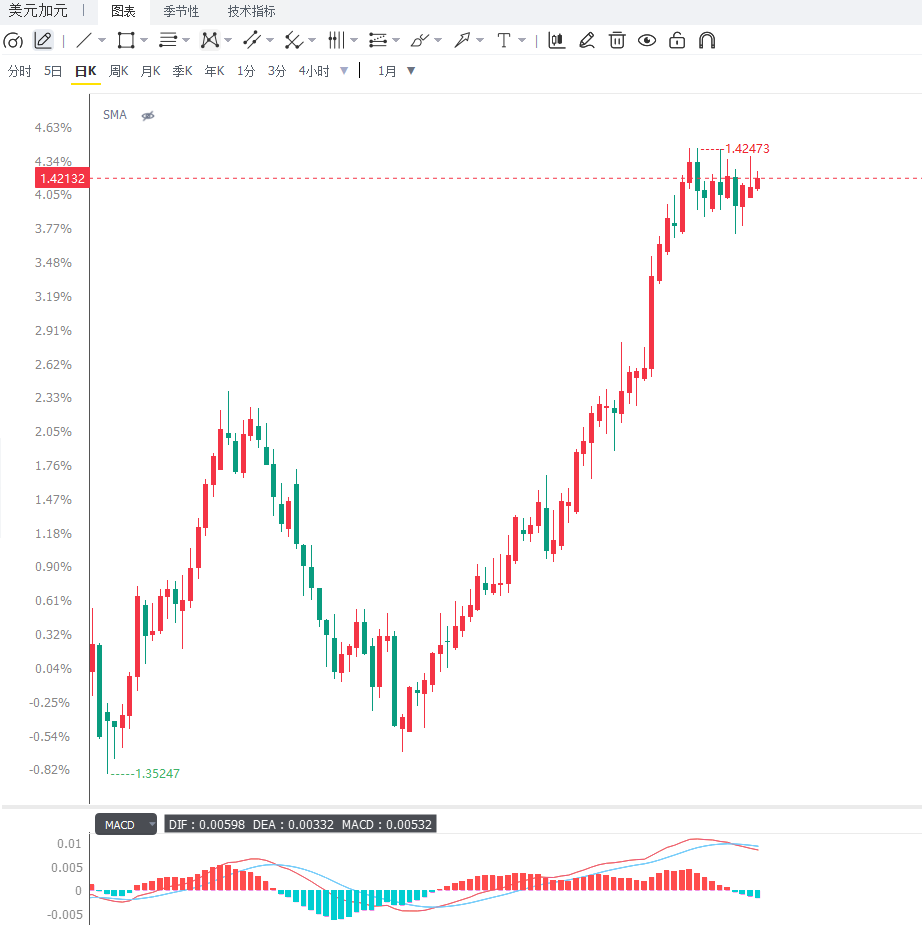
Editor's Summary : The recent rise in USD/CAD has been primarily driven by safe-haven demand for the US dollar, but the trend is not one-sided. Increased risks in the Strait of Hormuz have boosted market demand for the US dollar, while rebounding oil prices have provided support for the Canadian dollar, creating a tug-of-war between bulls and bears. Future movements will hinge on the sustainability of energy market risks and changes in expectations regarding Federal Reserve policy. If geopolitical risks escalate further, the US dollar may continue to receive safe-haven buying support; however, if oil prices remain strong, the Canadian dollar may limit the upside potential for USD/CAD. In the short term, the 1.4100 to 1.4250 area will be a crucial trading range for USD/CAD , and the direction of the breakout may determine the next phase of the trend. Investors should pay close attention to changes in oil prices, US economic data, and the evolution of global risk sentiment.
The evolving situation in the Strait of Hormuz has become a significant factor influencing the foreign exchange market recently. Escalating tensions between Iran and other parties over this strategic waterway, coupled with attacks on several commercial vessels during their passage, have raised concerns about the security of energy shipments. Iran recently fired at least two missiles at commercial vessels transiting the Strait of Hormuz, causing significant damage to two ships, but no casualties have been reported. Furthermore, the UK Maritime Trade Authority confirmed that an oil tanker traveling south was struck on its port side by an unidentified object, resulting in a fire on board.
Energy supply risks have driven a short-term rebound in international oil prices, with the market refocusing on the stability of global energy supplies. WTI crude oil prices, after a slight decline, have rebounded and are currently trading around $69.40 per barrel. The rise in oil prices has not only improved revenue expectations for energy-exporting countries but also provided support for the Canadian dollar, a commodity currency.
However, the appreciation of the US dollar against the Canadian dollar remains somewhat limited. As a major oil exporter, Canada's economy is closely linked to energy prices. When oil prices rise, the Canadian dollar typically receives capital inflows; conversely, falling oil prices can weaken Canadian export revenues and reduce foreign capital inflows, putting pressure on the Canadian dollar.
Regarding the US dollar, recent gains have primarily been driven by safe-haven demand, but monetary policy factors continue to exert downward pressure. US employment data showed that job growth in April, May, and June fell short of market expectations, leading investors to reduce their bets on a near-term Federal Reserve rate hike.
The market has significantly reduced its expectations for a Federal Reserve rate hike this month and in September, a shift that has weakened the confidence of dollar bulls. Meanwhile, the recent decline in oil prices is mainly due to increased OPEC+ production and expectations of easing tensions between the US and Iran, which has eased global inflationary pressures and reduced the need for the Federal Reserve to adopt aggressive policies.
The USD/CAD exchange rate is currently influenced by a confluence of factors. On one hand, geopolitical risks and demand for the US dollar as a safe haven are providing upward momentum; on the other hand, rising oil prices and the commodity attributes of the Canadian dollar are acting as headwinds. Going forward, the market will focus on changes in the energy market, US economic data, and shifts in global risk sentiment.
From a daily chart perspective, the USD/CAD pair has maintained its recent rebound, with prices rising continuously and regaining the 1.4200 area, indicating strengthened short-term bullish momentum. However, the exchange rate still faces resistance from the previous resistance zone. Currently, attention is focused on the resistance around 1.4250 ; a decisive break above this level could lead to a further test of the 1.4300 area. If the upward movement is met with resistance, a pullback to test the support around 1.4150 is possible, with further support at the 1.4100 area. Overall, the daily chart structure leans towards a volatile rebound, but sustained upward movement still requires further strengthening of the US dollar.
From a 4-hour chart perspective, the USD/CAD pair maintains its short-term upward channel, with the price moving along short-term moving averages, and buying power currently dominating. However, with technical indicators such as the RSI entering overbought territory, a short-term correction is possible. If the exchange rate breaks and holds above 1.4250, the upward trend may continue; if it falls below 1.4150, the short-term rebound structure may be disrupted, and the price may retest the support around 1.4100. The short-term direction still depends on oil price movements and changes in risk aversion.
Editor's Summary : The recent rise in USD/CAD has been primarily driven by safe-haven demand for the US dollar, but the trend is not one-sided. Increased risks in the Strait of Hormuz have boosted market demand for the US dollar, while rebounding oil prices have provided support for the Canadian dollar, creating a tug-of-war between bulls and bears. Future movements will hinge on the sustainability of energy market risks and changes in expectations regarding Federal Reserve policy. If geopolitical risks escalate further, the US dollar may continue to receive safe-haven buying support; however, if oil prices remain strong, the Canadian dollar may limit the upside potential for USD/CAD. In the short term, the 1.4100 to 1.4250 area will be a crucial trading range for USD/CAD , and the direction of the breakout may determine the next phase of the trend. Investors should pay close attention to changes in oil prices, US economic data, and the evolution of global risk sentiment.
- Risk Warning and Disclaimer
- The market involves risk, and trading may not be suitable for all investors. This article is for reference only and does not constitute personal investment advice, nor does it take into account certain users’ specific investment objectives, financial situation, or other needs. Any investment decisions made based on this information are at your own risk.