German industrial production unexpectedly accelerated, causing the euro to fluctuate around 1.1400 against the dollar.
2026-07-07 15:12:31
German industry has recently released positive signals. The latest data shows that German industrial production grew by 0.9% month-on-month in May, significantly higher than the market expectation of 0.2% and also higher than the previous value of 0.4%. This data indicates that as Europe's largest economy, Germany's manufacturing activity is gradually improving, and signs of economic recovery are strengthening.

However, the euro market reacted relatively mutedly to the release of German industrial data. The euro did not rise significantly against the dollar and is currently trading around 1.1430, indicating that investors remain cautious about the impact of a single economic data point. The market believes that despite the improvement in German industrial activity, the European economic recovery still faces challenges such as insufficient growth momentum and policy uncertainty.
From an exchange rate perspective, the euro has maintained a fluctuating pattern against the US dollar since mid-June, mainly trading within the 1.1350 to 1.1450 range. The market lacks new strong catalysts, and investors are awaiting more economic data and central bank policy signals in the fall. German industrial orders data previously indicated a gradual improvement in the economic cycle, which may provide some support for the euro in the future. Meanwhile, structural reforms and fiscal expansion policies in Europe are expected to improve regional economic growth expectations, strengthening market confidence in the euro's medium- to long-term performance.
Regarding monetary policy, the next European Central Bank (ECB) rate hike is expected to be delayed until September. The market anticipates that the ECB may maintain current interest rates while retaining the possibility of further tightening in the future to address inflation changes. In the US, the market currently expects the Federal Reserve to still have some possibility of raising interest rates before the end of the year, but the policy path remains highly uncertain. If the Fed subsequently releases more cautious signals, the upside potential of the dollar may be limited, thereby gradually supporting the euro's performance.
Analysts believe that the euro/dollar exchange rate is likely to remain range-bound in the short term, awaiting new direction from economic data and policy changes in Europe and the US. As we move into the next year, if the improving trend in the European economy continues, the euro may receive longer-term support.
From a daily chart perspective, the EUR/USD pair is currently maintaining a sideways trading pattern, with the price fluctuating within the 1.1350 to 1.1450 range, indicating a temporary balance between bullish and bearish forces. In the short term, the pair remains under pressure from the upper edge of this range. A break above the 1.1450 resistance area could lead to a further test of the 1.1500 resistance level; conversely, a break below the key 1.1350 support could result in a retest of the 1.1300 area. Current market momentum is neutral, and a clear trend direction requires confirmation through a breakout.
From a 4-hour chart perspective, the EUR/USD pair maintains a narrow consolidation pattern, with short-term moving averages flattening out, indicating the market is entering a phase of directional choice. Technical indicators do not show clear one-sided signals. If the price holds above 1.1430, it may challenge the 1.1450-1.1500 area; if the rebound is met with resistance, it may fall back to test support near 1.1380. Short-term movement still depends on the strength of the US dollar and adjustments in policy expectations from European and American central banks.
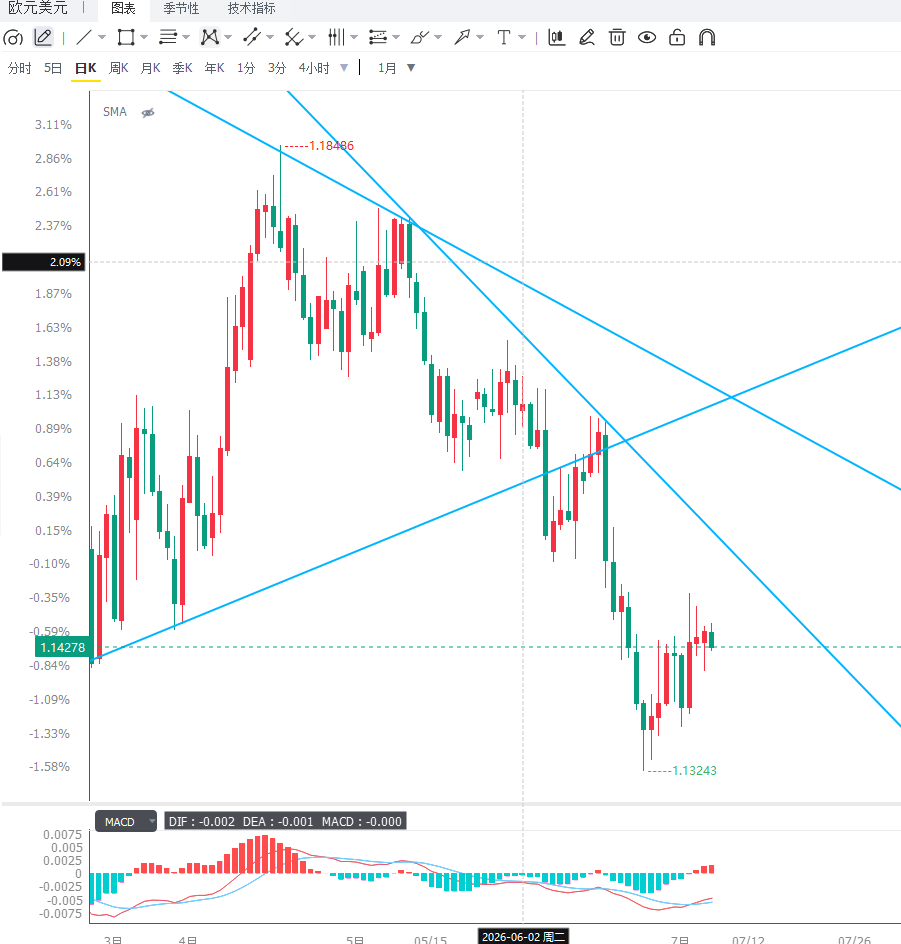
Editor's Summary : Stronger-than-expected growth in German industrial production provides a positive signal for the European economic recovery. However, the euro/dollar exchange rate remains affected by policy uncertainty and market caution in the short term, failing to establish a clear upward trend. The future direction of the euro hinges on the European Central Bank's policy adjustments, the Federal Reserve's interest rate path, and the strength of the European economic recovery. If the European economic improvement continues, and the dollar weakens due to policy expectations, the euro may gradually gain upward momentum. In the short term, the euro/dollar exchange rate remains in a consolidation phase, and the direction of the breakout from the 1.1350-1.1450 range will be the focus of market attention.
However, the euro market reacted relatively mutedly to the release of German industrial data. The euro did not rise significantly against the dollar and is currently trading around 1.1430, indicating that investors remain cautious about the impact of a single economic data point. The market believes that despite the improvement in German industrial activity, the European economic recovery still faces challenges such as insufficient growth momentum and policy uncertainty.
From an exchange rate perspective, the euro has maintained a fluctuating pattern against the US dollar since mid-June, mainly trading within the 1.1350 to 1.1450 range. The market lacks new strong catalysts, and investors are awaiting more economic data and central bank policy signals in the fall. German industrial orders data previously indicated a gradual improvement in the economic cycle, which may provide some support for the euro in the future. Meanwhile, structural reforms and fiscal expansion policies in Europe are expected to improve regional economic growth expectations, strengthening market confidence in the euro's medium- to long-term performance.
Regarding monetary policy, the next European Central Bank (ECB) rate hike is expected to be delayed until September. The market anticipates that the ECB may maintain current interest rates while retaining the possibility of further tightening in the future to address inflation changes. In the US, the market currently expects the Federal Reserve to still have some possibility of raising interest rates before the end of the year, but the policy path remains highly uncertain. If the Fed subsequently releases more cautious signals, the upside potential of the dollar may be limited, thereby gradually supporting the euro's performance.
Analysts believe that the euro/dollar exchange rate is likely to remain range-bound in the short term, awaiting new direction from economic data and policy changes in Europe and the US. As we move into the next year, if the improving trend in the European economy continues, the euro may receive longer-term support.
From a daily chart perspective, the EUR/USD pair is currently maintaining a sideways trading pattern, with the price fluctuating within the 1.1350 to 1.1450 range, indicating a temporary balance between bullish and bearish forces. In the short term, the pair remains under pressure from the upper edge of this range. A break above the 1.1450 resistance area could lead to a further test of the 1.1500 resistance level; conversely, a break below the key 1.1350 support could result in a retest of the 1.1300 area. Current market momentum is neutral, and a clear trend direction requires confirmation through a breakout.
From a 4-hour chart perspective, the EUR/USD pair maintains a narrow consolidation pattern, with short-term moving averages flattening out, indicating the market is entering a phase of directional choice. Technical indicators do not show clear one-sided signals. If the price holds above 1.1430, it may challenge the 1.1450-1.1500 area; if the rebound is met with resistance, it may fall back to test support near 1.1380. Short-term movement still depends on the strength of the US dollar and adjustments in policy expectations from European and American central banks.
Editor's Summary : Stronger-than-expected growth in German industrial production provides a positive signal for the European economic recovery. However, the euro/dollar exchange rate remains affected by policy uncertainty and market caution in the short term, failing to establish a clear upward trend. The future direction of the euro hinges on the European Central Bank's policy adjustments, the Federal Reserve's interest rate path, and the strength of the European economic recovery. If the European economic improvement continues, and the dollar weakens due to policy expectations, the euro may gradually gain upward momentum. In the short term, the euro/dollar exchange rate remains in a consolidation phase, and the direction of the breakout from the 1.1350-1.1450 range will be the focus of market attention.
- Risk Warning and Disclaimer
- The market involves risk, and trading may not be suitable for all investors. This article is for reference only and does not constitute personal investment advice, nor does it take into account certain users’ specific investment objectives, financial situation, or other needs. Any investment decisions made based on this information are at your own risk.