Overnight volatility intensified! Asian gold trading strategy following the FOMC meeting.
2026-07-07 18:03:42
The Federal Open Market Committee (FOMC) decision is usually released between 2 and 3 a.m. in the Asian session, which can easily trigger gaps in overnight gold positions and trigger concentrated stop-loss orders, significantly increasing the risk of overnight positions. Due to the time difference, Asian traders cannot monitor the market in real time during non-peak trading hours to deal with sudden market movements, greatly increasing the probability of passive losses. This is the core risk of overnight positions during the FOMC meeting window.

From a market-driven perspective, when market expectations for interest rate hikes intensify, the attractiveness of interest-bearing dollar assets increases significantly, directly weakening the value of non-interest-bearing safe-haven assets like gold, thus exerting sustained downward pressure on gold prices. In the initial stages following the FOMC decision, market activity is primarily driven by quantitative algorithmic trading, resulting in rapid and volatile gold price fluctuations and frequent short-term stop-loss orders. Subsequent comments from the Fed Chair's press conference will further revise and reshape market expectations for monetary policy, likely driving a market reversal or continuation of the existing trend, leading to a two-stage market movement. To mitigate this risk, traders can employ multiple risk management strategies, such as reducing position size, lowering leverage, appropriately widening stop-loss ranges, and utilizing micro-account trading, to effectively hedge against the overnight extreme volatility risk brought about by FOMC events.
The core impact of the FOMC meeting on Asian gold trading
The FOMC monetary policy meeting is a core macroeconomic event that dominates short-term international gold price trends. Coupled with the time difference restrictions in the Asian market, its impact on Asian gold traders and the associated trading risks are far greater than during European and American trading sessions. The interplay of macroeconomic policy signals, key technical price levels, and the time-sensitive nature of non-trading hours creates a unique market landscape in gold where high risk and high opportunity coexist.
Naked positions held overnight without proper risk management are highly susceptible to significant profit and loss fluctuations during short-term extreme market conditions. Traders who can monitor the market in real time and actively manage their positions can promptly capture market sentiment, interest rate hike expectations, and rapid changes in the US dollar index, adjust their trading strategies accordingly, and accurately seize swing trading opportunities.
The core reason why the market is focusing on the FOMC meeting
Trading time zone differences are a unique and core pain point for Asian gold traders. Key information such as FOMC policy decisions, interest rate adjustments, and forward policy guidance are all concentrated in the late-night, less active trading hours in Asia. Ordinary traders find it difficult to monitor the market in real time and respond promptly, leaving overnight positions completely exposed to the risks of sudden and drastic market movements.
From the perspective of market transmission rhythm, quantitative algorithmic trading systems will immediately capture interest rate decision data and automatically execute batch trades, driving gold prices into a rapid one-sided trend. Subsequently, the Fed Chairman's on-site Q&A and policy details interpretation will correct the market's previous one-sided expectations, triggering a rapid market reversal or accelerating the original trend. The combination of machine-programmed centralized trading and speculative market funds following the trend further amplifies the short-term volatility of gold and exacerbates market uncertainty.
Overall market sentiment is primarily driven by three core factors: expectations of Fed rate hikes and cuts, US inflation data, and the strength of the US dollar index. In response to such highly volatile market conditions, professional traders generally mitigate overnight risks and ensure account stability by setting reasonable stop-loss orders, strictly controlling trading leverage, and reducing position exposure. The convergence of multiple macroeconomic signals, technical patterns, and time zone risks makes the FOMC meeting a top-tier, crucial event determining the short-term trend of XAUUSD and influencing the success or failure of swing trading.
Gold Technical Analysis and Key Price Levels
A review of past FOMC meetings reveals that gold price fluctuations exhibit a clear two-stage pattern, with a well-defined and highly identifiable market rhythm. The first stage occurs immediately after the interest rate decision is announced, when quantitative funds and short-term speculative funds concentrate their portfolio adjustments, driving gold prices into rapid and significant price movements. These movements are characterized by extremely strong instantaneous volatility, a high probability of order book manipulation, and a distinctly disorderly fluctuation pattern.
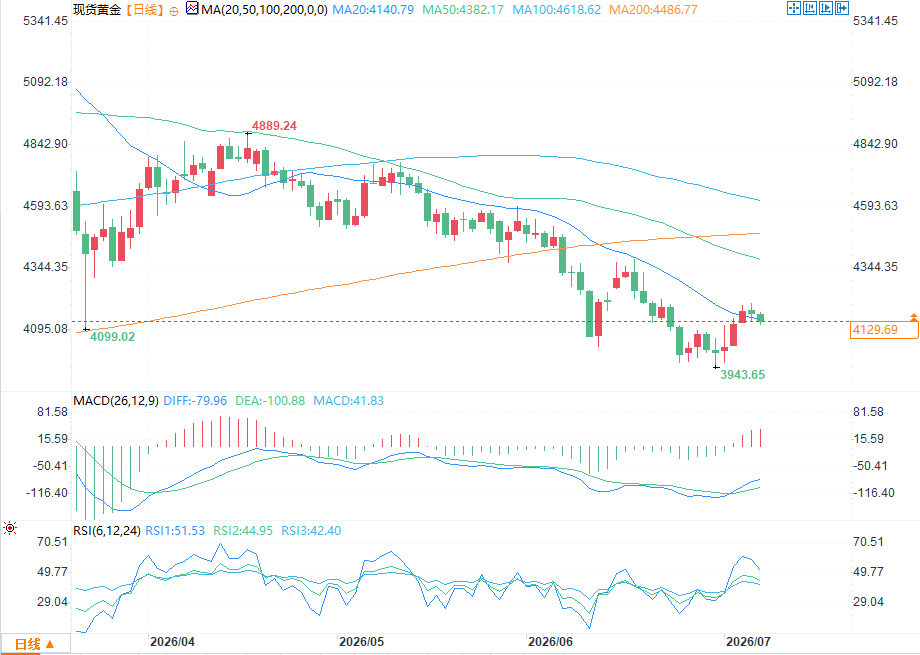
(Spot gold daily chart source: FX678)
The second phase of market activity will focus on the entire Federal Reserve press conference. The market will combine the tone and policy details of the Chairman's speech to reinterpret the future direction of monetary policy, and make a second correction to the initial rapid market movement after the decision. This could either confirm the initial trend and continue it, or it could completely reverse and move in the opposite direction.
In these event-driven, highly volatile market conditions, traders do not need to frequently gamble on short-term noise. By focusing on the short-term moving average trend and the intraday oscillation rhythm, they can accurately judge the strength of market momentum, capture bullish and bearish reversal signals, and lock in the optimal entry and exit points.
Short-term gold trading outlook and practical strategies
Spot gold edged lower on Monday, with XAU/USD falling approximately 0.50% to close at $4153. The continued strength of US Treasury yields and the US dollar index is directly limiting any potential rebound in gold prices. A slight decline in the US services PMI and cooling inflation data have driven continued adjustments in market interest rate expectations. The probability of a Fed rate hike in December has now risen to 88%, and expectations of tighter monetary policy continue to exert downward pressure on gold.
Both technical and fundamental factors are weak, with the US dollar index and 10-year US Treasury yield remaining high, continuously raising the opportunity cost of holding gold and lowering the value of non-interest-bearing gold assets. In the short term, the focus is on two key indicators: the US CPI data on July 14th and the Fed meeting minutes . Technically, the daily chart has formed a death cross bearish pattern, with the $4200-$4225 range as the core strong resistance zone, and the $4100 psychological level and the year's low of $3941 as key support levels. The overall bearish pattern is clear.
During the FOMC meeting window, the gold market is extremely sensitive to sentiment and reacts sharply. Traders need to completely abandon the mindset of passively holding positions and holding naked positions overnight, and instead proactively and meticulously manage their positions to flexibly respond to rapid market shifts. Until gold prices effectively break through the key resistance level of $4200, the short-term weak and volatile pattern is unlikely to reverse.
Practical trading requires focusing on three core dimensions to accurately grasp the main market trend. First, closely follow the FOMC policy decisions and real-time speeches by Federal Reserve officials to accurately capture changes in policy direction and tone. Second, continuously track core US economic data such as inflation and employment, as this data is the core basis for market adjustments to interest rate hike expectations and directly dominates the medium-term trend of gold prices. Third, closely monitor fluctuations in the US dollar index and US Treasury yields, as these determine the opportunity cost of gold and are the core driving factors for short-term market movements. Among these, the US CPI data on July 14th is a key indicator for short-term gold prices; the strength of core US inflation will directly determine the Federal Reserve's policy expectations and thus the short-term bullish or bearish trend of gold.
The gold CFD two-way trading mechanism provides flexible tactical position adjustments in highly volatile markets, allowing for rapid switching between long and short positions based on trend changes. During periods of high volatility following the FOMC meeting, strictly adhering to trading discipline, proactively reducing leverage, and positioning based on key technical price levels can effectively mitigate the risks of overnight extreme gaps and stop-loss orders, while accurately capturing event-driven swing trading opportunities, achieving a balance between risk and return. Given the current bearish technical pattern, short-term positions can be opened with put options at a strike price of $4100, while also reserving contingency plans for a potential rebound in gold prices due to cooling inflation data. With the CPI data release approaching, market volatility continues to rise, and institutional positions are generally cautious. Therefore, strict position control and light trading are necessary to minimize uncertainty risks.
From a market-driven perspective, when market expectations for interest rate hikes intensify, the attractiveness of interest-bearing dollar assets increases significantly, directly weakening the value of non-interest-bearing safe-haven assets like gold, thus exerting sustained downward pressure on gold prices. In the initial stages following the FOMC decision, market activity is primarily driven by quantitative algorithmic trading, resulting in rapid and volatile gold price fluctuations and frequent short-term stop-loss orders. Subsequent comments from the Fed Chair's press conference will further revise and reshape market expectations for monetary policy, likely driving a market reversal or continuation of the existing trend, leading to a two-stage market movement. To mitigate this risk, traders can employ multiple risk management strategies, such as reducing position size, lowering leverage, appropriately widening stop-loss ranges, and utilizing micro-account trading, to effectively hedge against the overnight extreme volatility risk brought about by FOMC events.
The core impact of the FOMC meeting on Asian gold trading
The FOMC monetary policy meeting is a core macroeconomic event that dominates short-term international gold price trends. Coupled with the time difference restrictions in the Asian market, its impact on Asian gold traders and the associated trading risks are far greater than during European and American trading sessions. The interplay of macroeconomic policy signals, key technical price levels, and the time-sensitive nature of non-trading hours creates a unique market landscape in gold where high risk and high opportunity coexist.
Naked positions held overnight without proper risk management are highly susceptible to significant profit and loss fluctuations during short-term extreme market conditions. Traders who can monitor the market in real time and actively manage their positions can promptly capture market sentiment, interest rate hike expectations, and rapid changes in the US dollar index, adjust their trading strategies accordingly, and accurately seize swing trading opportunities.
The core reason why the market is focusing on the FOMC meeting
Trading time zone differences are a unique and core pain point for Asian gold traders. Key information such as FOMC policy decisions, interest rate adjustments, and forward policy guidance are all concentrated in the late-night, less active trading hours in Asia. Ordinary traders find it difficult to monitor the market in real time and respond promptly, leaving overnight positions completely exposed to the risks of sudden and drastic market movements.
From the perspective of market transmission rhythm, quantitative algorithmic trading systems will immediately capture interest rate decision data and automatically execute batch trades, driving gold prices into a rapid one-sided trend. Subsequently, the Fed Chairman's on-site Q&A and policy details interpretation will correct the market's previous one-sided expectations, triggering a rapid market reversal or accelerating the original trend. The combination of machine-programmed centralized trading and speculative market funds following the trend further amplifies the short-term volatility of gold and exacerbates market uncertainty.
Overall market sentiment is primarily driven by three core factors: expectations of Fed rate hikes and cuts, US inflation data, and the strength of the US dollar index. In response to such highly volatile market conditions, professional traders generally mitigate overnight risks and ensure account stability by setting reasonable stop-loss orders, strictly controlling trading leverage, and reducing position exposure. The convergence of multiple macroeconomic signals, technical patterns, and time zone risks makes the FOMC meeting a top-tier, crucial event determining the short-term trend of XAUUSD and influencing the success or failure of swing trading.
Gold Technical Analysis and Key Price Levels
A review of past FOMC meetings reveals that gold price fluctuations exhibit a clear two-stage pattern, with a well-defined and highly identifiable market rhythm. The first stage occurs immediately after the interest rate decision is announced, when quantitative funds and short-term speculative funds concentrate their portfolio adjustments, driving gold prices into rapid and significant price movements. These movements are characterized by extremely strong instantaneous volatility, a high probability of order book manipulation, and a distinctly disorderly fluctuation pattern.
(Spot gold daily chart source: FX678)
The second phase of market activity will focus on the entire Federal Reserve press conference. The market will combine the tone and policy details of the Chairman's speech to reinterpret the future direction of monetary policy, and make a second correction to the initial rapid market movement after the decision. This could either confirm the initial trend and continue it, or it could completely reverse and move in the opposite direction.
In these event-driven, highly volatile market conditions, traders do not need to frequently gamble on short-term noise. By focusing on the short-term moving average trend and the intraday oscillation rhythm, they can accurately judge the strength of market momentum, capture bullish and bearish reversal signals, and lock in the optimal entry and exit points.
Short-term gold trading outlook and practical strategies
Spot gold edged lower on Monday, with XAU/USD falling approximately 0.50% to close at $4153. The continued strength of US Treasury yields and the US dollar index is directly limiting any potential rebound in gold prices. A slight decline in the US services PMI and cooling inflation data have driven continued adjustments in market interest rate expectations. The probability of a Fed rate hike in December has now risen to 88%, and expectations of tighter monetary policy continue to exert downward pressure on gold.
Both technical and fundamental factors are weak, with the US dollar index and 10-year US Treasury yield remaining high, continuously raising the opportunity cost of holding gold and lowering the value of non-interest-bearing gold assets. In the short term, the focus is on two key indicators: the US CPI data on July 14th and the Fed meeting minutes . Technically, the daily chart has formed a death cross bearish pattern, with the $4200-$4225 range as the core strong resistance zone, and the $4100 psychological level and the year's low of $3941 as key support levels. The overall bearish pattern is clear.
During the FOMC meeting window, the gold market is extremely sensitive to sentiment and reacts sharply. Traders need to completely abandon the mindset of passively holding positions and holding naked positions overnight, and instead proactively and meticulously manage their positions to flexibly respond to rapid market shifts. Until gold prices effectively break through the key resistance level of $4200, the short-term weak and volatile pattern is unlikely to reverse.
Practical trading requires focusing on three core dimensions to accurately grasp the main market trend. First, closely follow the FOMC policy decisions and real-time speeches by Federal Reserve officials to accurately capture changes in policy direction and tone. Second, continuously track core US economic data such as inflation and employment, as this data is the core basis for market adjustments to interest rate hike expectations and directly dominates the medium-term trend of gold prices. Third, closely monitor fluctuations in the US dollar index and US Treasury yields, as these determine the opportunity cost of gold and are the core driving factors for short-term market movements. Among these, the US CPI data on July 14th is a key indicator for short-term gold prices; the strength of core US inflation will directly determine the Federal Reserve's policy expectations and thus the short-term bullish or bearish trend of gold.
The gold CFD two-way trading mechanism provides flexible tactical position adjustments in highly volatile markets, allowing for rapid switching between long and short positions based on trend changes. During periods of high volatility following the FOMC meeting, strictly adhering to trading discipline, proactively reducing leverage, and positioning based on key technical price levels can effectively mitigate the risks of overnight extreme gaps and stop-loss orders, while accurately capturing event-driven swing trading opportunities, achieving a balance between risk and return. Given the current bearish technical pattern, short-term positions can be opened with put options at a strike price of $4100, while also reserving contingency plans for a potential rebound in gold prices due to cooling inflation data. With the CPI data release approaching, market volatility continues to rise, and institutional positions are generally cautious. Therefore, strict position control and light trading are necessary to minimize uncertainty risks.
- Risk Warning and Disclaimer
- The market involves risk, and trading may not be suitable for all investors. This article is for reference only and does not constitute personal investment advice, nor does it take into account certain users’ specific investment objectives, financial situation, or other needs. Any investment decisions made based on this information are at your own risk.