The Hormuz Rivers are in turmoil again; Brent crude at $73 is just the first sign.
2026-07-07 17:52:34
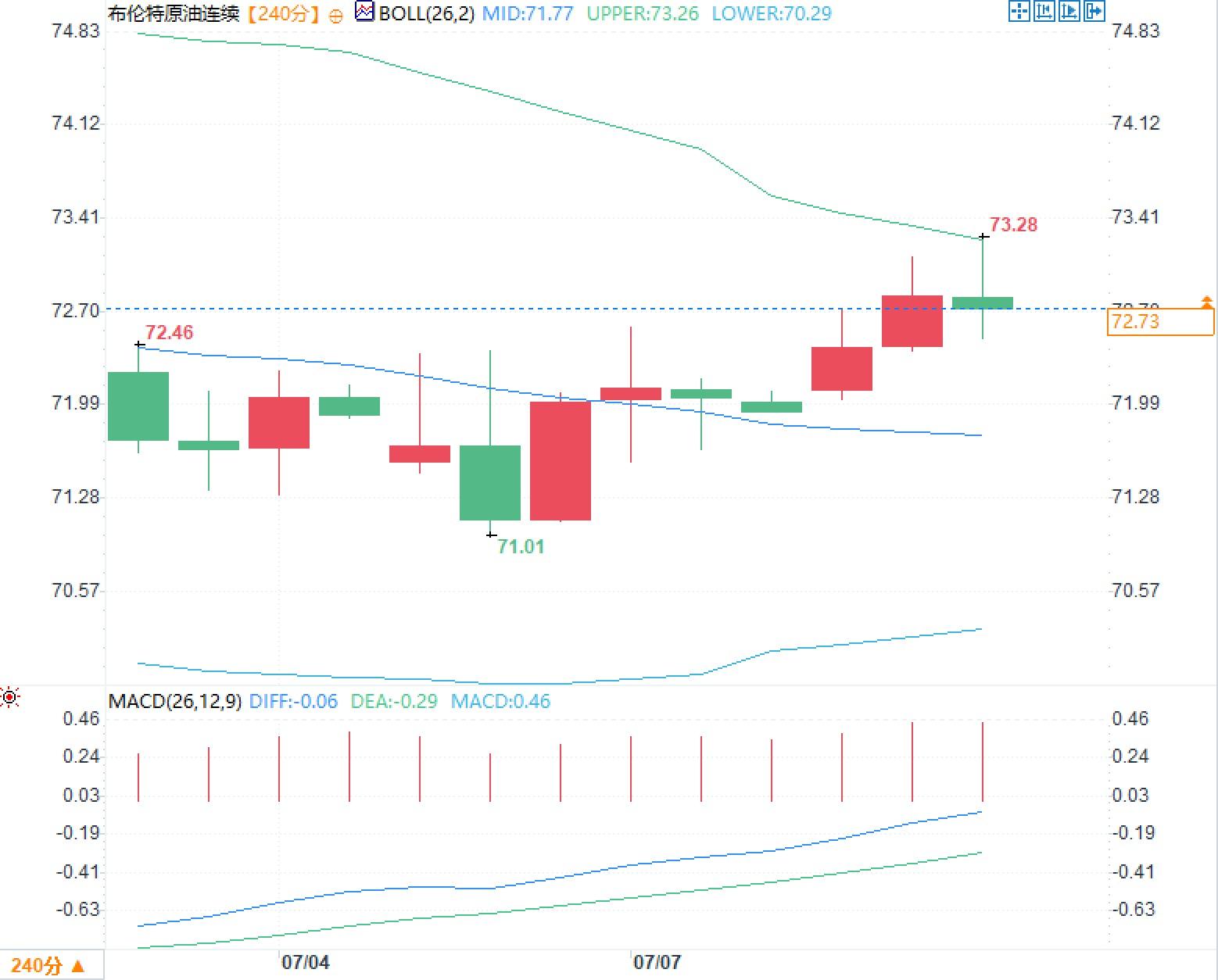
On Tuesday, July 7th, the core variable in the crude oil market shifted from simple supply and demand pricing to a "rebalancing of shipping safety premiums and expectations of supply recovery." Currently, Brent crude oil futures are trading around $73 per barrel, and West Texas Intermediate (WTI) crude oil futures are around $69 per barrel, a modest increase from the previous trading day. The price reaction was not exaggerated, but it was highly informative: another merchant ship was damaged near the Strait of Hormuz, and the market is re-incorporating the probability of shipping disruptions, insurance rate increases, and shipowners taking safer routes. Meanwhile, major oil-producing countries continued to increase production by 188,000 barrels per day in August, and expectations of supply recovery continue to suppress the expansion of risk premiums.
The key to this round of oil price reactions lies not in the damage to individual vessels, but in the market's reassessment of whether the resumption of traffic flow is stable. Recent news indicates that after an LNG carrier was attacked in waters near Oman, reports have emerged of damage to Saudi-flagged crude oil tankers in the vicinity of the Strait of Hormuz's exit. If stable expectations for traffic flow through this strait cannot be established, the crude oil futures curve will prioritize reflecting shipping risks rather than waiting for a physical shortage to materialize.
It's worth noting that Brent crude rebounded from around $71.99/barrel the previous day to around $73/barrel, with the increase reflecting more of a short-term risk premium recovery than a new structural gap emerging in the inventory situation. The market did not experience an out-of-control surge, indicating that funds are still differentiating between pricing differences between "localized disruptions" and "complete liquidity disruptions."
The Strait of Hormuz repeatedly influences crude oil prices because it is not an ordinary shipping route, but a key bottleneck in energy trade. Energy statistics show that in the first half of 2025, approximately 19.2 million barrels of crude oil and condensate passed through the strait per day, accounting for a significant share of global maritime energy flows. As long as shipowners, charterers, and insurers cannot confirm safe passage, the market will revalue "passable" as "high-cost passage."
This is also why this event is more sensitive to trading activity. Shipping disruptions may not immediately manifest as a shortage of spot goods, but they will first appear in insurance premiums, shipping delays, landed costs, and regional price differentials. If merchant ships are attacked repeatedly in the same sea area, insurance companies usually do not wait for the official conclusions to be fully released, but instead raise their risk pricing. For the crude oil market, these costs are not explicit inventory on the inventory list, but they will be transmitted to prices through premiums/discounts, freight, and refinery purchasing patterns.
Parallel to geopolitical disruptions is a recovery on the supply side. Major oil-producing countries have raised their production plans for the fifth consecutive month, with an increase of 188,000 barrels per day in August. This means the market is not only facing supply disruptions, but also production replenishment and market share competition. If the strait remains a low-intensity disturbance, prices will rise to a higher risk level; if physical logistics recover faster than expected, the risk premium will likely be absorbed by increased production and seller competition.
Demand is not strong enough to unconditionally absorb high prices. The latest monthly energy report projects that global oil demand will decline by 1.1 million barrels per day year-on-year in 2026, while global supply is expected to fall to 102.4 million barrels per day. The report also emphasizes that the restoration of the Strait of Hormuz is still constrained by mine clearance, passage arrangements, and the normalization of the supply chain. In other words, the fundamentals are not a simple "oil shortage narrative," but rather a combination of supply recovery, weakening demand, and risks associated with the passage.
Inventory data provided some support for oil prices. For the week ending June 26, U.S. commercial crude oil inventories decreased by 3.775 million barrels to 408.3 million barrels, refinery utilization rose to 96.6%, and refinery crude oil processing volume was 17.2 million barrels per day, an increase of 85,000 barrels per day from the previous week. This data indicates that seasonal demand for refined products and refinery processing are still supporting crude oil consumption, but the rebound of 709,000 barrels in Cushing inventories also suggests that the tightness at the delivery point has eased somewhat.
For traders, the key is not to mechanically interpret declining inventories as bullish, but rather to consider the price, freight, and cracking conditions under which the inventory decline occurs. If high refinery operating rates are based on still-profitable refined oil products, crude oil demand remains resilient; however, if refined oil product inventories accumulate or cracking declines subsequently, the crude oil market's response to geopolitical risks will become more dependent on news-driven events.
First, the rise in oil prices is not a declaration of a trend, but rather a correction of the risk premium.
The key to this round of oil price reactions lies not in the damage to individual vessels, but in the market's reassessment of whether the resumption of traffic flow is stable. Recent news indicates that after an LNG carrier was attacked in waters near Oman, reports have emerged of damage to Saudi-flagged crude oil tankers in the vicinity of the Strait of Hormuz's exit. If stable expectations for traffic flow through this strait cannot be established, the crude oil futures curve will prioritize reflecting shipping risks rather than waiting for a physical shortage to materialize.
It's worth noting that Brent crude rebounded from around $71.99/barrel the previous day to around $73/barrel, with the increase reflecting more of a short-term risk premium recovery than a new structural gap emerging in the inventory situation. The market did not experience an out-of-control surge, indicating that funds are still differentiating between pricing differences between "localized disruptions" and "complete liquidity disruptions."
Second, the pricing power in the Strait of Hormuz comes from insurance and shipping schedules, not just the passage itself.
The Strait of Hormuz repeatedly influences crude oil prices because it is not an ordinary shipping route, but a key bottleneck in energy trade. Energy statistics show that in the first half of 2025, approximately 19.2 million barrels of crude oil and condensate passed through the strait per day, accounting for a significant share of global maritime energy flows. As long as shipowners, charterers, and insurers cannot confirm safe passage, the market will revalue "passable" as "high-cost passage."
This is also why this event is more sensitive to trading activity. Shipping disruptions may not immediately manifest as a shortage of spot goods, but they will first appear in insurance premiums, shipping delays, landed costs, and regional price differentials. If merchant ships are attacked repeatedly in the same sea area, insurance companies usually do not wait for the official conclusions to be fully released, but instead raise their risk pricing. For the crude oil market, these costs are not explicit inventory on the inventory list, but they will be transmitted to prices through premiums/discounts, freight, and refinery purchasing patterns.
Third, expectations of supply recovery limit upside potential; fundamentals are not simply tight.
Parallel to geopolitical disruptions is a recovery on the supply side. Major oil-producing countries have raised their production plans for the fifth consecutive month, with an increase of 188,000 barrels per day in August. This means the market is not only facing supply disruptions, but also production replenishment and market share competition. If the strait remains a low-intensity disturbance, prices will rise to a higher risk level; if physical logistics recover faster than expected, the risk premium will likely be absorbed by increased production and seller competition.
Demand is not strong enough to unconditionally absorb high prices. The latest monthly energy report projects that global oil demand will decline by 1.1 million barrels per day year-on-year in 2026, while global supply is expected to fall to 102.4 million barrels per day. The report also emphasizes that the restoration of the Strait of Hormuz is still constrained by mine clearance, passage arrangements, and the normalization of the supply chain. In other words, the fundamentals are not a simple "oil shortage narrative," but rather a combination of supply recovery, weakening demand, and risks associated with the passage.
IV. Inventory and Refinery Operating Rates: Short-term support exists, but this cannot be extrapolated to a sustained shortage.
Inventory data provided some support for oil prices. For the week ending June 26, U.S. commercial crude oil inventories decreased by 3.775 million barrels to 408.3 million barrels, refinery utilization rose to 96.6%, and refinery crude oil processing volume was 17.2 million barrels per day, an increase of 85,000 barrels per day from the previous week. This data indicates that seasonal demand for refined products and refinery processing are still supporting crude oil consumption, but the rebound of 709,000 barrels in Cushing inventories also suggests that the tightness at the delivery point has eased somewhat.
For traders, the key is not to mechanically interpret declining inventories as bullish, but rather to consider the price, freight, and cracking conditions under which the inventory decline occurs. If high refinery operating rates are based on still-profitable refined oil products, crude oil demand remains resilient; however, if refined oil product inventories accumulate or cracking declines subsequently, the crude oil market's response to geopolitical risks will become more dependent on news-driven events.
- Risk Warning and Disclaimer
- The market involves risk, and trading may not be suitable for all investors. This article is for reference only and does not constitute personal investment advice, nor does it take into account certain users’ specific investment objectives, financial situation, or other needs. Any investment decisions made based on this information are at your own risk.