The US dollar weakened against the Indian rupee, with oil price rebound and the FOMC minutes becoming key variables for the market outlook.
2026-07-07 16:43:27
On Tuesday (July 7), the US dollar weakened against the Indian rupee during the European session, currently trading around 95.20.
The Indian rupee was weak in Tuesday's trading, with the main pressure coming from the rebound in oil prices.
News of commercial vessels crossing the Strait of Hormuz being struck by missiles has reignited market concerns about disruptions to global energy supplies.
According to reports, two commercial vessels were hit and severely damaged, but fortunately there are no reports of casualties.
The Strait of Hormuz handles nearly 20% of the world's energy supply, and any attack on commercial shipping through this waterway would directly trigger a rise in oil prices. Brent crude futures are currently up about 1.5%, trading around $73 per barrel.
For the Indian rupee, a rebound in oil prices is one of the most sensitive external variables. India is the world's third-largest oil importer, relying on imports for the vast majority of its energy needs. Rising oil prices mean inflated import bills, a widening trade deficit, and a worsening current account deficit—all of which directly weaken the rupee's fundamental support.
This transmission chain is extremely clear: tensions in the Hormuz → rising oil prices → increased import costs for India → weakening rupee under pressure. As long as oil prices remain at current levels or rise further, the rupee will find little room to breathe.
The most important macroeconomic event for the USD/INR pair this week is undoubtedly the release of the FOMC June policy meeting minutes on Wednesday.
At its June meeting, the Federal Reserve decided to maintain the interest rate range at 3.50%-3.75%. The dot plot showed that nine of the 19 policymakers supported raising interest rates before the end of the year. At the same time, the Fed chose to avoid providing forward guidance on monetary policy at this meeting.
The market will look for the following key information in the meeting minutes:
Why are officials collectively avoiding forward guidance? Is it due to concerns about the uncertainty of the economic outlook, or does it hint at a policy shift in the works?
A detailed discussion of the "data dependency" framework—what conditions would trigger an interest rate hike, and what conditions would preclude one?
Assessment of energy price volatility – Has the Hormuz tension been taken into account in decision-making?
Currently, the CME FedWatch tool shows a 55.2% probability that the market expects the Federal Reserve to raise interest rates at least once before its September policy meeting. If the meeting minutes release a more hawkish signal, the US dollar will receive further support, and the USD/INR exchange rate will test higher levels; if the minutes show more hesitation on raising rates, the US dollar may come under pressure, providing breathing room for the rupee.
There have been some positive signs regarding foreign capital flows.
Foreign institutional investors (FIIs) were net buyers of Indian stocks for the second consecutive trading day – although Monday’s purchases (243.03 million rupees) were far less than Friday’s 1.35533 billion rupees, the continued trend of net buying is itself a positive sign.
This change appears to be related to oil price movements. As crude oil prices have fallen back to pre-Middle East conflict levels, overseas investors' confidence in the Indian stock market has improved. The drop in oil prices has reduced India's import costs and inflationary pressures, improved corporate profit prospects, and eased pressure on the rupee to depreciate.
Looking ahead, foreign investors will be closely watching the earnings reports of Indian companies. Among Nifty 50 constituents, Tata Consultancy Services (TCS) will be the first to release its Q1 FY2027 earnings report on Thursday. A strong earnings season overall could further attract foreign investment inflows, providing support for the rupee.
The technical structure of the USD/INR pair remains mildly bullish.
Bullish signals: The price has held steady above the 20-day moving average (95.00), confirming the validity of the recent descending triangle breakout. The RSI indicator is around 54.8, indicating constructive momentum but not yet in overbought territory – meaning there is still room for a modest upward move without immediate concerns about an overbought pullback.
Support levels below: The first support level is at the 20-day moving average of 95.00, followed by the low of 94.03 on May 7.
Upside target: The bulls are targeting the historical high of around 97.10.
Given the bullish technical outlook, the rebound in oil prices putting downward pressure on the rupee, and the upcoming release of the FOMC minutes, the USD/INR exchange rate is more likely to maintain a high-level consolidation with a slight upward bias in the short term. The historical high of 97.10 is the most important resistance level in the medium term, while the 20-day moving average at 95.00 is the most crucial support level in the near term.
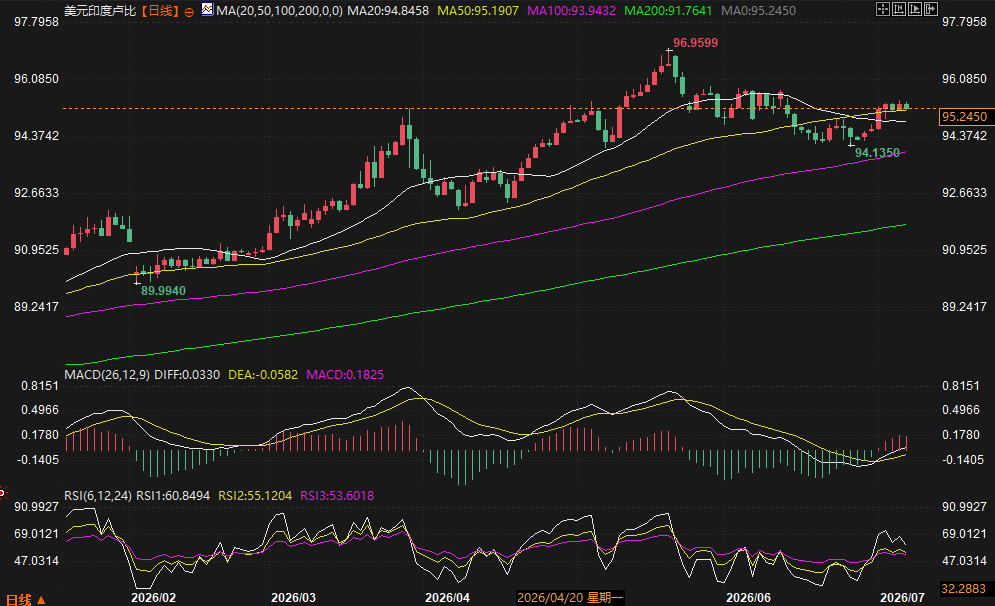
(USD/INR daily chart, source: FX678)
The short-term trend of the Indian rupee depends on two key variables:
First, the evolution of the situation in Hormuz. If tensions persist or escalate, oil prices will rise further, putting continued pressure on the rupee; if the situation unexpectedly eases, oil prices will give back their geopolitical premium, providing the rupee with some breathing room. For India, the stability of Hormuz is directly related to its energy security and trade balance.
Second, the hawkish or dovish bias of the FOMC minutes. If the minutes release a clear signal that "half of the members support a rate hike," a stronger dollar will push USD/INR to the 96-97 area; if the minutes show that the members are increasingly hesitant about a rate hike, a weaker dollar will provide a window for the rupee to rebound.
At 16:12 Beijing time on July 7, the US dollar was trading at 95.22/23 against the Indian rupee.
Oil price rebound: The biggest drag on the Indian rupee
The Indian rupee was weak in Tuesday's trading, with the main pressure coming from the rebound in oil prices.
News of commercial vessels crossing the Strait of Hormuz being struck by missiles has reignited market concerns about disruptions to global energy supplies.
According to reports, two commercial vessels were hit and severely damaged, but fortunately there are no reports of casualties.
The Strait of Hormuz handles nearly 20% of the world's energy supply, and any attack on commercial shipping through this waterway would directly trigger a rise in oil prices. Brent crude futures are currently up about 1.5%, trading around $73 per barrel.
For the Indian rupee, a rebound in oil prices is one of the most sensitive external variables. India is the world's third-largest oil importer, relying on imports for the vast majority of its energy needs. Rising oil prices mean inflated import bills, a widening trade deficit, and a worsening current account deficit—all of which directly weaken the rupee's fundamental support.
This transmission chain is extremely clear: tensions in the Hormuz → rising oil prices → increased import costs for India → weakening rupee under pressure. As long as oil prices remain at current levels or rise further, the rupee will find little room to breathe.
FOMC Meeting Minutes: Potential Catalysts for the Dollar
The most important macroeconomic event for the USD/INR pair this week is undoubtedly the release of the FOMC June policy meeting minutes on Wednesday.
At its June meeting, the Federal Reserve decided to maintain the interest rate range at 3.50%-3.75%. The dot plot showed that nine of the 19 policymakers supported raising interest rates before the end of the year. At the same time, the Fed chose to avoid providing forward guidance on monetary policy at this meeting.
The market will look for the following key information in the meeting minutes:
Why are officials collectively avoiding forward guidance? Is it due to concerns about the uncertainty of the economic outlook, or does it hint at a policy shift in the works?
A detailed discussion of the "data dependency" framework—what conditions would trigger an interest rate hike, and what conditions would preclude one?
Assessment of energy price volatility – Has the Hormuz tension been taken into account in decision-making?
Currently, the CME FedWatch tool shows a 55.2% probability that the market expects the Federal Reserve to raise interest rates at least once before its September policy meeting. If the meeting minutes release a more hawkish signal, the US dollar will receive further support, and the USD/INR exchange rate will test higher levels; if the minutes show more hesitation on raising rates, the US dollar may come under pressure, providing breathing room for the rupee.
Foreign capital inflows: Falling oil prices and the attractiveness of the Indian stock market
There have been some positive signs regarding foreign capital flows.
Foreign institutional investors (FIIs) were net buyers of Indian stocks for the second consecutive trading day – although Monday’s purchases (243.03 million rupees) were far less than Friday’s 1.35533 billion rupees, the continued trend of net buying is itself a positive sign.
This change appears to be related to oil price movements. As crude oil prices have fallen back to pre-Middle East conflict levels, overseas investors' confidence in the Indian stock market has improved. The drop in oil prices has reduced India's import costs and inflationary pressures, improved corporate profit prospects, and eased pressure on the rupee to depreciate.
Looking ahead, foreign investors will be closely watching the earnings reports of Indian companies. Among Nifty 50 constituents, Tata Consultancy Services (TCS) will be the first to release its Q1 FY2027 earnings report on Thursday. A strong earnings season overall could further attract foreign investment inflows, providing support for the rupee.
Technical Analysis
The technical structure of the USD/INR pair remains mildly bullish.
Bullish signals: The price has held steady above the 20-day moving average (95.00), confirming the validity of the recent descending triangle breakout. The RSI indicator is around 54.8, indicating constructive momentum but not yet in overbought territory – meaning there is still room for a modest upward move without immediate concerns about an overbought pullback.
Support levels below: The first support level is at the 20-day moving average of 95.00, followed by the low of 94.03 on May 7.
Upside target: The bulls are targeting the historical high of around 97.10.
Given the bullish technical outlook, the rebound in oil prices putting downward pressure on the rupee, and the upcoming release of the FOMC minutes, the USD/INR exchange rate is more likely to maintain a high-level consolidation with a slight upward bias in the short term. The historical high of 97.10 is the most important resistance level in the medium term, while the 20-day moving average at 95.00 is the most crucial support level in the near term.
(USD/INR daily chart, source: FX678)
Outlook: Two variables will determine the direction of the rupee
The short-term trend of the Indian rupee depends on two key variables:
First, the evolution of the situation in Hormuz. If tensions persist or escalate, oil prices will rise further, putting continued pressure on the rupee; if the situation unexpectedly eases, oil prices will give back their geopolitical premium, providing the rupee with some breathing room. For India, the stability of Hormuz is directly related to its energy security and trade balance.
Second, the hawkish or dovish bias of the FOMC minutes. If the minutes release a clear signal that "half of the members support a rate hike," a stronger dollar will push USD/INR to the 96-97 area; if the minutes show that the members are increasingly hesitant about a rate hike, a weaker dollar will provide a window for the rupee to rebound.
At 16:12 Beijing time on July 7, the US dollar was trading at 95.22/23 against the Indian rupee.
- Risk Warning and Disclaimer
- The market involves risk, and trading may not be suitable for all investors. This article is for reference only and does not constitute personal investment advice, nor does it take into account certain users’ specific investment objectives, financial situation, or other needs. Any investment decisions made based on this information are at your own risk.