Goldman Sachs is eyeing 165, but the market is focused on the entry button: USD/JPY enters a high-pressure zone.
2026-07-07 21:19:15
On Tuesday, July 7th, the USD/JPY pair was fluctuating around 161.80, still close to the 40-year extreme range of 162.83. The market context is not simply about the strength or weakness of the dollar, but rather a combination of factors including expectations of intervention, carry trades, controversies surrounding policy independence, and crowded positions.

The recent depreciation of the USD/JPY exchange rate does not necessarily indicate official intervention. A more plausible explanation is that the market proactively reduced its risk exposure before the holiday liquidity slowdown. Previously, the Japanese Ministry of Finance disclosed that total foreign exchange intervention amounted to 11.7349 trillion yen (approximately US$73.5 billion) between April 28 and May 27; however, intervention amounted to zero between May 28 and June 26. This suggests that the recent depreciation has not been confirmed by the published data.
The panic stems from positioning, not prices themselves. Publicly available positioning data shows that short positions in the yen remained highly crowded in early July, with speculative net short positions reaching approximately 155,000 contracts, worth about $12 billion. This positioning structure dictates that traders will prioritize closing positions rather than waiting for confirmation should news emerge that "the authorities have changed their communication methods and are no longer issuing advance warnings." In other words, the short-term yen rebound is more a result of position squeeze than a trend reversal.
The core anchor for the USD/JPY exchange rate remains the interest rate differential. The Federal Reserve maintained its target range for the federal funds rate at 3.50%-3.75% at its June meeting, stating that inflation remained above the 2% target. The Bank of Japan guided its unsecured overnight call rate to approximately 1.0% in June, while emphasizing that it would continue to adjust the degree of easing based on economic, price, and financial conditions. Neither central bank gave a clear signal of a rapid shift, thus maintaining the basis for carry trades.
The bond market also supports this logic. On July 7, the yield on 10-year Japanese government bonds was approximately 2.85%, while the yield on 10-year US Treasury bonds was approximately 4.499%, with the spread between the two still around 1.65 percentage points. The rise in Japanese government bond yields will reduce some of the attractiveness of carry trades, but as long as US Treasury yields remain high in tandem, the funding cost pressures on yen short positions will not suddenly reverse.
Goldman Sachs recently raised its three-month, six-month, and twelve-month forecasts for the USD/JPY exchange rate to 162, 163, and 165, respectively, up from its previous forecasts of 160, 158, and 155. The key to this assessment is not a bet on a one-sided upward trend, but rather the belief that while intervention by Japanese authorities can slow the rise, it cannot replace monetary policy and interest rate differentials themselves.
The current pressure on the yen comes not only from overseas yields but also from domestic policy expectations. The market is focused on the Japanese government's stimulus package, long-term investment plans, and their impact on the Bank of Japan's policy pace. The government has denied pressuring the Bank of Japan to maintain low interest rates and emphasized that monetary policy remains the responsibility of the central bank; however, what the market is truly pricing in is the credibility of the policy, not just a single denial. As long as investors doubt that the path of interest rate hikes will be slowed by growth and fiscal demands, the yen will struggle to attract sustained buying.
This is why intervention can only "buy time." Authorities can disrupt the pace by suddenly entering the market, but they cannot replace the long-term repricing of real interest rates. If the Bank of Japan's subsequent rate hikes are moderate, while the Federal Reserve maintains higher policy rates, each decline in the USD/JPY exchange rate could be reinterpreted as a buying opportunity at lower levels. Conversely, if the Bank of Japan releases clearer signals of continuous tightening, or if expectations of a Fed rate cut increase, the yen's rebound is more likely to shift from a technical correction to a macroeconomic correction.
Looking at the chart, the area around 162.834 is a recent high, with the upper Bollinger Band at 162.735 providing the first layer of resistance. The current price has returned to around 161.80, still above the middle Bollinger Band at 161.038, indicating that the daily chart has not entered a bearish structure. What truly needs to be observed are the low of 160.478 and the horizontal support around 160.180. Only if these levels are broken consecutively will it mean that fear of entering the market and position closing may evolve from a short-term shock into a cooling trend.
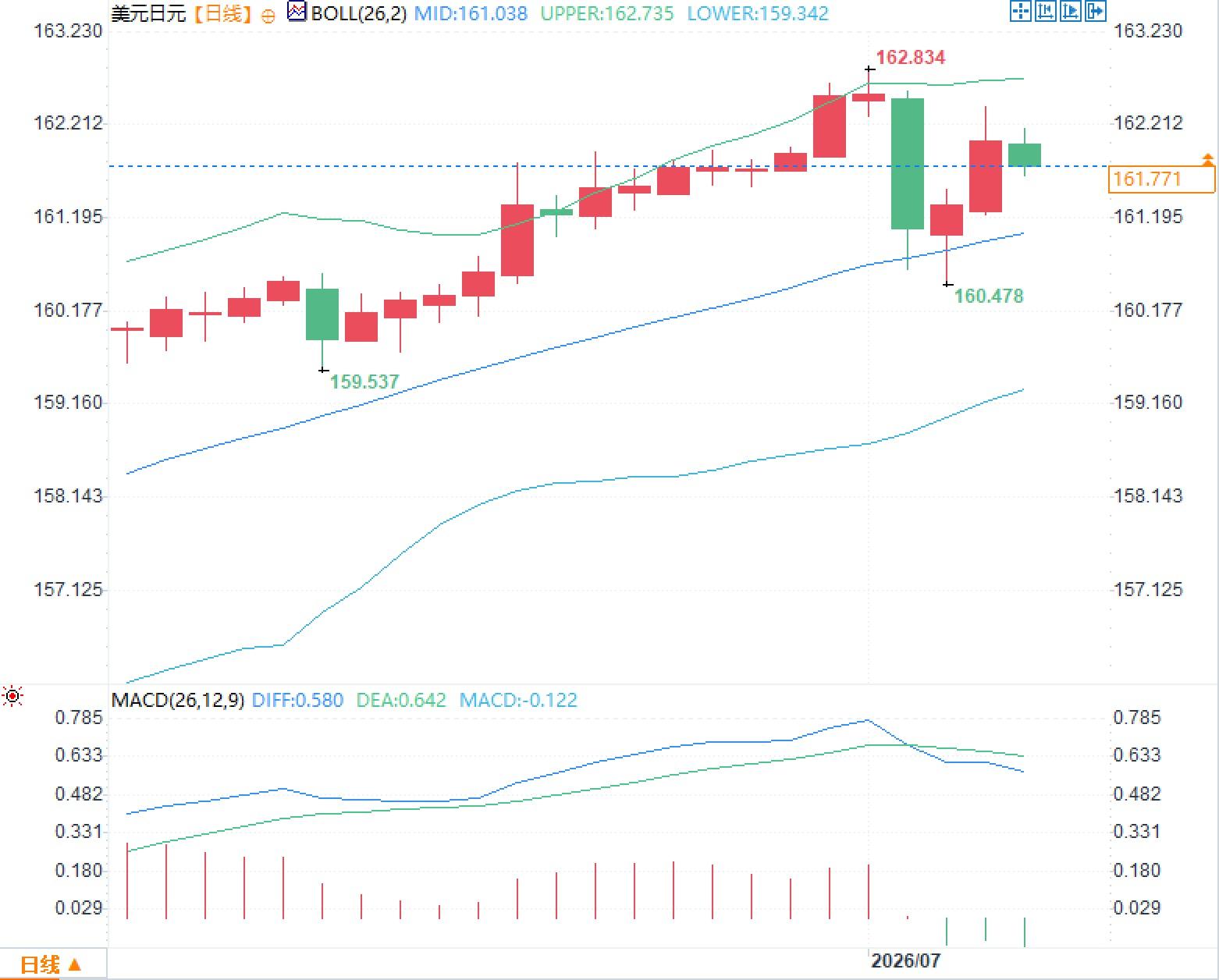
Momentum indicators show that upward momentum is no longer smooth. In the MACD, the DIFF is 0.580, the DEA is 0.642, and the histogram is -0.122, indicating a short-term divergence and slowdown. This structure doesn't simply mean bullish or bearish; rather, it suggests that volatility may continue to increase. Approaching 162.83, rumors of intervention will compress the upside potential; approaching 160.5, interest rate differentials may limit further yen rebound. The market is entering a phase where the trend remains intact, but tail risks are rising.
I. The essence of panic trading: Rumors trigger the initial surge in crowded positions.
The recent depreciation of the USD/JPY exchange rate does not necessarily indicate official intervention. A more plausible explanation is that the market proactively reduced its risk exposure before the holiday liquidity slowdown. Previously, the Japanese Ministry of Finance disclosed that total foreign exchange intervention amounted to 11.7349 trillion yen (approximately US$73.5 billion) between April 28 and May 27; however, intervention amounted to zero between May 28 and June 26. This suggests that the recent depreciation has not been confirmed by the published data.
The panic stems from positioning, not prices themselves. Publicly available positioning data shows that short positions in the yen remained highly crowded in early July, with speculative net short positions reaching approximately 155,000 contracts, worth about $12 billion. This positioning structure dictates that traders will prioritize closing positions rather than waiting for confirmation should news emerge that "the authorities have changed their communication methods and are no longer issuing advance warnings." In other words, the short-term yen rebound is more a result of position squeeze than a trend reversal.
II. Interest rate differentials remain the main theme: the yen's rebound lacks sustained momentum.
The core anchor for the USD/JPY exchange rate remains the interest rate differential. The Federal Reserve maintained its target range for the federal funds rate at 3.50%-3.75% at its June meeting, stating that inflation remained above the 2% target. The Bank of Japan guided its unsecured overnight call rate to approximately 1.0% in June, while emphasizing that it would continue to adjust the degree of easing based on economic, price, and financial conditions. Neither central bank gave a clear signal of a rapid shift, thus maintaining the basis for carry trades.
The bond market also supports this logic. On July 7, the yield on 10-year Japanese government bonds was approximately 2.85%, while the yield on 10-year US Treasury bonds was approximately 4.499%, with the spread between the two still around 1.65 percentage points. The rise in Japanese government bond yields will reduce some of the attractiveness of carry trades, but as long as US Treasury yields remain high in tandem, the funding cost pressures on yen short positions will not suddenly reverse.
Goldman Sachs recently raised its three-month, six-month, and twelve-month forecasts for the USD/JPY exchange rate to 162, 163, and 165, respectively, up from its previous forecasts of 160, 158, and 155. The key to this assessment is not a bet on a one-sided upward trend, but rather the belief that while intervention by Japanese authorities can slow the rise, it cannot replace monetary policy and interest rate differentials themselves.
III. Policy Credibility and Central Bank Independence: The Second Resistance Line for the Yen
The current pressure on the yen comes not only from overseas yields but also from domestic policy expectations. The market is focused on the Japanese government's stimulus package, long-term investment plans, and their impact on the Bank of Japan's policy pace. The government has denied pressuring the Bank of Japan to maintain low interest rates and emphasized that monetary policy remains the responsibility of the central bank; however, what the market is truly pricing in is the credibility of the policy, not just a single denial. As long as investors doubt that the path of interest rate hikes will be slowed by growth and fiscal demands, the yen will struggle to attract sustained buying.
This is why intervention can only "buy time." Authorities can disrupt the pace by suddenly entering the market, but they cannot replace the long-term repricing of real interest rates. If the Bank of Japan's subsequent rate hikes are moderate, while the Federal Reserve maintains higher policy rates, each decline in the USD/JPY exchange rate could be reinterpreted as a buying opportunity at lower levels. Conversely, if the Bank of Japan releases clearer signals of continuous tightening, or if expectations of a Fed rate cut increase, the yen's rebound is more likely to shift from a technical correction to a macroeconomic correction.
IV. Technical Structure: Squeeze between upper rail pressure and middle rail support
Looking at the chart, the area around 162.834 is a recent high, with the upper Bollinger Band at 162.735 providing the first layer of resistance. The current price has returned to around 161.80, still above the middle Bollinger Band at 161.038, indicating that the daily chart has not entered a bearish structure. What truly needs to be observed are the low of 160.478 and the horizontal support around 160.180. Only if these levels are broken consecutively will it mean that fear of entering the market and position closing may evolve from a short-term shock into a cooling trend.
Momentum indicators show that upward momentum is no longer smooth. In the MACD, the DIFF is 0.580, the DEA is 0.642, and the histogram is -0.122, indicating a short-term divergence and slowdown. This structure doesn't simply mean bullish or bearish; rather, it suggests that volatility may continue to increase. Approaching 162.83, rumors of intervention will compress the upside potential; approaching 160.5, interest rate differentials may limit further yen rebound. The market is entering a phase where the trend remains intact, but tail risks are rising.
- Risk Warning and Disclaimer
- The market involves risk, and trading may not be suitable for all investors. This article is for reference only and does not constitute personal investment advice, nor does it take into account certain users’ specific investment objectives, financial situation, or other needs. Any investment decisions made based on this information are at your own risk.