When big countries fight, small countries pay the price: A complete analysis of the Turkish lira's decade-long collapse.
2026-07-08 21:11:16
The US-Iran conflict has once again taken center stage in the world today, with Trump stating that the interim agreement with Iran has ended, causing global oil prices and Treasury yields to soar.
But then the scene shifts, and in this grand drama of great power rivalry and geopolitical turmoil, there is a country that, though geographically distant, has been significantly impacted and is lying on the ground, barely clinging to life—that country is Turkey.
In less than a decade, the Turkish lira, the official currency of Turkey, a nominally major industrial power in Europe, has lost more than 90% of its external value.
In this country, the purchasing power of holding local currency cash is not just "halved," but almost equivalent to zero.
What exactly happened, and why does it feel like Türkiye is footing the bill? We must first confront this unprecedented devaluation phenomenon in the history of human currency.
The lira's collapse was not a sudden event, but a long-term process of wealth evaporation that lasted nearly a decade.
Looking back at 2017, one US dollar could only be exchanged for about 3.8 lira, and at that time the lira was still considered a healthy local currency.
However, by the end of 2020, this figure had quietly doubled to 7.4 lira, officially kicking off the devaluation process.
After that, the lira spiraled out of control: it plummeted to 13.3 lira at the end of 2021, a precipitous drop of 44% for the year; it continued to lose 29% to 18.7 lira at the end of 2022; and by the end of 2023, the decline had widened again by 36%, with the exchange rate breaking through the 29.5 lira mark.
Although the decline narrowed to 17% (approximately 34.5 lira) by the end of 2024, the depreciation trend never reversed. As of the latest reading in 2026, 1 US dollar could be exchanged for a staggering 46.8 lira.
In less than a decade, the lira has hit a humiliating record low, with its value evaporating by more than 90%, mercilessly dragging the paper wealth of its citizens into an abyss.
From 3.8 to 46.8, this means that the lira you saved in Türkiye ten years ago now has less than 10% of its international purchasing power.
Even after the 2023 election, when Turkey's new economic team made a drastic change of course and violently raised interest rates to a record high of 50%, and maintained a high-pressure limit of 37% in 2026, the lira's depreciation momentum was still not completely curbed.
It became one of the worst-performing currencies in major emerging markets worldwide.
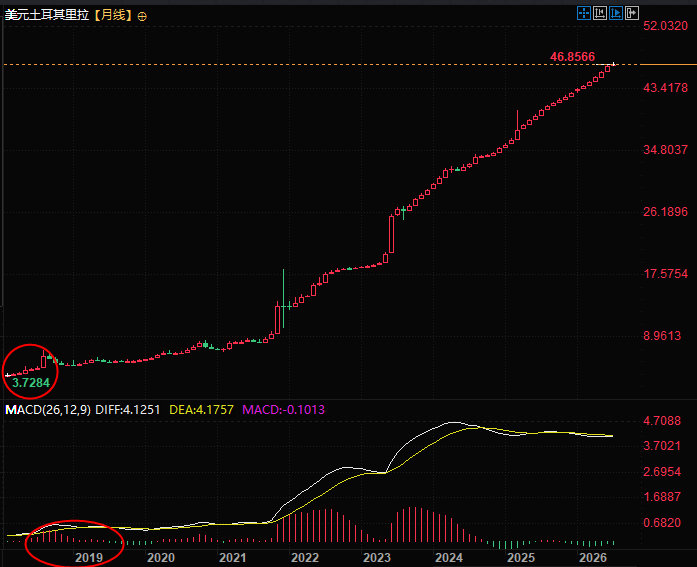
(Turkish Lira monthly chart, source: EasyForex)
Faced with such a terrifying devaluation, many people's first reaction is: Is the country's central bank asleep? Why isn't it raising interest rates?
This was precisely the "magical climax" of the lira's early devaluation—before oil prices soared and geopolitical conflicts erupted, Türkiye was conducting an experiment that defied common economic sense.
Between 2018 and 2021, Türkiye faced an extremely severe unemployment crisis.
The overall unemployment rate once approached a historical high of 14%, and the youth unemployment rate even exceeded 25%.
For President Erdogan, who faces pressure to vote and maintain his regime's stability, high unemployment is a deadly poison. In order to prevent businesses from going bankrupt and to protect the livelihoods of ordinary voters, he is eager to stimulate the economy by "flooding" the country.
Thus, one of the most bizarre scenes in the history of world finance unfolded: Erdogan publicly declared that "high interest rates are the cause of high inflation," forcing the central bank to cut interest rates sharply and continuously when inflation was rising.
Anyone who dared to disobey him would be fired on the spot, resulting in four different central bank governors in just a few years.
His logic is:
Low enough interest rates → businesses can borrow money cheaply → factories can start operating → jobs are preserved
However, this short-sighted approach opened Pandora's box.
The interest rate cut did temporarily improve the employment figures, but at the cost of completely destroying the lira's credibility, triggering a textbook example of a vicious cycle of imported inflation and currency devaluation in Turkey.
Residents spontaneously rushed to withdraw their money, making the most instinctive reaction: "Abandon the lira and embrace the dollar and gold," thus creating two super vicious cycles.
Super Flywheel 1: In order to repay their debts, companies can only frantically buy up US dollars in the market, forming a vicious cycle of "devaluation → increased debt pressure → buying up US dollars to repay debts → further devaluation".
Super Flywheel 2: Foreign capital withdrawal → shortage of US dollars → lira devaluation → increased cost of imported energy and components → Turkish factories suffer further setbacks and accelerate closure.
When the government chose to drastically cut interest rates and over-issue currency, astute international capital instantly panicked and began to withdraw funds frantically. The resolute departure of foreign capital directly triggered a precipitous drop in the lira's exchange rate.
However, for Turkish industries that are highly dependent on external markets, every cent the lira depreciates makes imported raw materials and machinery more expensive. This severe "imported inflation" quickly spreads to the consumer end, causing prices in Turkey to spiral out of control.
Faced with goods whose prices change daily, Turkish residents and businesses have completely lost faith in their local currency and have begun to spontaneously abandon the lira and frantically hoard dollars and gold as safe havens.
This spontaneous societal defection, in turn, exerted even more terrifying selling pressure on the foreign exchange market, ultimately plunging the lira into an abyss of accelerated depreciation and utter ruin.
Even before the oil price surge, this internal squeeze had already completely crippled Turkey's economic "immune system."
Later, more than half of the deposits in Turkish commercial banks were not in lira at all, but in US dollars or gold that ordinary people had exchanged. Even the people themselves were abandoning their own currency, and the lira had effectively become a critically ill patient in the intensive care unit.
Why does Turkey suffer so much when the global economy slows down? Can it break this vicious cycle through its own efforts?
The answer is no, because Turkey is stuck in an extremely awkward "tragic niche" in the international industrial chain division of labor.
Turkey, a "high-end assembly line" reliant on Europe, lacks core technologies despite joining the EU's customs union. It heavily depends on importing high-end chips, components, and machinery from Europe, assembling them domestically using relatively cheap labor, and then selling the cars, appliances, and textiles back to Europe, earning only meager processing fees.
Awkward size that doesn't fit in either direction: In terms of resources, it's not an energy-rich country like its Middle Eastern neighbors, born with a silver spoon in its mouth. It has to import more than 90% of its oil and natural gas in US dollars, inherently "bleeding out"; in terms of cost and efficiency, it can't compete with East Asian manufacturing giants, nor with Southeast Asia's cheaper labor.
Ultimately, it became a "radiator for the global economy": once the global economic growth slowed down, Europeans stopped buying cars and clothes, and Turkey, as the "end-of-line workshop" of the industrial chain, would instantly see its orders drop to zero, triggering an industrial tsunami and widespread unemployment—this was precisely the desperate situation at the bottom of society that led Erdogan to recklessly cut interest rates and try to forcibly protect employment by injecting liquidity into the local currency.
The phenomenon of small countries paying the price for conflicts between major powers is merely a microcosm of the global economic law.
The lira's devaluation is an amplified global economic paradigm. A slowdown in global economic growth leads to decreased employment and a deterioration in a country's debt repayment capacity, resulting in currency devaluation. Political interference in the independence of central banks directly pushes up inflation, causing a collapse in the credit of the currency, requiring higher interest rates to mitigate the devaluation. This concept can also be used when discussing whether the debt repayment pressure of US and Japanese government bonds affects currency devaluation, and when analyzing the pressure exerted by the US and Japanese governments on their central banks. Turkey amplifies the impact of these factors.
But then the scene shifts, and in this grand drama of great power rivalry and geopolitical turmoil, there is a country that, though geographically distant, has been significantly impacted and is lying on the ground, barely clinging to life—that country is Turkey.
In less than a decade, the Turkish lira, the official currency of Turkey, a nominally major industrial power in Europe, has lost more than 90% of its external value.
In this country, the purchasing power of holding local currency cash is not just "halved," but almost equivalent to zero.
What exactly happened, and why does it feel like Türkiye is footing the bill? We must first confront this unprecedented devaluation phenomenon in the history of human currency.
A shocking avalanche: the long scroll of the lira's devaluation
The lira's collapse was not a sudden event, but a long-term process of wealth evaporation that lasted nearly a decade.
Looking back at 2017, one US dollar could only be exchanged for about 3.8 lira, and at that time the lira was still considered a healthy local currency.
However, by the end of 2020, this figure had quietly doubled to 7.4 lira, officially kicking off the devaluation process.
After that, the lira spiraled out of control: it plummeted to 13.3 lira at the end of 2021, a precipitous drop of 44% for the year; it continued to lose 29% to 18.7 lira at the end of 2022; and by the end of 2023, the decline had widened again by 36%, with the exchange rate breaking through the 29.5 lira mark.
Although the decline narrowed to 17% (approximately 34.5 lira) by the end of 2024, the depreciation trend never reversed. As of the latest reading in 2026, 1 US dollar could be exchanged for a staggering 46.8 lira.
In less than a decade, the lira has hit a humiliating record low, with its value evaporating by more than 90%, mercilessly dragging the paper wealth of its citizens into an abyss.
From 3.8 to 46.8, this means that the lira you saved in Türkiye ten years ago now has less than 10% of its international purchasing power.
Even after the 2023 election, when Turkey's new economic team made a drastic change of course and violently raised interest rates to a record high of 50%, and maintained a high-pressure limit of 37% in 2026, the lira's depreciation momentum was still not completely curbed.
It became one of the worst-performing currencies in major emerging markets worldwide.
(Turkish Lira monthly chart, source: EasyForex)
Drinking poison to quench thirst: A political gamble between unconventional interest rate cuts and inflation.
Faced with such a terrifying devaluation, many people's first reaction is: Is the country's central bank asleep? Why isn't it raising interest rates?
This was precisely the "magical climax" of the lira's early devaluation—before oil prices soared and geopolitical conflicts erupted, Türkiye was conducting an experiment that defied common economic sense.
Between 2018 and 2021, Türkiye faced an extremely severe unemployment crisis.
The overall unemployment rate once approached a historical high of 14%, and the youth unemployment rate even exceeded 25%.
For President Erdogan, who faces pressure to vote and maintain his regime's stability, high unemployment is a deadly poison. In order to prevent businesses from going bankrupt and to protect the livelihoods of ordinary voters, he is eager to stimulate the economy by "flooding" the country.
Thus, one of the most bizarre scenes in the history of world finance unfolded: Erdogan publicly declared that "high interest rates are the cause of high inflation," forcing the central bank to cut interest rates sharply and continuously when inflation was rising.
Anyone who dared to disobey him would be fired on the spot, resulting in four different central bank governors in just a few years.
His logic is:
Low enough interest rates → businesses can borrow money cheaply → factories can start operating → jobs are preserved
However, this short-sighted approach opened Pandora's box.
Chain reaction: Imported inflation and the vicious cycle of the local currency
The interest rate cut did temporarily improve the employment figures, but at the cost of completely destroying the lira's credibility, triggering a textbook example of a vicious cycle of imported inflation and currency devaluation in Turkey.
Residents spontaneously rushed to withdraw their money, making the most instinctive reaction: "Abandon the lira and embrace the dollar and gold," thus creating two super vicious cycles.
Super Flywheel 1: In order to repay their debts, companies can only frantically buy up US dollars in the market, forming a vicious cycle of "devaluation → increased debt pressure → buying up US dollars to repay debts → further devaluation".
Super Flywheel 2: Foreign capital withdrawal → shortage of US dollars → lira devaluation → increased cost of imported energy and components → Turkish factories suffer further setbacks and accelerate closure.
When the government chose to drastically cut interest rates and over-issue currency, astute international capital instantly panicked and began to withdraw funds frantically. The resolute departure of foreign capital directly triggered a precipitous drop in the lira's exchange rate.
However, for Turkish industries that are highly dependent on external markets, every cent the lira depreciates makes imported raw materials and machinery more expensive. This severe "imported inflation" quickly spreads to the consumer end, causing prices in Turkey to spiral out of control.
Faced with goods whose prices change daily, Turkish residents and businesses have completely lost faith in their local currency and have begun to spontaneously abandon the lira and frantically hoard dollars and gold as safe havens.
This spontaneous societal defection, in turn, exerted even more terrifying selling pressure on the foreign exchange market, ultimately plunging the lira into an abyss of accelerated depreciation and utter ruin.
Even before the oil price surge, this internal squeeze had already completely crippled Turkey's economic "immune system."
Later, more than half of the deposits in Turkish commercial banks were not in lira at all, but in US dollars or gold that ordinary people had exchanged. Even the people themselves were abandoning their own currency, and the lira had effectively become a critically ill patient in the intensive care unit.
The Fateful Dilemma: Sponges in Small Countries Without Competitive Advantage
Why does Turkey suffer so much when the global economy slows down? Can it break this vicious cycle through its own efforts?
The answer is no, because Turkey is stuck in an extremely awkward "tragic niche" in the international industrial chain division of labor.
Turkey, a "high-end assembly line" reliant on Europe, lacks core technologies despite joining the EU's customs union. It heavily depends on importing high-end chips, components, and machinery from Europe, assembling them domestically using relatively cheap labor, and then selling the cars, appliances, and textiles back to Europe, earning only meager processing fees.
Awkward size that doesn't fit in either direction: In terms of resources, it's not an energy-rich country like its Middle Eastern neighbors, born with a silver spoon in its mouth. It has to import more than 90% of its oil and natural gas in US dollars, inherently "bleeding out"; in terms of cost and efficiency, it can't compete with East Asian manufacturing giants, nor with Southeast Asia's cheaper labor.
Ultimately, it became a "radiator for the global economy": once the global economic growth slowed down, Europeans stopped buying cars and clothes, and Turkey, as the "end-of-line workshop" of the industrial chain, would instantly see its orders drop to zero, triggering an industrial tsunami and widespread unemployment—this was precisely the desperate situation at the bottom of society that led Erdogan to recklessly cut interest rates and try to forcibly protect employment by injecting liquidity into the local currency.
Conclusion: The Paradigm of the Economic Impact of the US-Iran Conflict
The phenomenon of small countries paying the price for conflicts between major powers is merely a microcosm of the global economic law.
The lira's devaluation is an amplified global economic paradigm. A slowdown in global economic growth leads to decreased employment and a deterioration in a country's debt repayment capacity, resulting in currency devaluation. Political interference in the independence of central banks directly pushes up inflation, causing a collapse in the credit of the currency, requiring higher interest rates to mitigate the devaluation. This concept can also be used when discussing whether the debt repayment pressure of US and Japanese government bonds affects currency devaluation, and when analyzing the pressure exerted by the US and Japanese governments on their central banks. Turkey amplifies the impact of these factors.
- Risk Warning and Disclaimer
- The market involves risk, and trading may not be suitable for all investors. This article is for reference only and does not constitute personal investment advice, nor does it take into account certain users’ specific investment objectives, financial situation, or other needs. Any investment decisions made based on this information are at your own risk.