The Fed's key minutes are here! Warsh's new policy debut holds hidden implications.
2026-07-08 21:54:38
At 2 a.m. tomorrow, the Federal Reserve will release the minutes of the June 16-17 FOMC meeting, which will be the first full review of the meeting since the new chairman Kevin Warsh took office.
Unlike his predecessor Powell's transparent policy style, Warsh implemented a new communication mechanism that weakens forward guidance. The minutes of this meeting will be significantly simplified and the signals will be more restrained. The market will find it difficult to obtain straightforward hints about the interest rate path and can only deduce the Fed's latest policy stance and decision-making logic through the details of the meeting.
Looking back at the June policy meeting, the Federal Reserve maintained the benchmark interest rate range of 3.50%-3.75% as expected, marking the sixth consecutive time that the benchmark interest rate has remained stable, which is in line with market consensus.
However, the biggest highlight of this meeting was the unexpectedly hawkish stance on maintaining stability. The post-meeting statement was hawkish in wording, breaking the market's calm expectations and providing direct support for the US dollar index in the short term.
The Federal Reserve's interest rate decision was unanimously approved, completely eliminating any speculation in the market about internal policy disagreements within the Fed. At the same time, the official statement clearly acknowledged the resilience of the US economy and that inflation remained above the 2% policy target, laying a solid policy foundation for subsequent phased interest rate hikes.
Warsh's appointment brought about systemic policy changes at the Federal Reserve, which is also the core focus of this meeting minutes.
In order to maximize the flexibility of monetary policy adjustments, Warsh completely abandoned the forward guidance model that was the norm during the Powell era, and stopped releasing expectations of a fixed interest rate path to the market.
At the same time, it officially announced that it will carry out in-depth reforms to the core system of the Federal Reserve, covering three core areas: policy communication system, data traceability channels, and inflation assessment framework. In the medium to long term, it is expected to completely reshape the tone and control logic of the Federal Reserve's monetary policy.
In response to market doubts about the independence of the central bank's policies, Warsh also made a clear and tough statement, saying that he would adhere to the core policy goal of price stability. This attitude was uniformly interpreted by the financial market as a major hawkish signal.
Due to the new communication rules, this meeting minutes will only disclose the general economic and inflation outlook and will not provide any clear guidance on the path of interest rate hikes or cuts.
The market's pricing of the Federal Reserve's policies is currently highly dependent on the revisions to the latest economic data.
The US non-farm payroll data released last week for June was a major disappointment, with only 57,000 new jobs added, far below the market expectation of 110,000. This ended the strong employment trend of the previous three months and directly led the market to postpone its bets on aggressive interest rate hikes.
At the same time, inflationary pressures have eased somewhat. Although overall US inflation has not yet fallen back to the policy target, the easing of geopolitical conflicts in the Middle East has led to a return of international crude oil prices to pre-conflict levels, effectively alleviating imported inflationary pressures and providing Walsh with ample policy leeway to postpone interest rate hikes.
Market pricing in interest rate hike expectations: Tightening expectations have not completely subsided this year.
Even with weak employment data and marginal cooling of inflation, the market has not completely given up on the expectation of a Fed rate hike, and the dollar has continued to receive solid support.
Current money market pricing suggests that the Federal Reserve still has at least 25 basis points of room to raise interest rates over the next six months.
According to CME Group's FedWatch data, the probability of a Fed rate hike in September remains at 58%, and the probability of a rate hike this year is close to 80%. This expectation is the core reason for the recent relatively strong dollar exchange rate, providing solid support for the dollar.
The minutes of this meeting will be a key catalyst for the short-term trend of the US dollar, directly determining the direction of its subsequent fluctuations.
If the minutes reinforce the anti-inflation stance, release hawkish signals, emphasize the risk of sticky inflation, and maintain a firm commitment to raising interest rates this year, it will repair and solidify market expectations for interest rate hikes, pushing the dollar index higher again.
Conversely, if the minutes downplay the risk of secondary inflation spread and attribute the current high inflation mainly to a temporary energy shock, releasing a dovish signal, it will suppress market bets on interest rate hikes and directly harm the dollar's bullish trend.
Overall, influenced by geopolitical variables in the Middle East and the early pricing of weak non-farm payroll data, this meeting minutes is unlikely to trigger a one-sided extreme market movement. The US dollar is likely to maintain a range-bound trading pattern with limited short-term volatility. Further one-sided trends will require the release of more important US economic data to further confirm the Fed's interest rate hike pace.
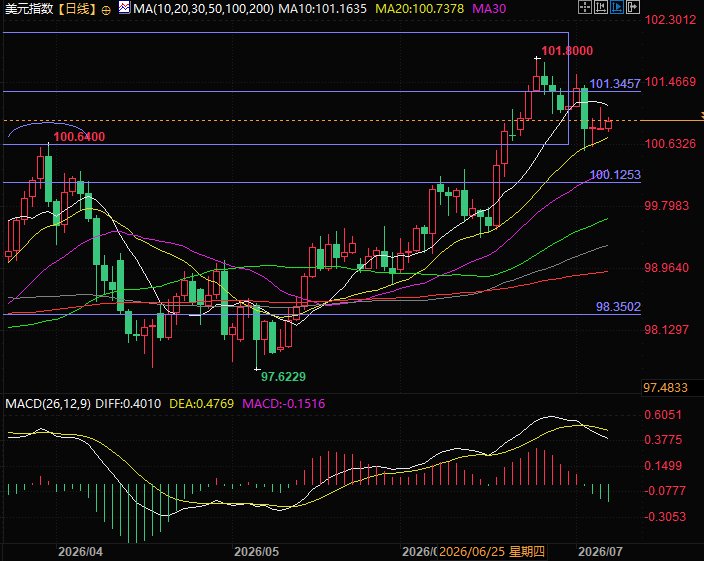
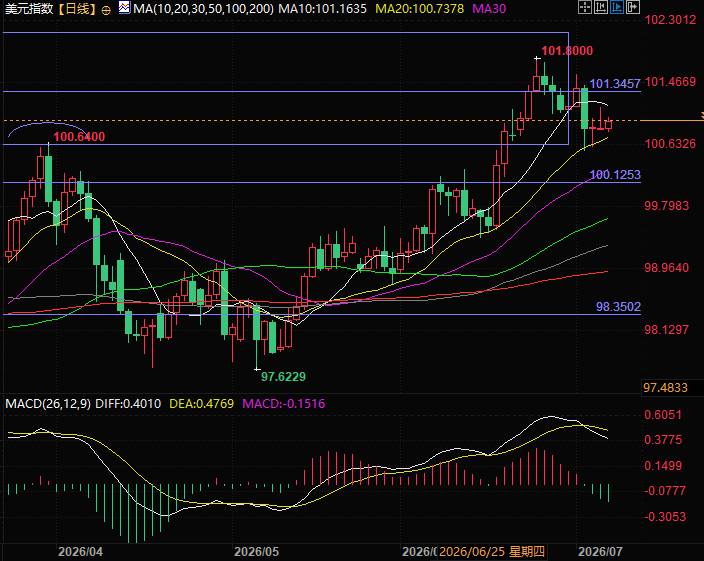
(US Dollar Index Daily Chart, Source: FX678)
At 21:51 Beijing time, the US dollar index is currently at 101.08.
Unlike his predecessor Powell's transparent policy style, Warsh implemented a new communication mechanism that weakens forward guidance. The minutes of this meeting will be significantly simplified and the signals will be more restrained. The market will find it difficult to obtain straightforward hints about the interest rate path and can only deduce the Fed's latest policy stance and decision-making logic through the details of the meeting.
June FOMC Meeting Recap: Interest Rates Remained Stable but Unexpectedly Hawkish Signals Were Released
Looking back at the June policy meeting, the Federal Reserve maintained the benchmark interest rate range of 3.50%-3.75% as expected, marking the sixth consecutive time that the benchmark interest rate has remained stable, which is in line with market consensus.
However, the biggest highlight of this meeting was the unexpectedly hawkish stance on maintaining stability. The post-meeting statement was hawkish in wording, breaking the market's calm expectations and providing direct support for the US dollar index in the short term.
The Federal Reserve's interest rate decision was unanimously approved, completely eliminating any speculation in the market about internal policy disagreements within the Fed. At the same time, the official statement clearly acknowledged the resilience of the US economy and that inflation remained above the 2% policy target, laying a solid policy foundation for subsequent phased interest rate hikes.
Warsh's New Deal: Core Changes – Reshaping the Fed's Policy and Communication System
Warsh's appointment brought about systemic policy changes at the Federal Reserve, which is also the core focus of this meeting minutes.
In order to maximize the flexibility of monetary policy adjustments, Warsh completely abandoned the forward guidance model that was the norm during the Powell era, and stopped releasing expectations of a fixed interest rate path to the market.
At the same time, it officially announced that it will carry out in-depth reforms to the core system of the Federal Reserve, covering three core areas: policy communication system, data traceability channels, and inflation assessment framework. In the medium to long term, it is expected to completely reshape the tone and control logic of the Federal Reserve's monetary policy.
In response to market doubts about the independence of the central bank's policies, Warsh also made a clear and tough statement, saying that he would adhere to the core policy goal of price stability. This attitude was uniformly interpreted by the financial market as a major hawkish signal.
Due to the new communication rules, this meeting minutes will only disclose the general economic and inflation outlook and will not provide any clear guidance on the path of interest rate hikes or cuts.
Current fundamental environment: Weakening employment coupled with marginal cooling of inflation.
The market's pricing of the Federal Reserve's policies is currently highly dependent on the revisions to the latest economic data.
The US non-farm payroll data released last week for June was a major disappointment, with only 57,000 new jobs added, far below the market expectation of 110,000. This ended the strong employment trend of the previous three months and directly led the market to postpone its bets on aggressive interest rate hikes.
At the same time, inflationary pressures have eased somewhat. Although overall US inflation has not yet fallen back to the policy target, the easing of geopolitical conflicts in the Middle East has led to a return of international crude oil prices to pre-conflict levels, effectively alleviating imported inflationary pressures and providing Walsh with ample policy leeway to postpone interest rate hikes.
Market pricing in interest rate hike expectations: Tightening expectations have not completely subsided this year.
Even with weak employment data and marginal cooling of inflation, the market has not completely given up on the expectation of a Fed rate hike, and the dollar has continued to receive solid support.
Current money market pricing suggests that the Federal Reserve still has at least 25 basis points of room to raise interest rates over the next six months.
According to CME Group's FedWatch data, the probability of a Fed rate hike in September remains at 58%, and the probability of a rate hike this year is close to 80%. This expectation is the core reason for the recent relatively strong dollar exchange rate, providing solid support for the dollar.
Market Outlook (Minutes): The interplay of bullish and bearish signals will determine the short-term trend of the US dollar.
The minutes of this meeting will be a key catalyst for the short-term trend of the US dollar, directly determining the direction of its subsequent fluctuations.
If the minutes reinforce the anti-inflation stance, release hawkish signals, emphasize the risk of sticky inflation, and maintain a firm commitment to raising interest rates this year, it will repair and solidify market expectations for interest rate hikes, pushing the dollar index higher again.
Conversely, if the minutes downplay the risk of secondary inflation spread and attribute the current high inflation mainly to a temporary energy shock, releasing a dovish signal, it will suppress market bets on interest rate hikes and directly harm the dollar's bullish trend.
Overall, influenced by geopolitical variables in the Middle East and the early pricing of weak non-farm payroll data, this meeting minutes is unlikely to trigger a one-sided extreme market movement. The US dollar is likely to maintain a range-bound trading pattern with limited short-term volatility. Further one-sided trends will require the release of more important US economic data to further confirm the Fed's interest rate hike pace.
(US Dollar Index Daily Chart, Source: FX678)
At 21:51 Beijing time, the US dollar index is currently at 101.08.
- Risk Warning and Disclaimer
- The market involves risk, and trading may not be suitable for all investors. This article is for reference only and does not constitute personal investment advice, nor does it take into account certain users’ specific investment objectives, financial situation, or other needs. Any investment decisions made based on this information are at your own risk.