Oil supply lifeline in crisis: US airstrikes on Iran cause oil price risk premiums to surge.
2026-07-09 09:11:30
On Thursday (July 9) in early Asian trading, US crude oil futures opened about 2% higher, once touching $75.13 per barrel, a new high since June 23, and are currently trading around $74.20 per barrel.
On Wednesday, the U.S. military announced a new round of airstrikes against Iran, aimed at keeping the Strait of Hormuz, one of the world's most critical energy transport routes, open.
Hours earlier, US President Trump announced during the NATO summit in Ankara, Turkey, that the interim agreement aimed at ending the war with Iran "has ended." This statement marked the formal closure of the already fragile peace window between the US and Iran, and a significant escalation of military confrontation between the two sides.
The Strait of Hormuz is a vital passage for approximately one-fifth of the world's oil supply. Control of the strait gives Tehran significant strategic leverage, wielding considerable influence in its rivalry with the United States. The trigger for this conflict was Iran's attack on three oil tankers in the Strait of Hormuz on Tuesday, which subsequently prompted the U.S. Central Command to announce retaliatory strikes.
Iran said on Wednesday it had attacked U.S. military facilities in Bahrain and Kuwait, triggering a new round of U.S. airstrikes in response. The situation is spiraling out of control.
The U.S. military launched a new round of airstrikes against Iran on Wednesday. On the same day, Trump announced that the interim U.S.-Iran agreement "had ended," closing the window for peace. This followed Iran's attacks on oil tankers in the Strait of Hormuz and its claims to have struck U.S. targets in Bahrain and Kuwait.
In a statement released on social media, U.S. Central Command explicitly announced Wednesday's new round of strikes: "Under the direction of the Commander-in-Chief, U.S. Central Command forces have begun further strikes against Iran to further weaken its ability to threaten freedom of navigation in the Strait of Hormuz."
The announcement further emphasized: "The United States will hold Iran accountable for its recent acts of aggression against merchant ships and civilian crew members who are freely navigating important international waterways."
Judging from the US military's wording, the objective of this military operation is clear—not to overthrow the Iranian regime or launch a full-scale war, but a limited strike aimed at "ensuring the safety of navigation in the Strait of Hormuz." However, in the absence of effective communication channels between the two sides, such a "limited strike" could easily escalate into a wider conflict due to miscalculation.
Iran responded on Wednesday by saying it had attacked U.S. military facilities in Bahrain and Kuwait, further escalating the situation.
Iran's attacks demonstrate that Tehran is not willing to passively endure US strikes, but rather chooses to increase US military costs by expanding the scope of the conflict.
Although Iran has not officially claimed responsibility for Tuesday's tanker attacks in the Strait of Hormuz, analysts point out that Tehran is using such actions to strengthen its strategic influence during negotiations with the United States for a long-term peace agreement. Attacking merchant ships and threatening navigation in the strait have become common tactics for Iran to demonstrate its leverage in strategic maneuvering.
This military escalation has dealt a heavy blow to hopes of transforming the June 17 memorandum of understanding into a permanent peace agreement to end the war, which began on February 28 with US and Israeli airstrikes against Iran and has now lasted for more than four months.
At a press conference at the NATO summit, Trump expressed a pessimistic outlook on the prospects of a US-Iran deal: "If we reach a deal with Iran, I'm not sure it will last. I think they are very untrustworthy."
However, the report also points out that Trump had previously threatened to escalate military action multiple times, but subsequently toned it down. He stated that he did not believe in a return to "all-out war," and it remains unclear whether negotiations on reaching a permanent agreement will continue. This ambiguous stance of "fighting while negotiating" makes it difficult for the market to form stable, linear expectations regarding the situation in the Middle East.
In summary, the US-Iran military conflict has evolved from initial limited skirmishes into a sustained confrontation. The US launched a new round of airstrikes to ensure navigation in the Strait of Hormuz, while Iran responded by attacking US targets in the region; both sides have demonstrated an unwillingness to unilaterally back down. Trump's announcement that the interim agreement "has ended" has further reinforced market expectations of a prolonged conflict.
For the global energy market, the security situation in the Strait of Hormuz has become a core variable determining the direction of oil prices. Given the ongoing military actions by both sides and the uncertain diplomatic outlook, the risk premium for energy supply disruptions will remain high.
Market participants need to closely monitor two key variables: first, whether the duration and intensity of the US airstrikes will escalate further; and second, whether there is a possibility of third-party diplomatic intervention to break the current deadlock. Under the current circumstances, any unexpected action by either side could trigger significant fluctuations in energy prices.
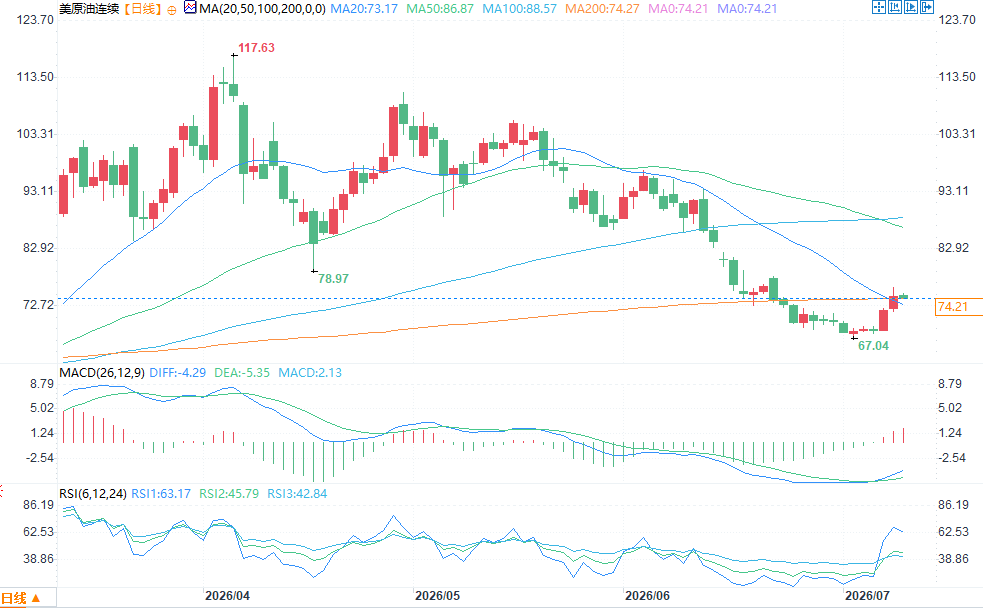
(US crude oil futures daily chart, source: FX678)
At 9:10 AM Beijing time on July 9, US crude oil futures were trading at $74.20 per barrel.
On Wednesday, the U.S. military announced a new round of airstrikes against Iran, aimed at keeping the Strait of Hormuz, one of the world's most critical energy transport routes, open.
Hours earlier, US President Trump announced during the NATO summit in Ankara, Turkey, that the interim agreement aimed at ending the war with Iran "has ended." This statement marked the formal closure of the already fragile peace window between the US and Iran, and a significant escalation of military confrontation between the two sides.
The Strait of Hormuz is a vital passage for approximately one-fifth of the world's oil supply. Control of the strait gives Tehran significant strategic leverage, wielding considerable influence in its rivalry with the United States. The trigger for this conflict was Iran's attack on three oil tankers in the Strait of Hormuz on Tuesday, which subsequently prompted the U.S. Central Command to announce retaliatory strikes.
Iran said on Wednesday it had attacked U.S. military facilities in Bahrain and Kuwait, triggering a new round of U.S. airstrikes in response. The situation is spiraling out of control.
US military action: The airstrikes were aimed at "further weakening Iran's ability to threaten freedom of navigation in the Straits."
The U.S. military launched a new round of airstrikes against Iran on Wednesday. On the same day, Trump announced that the interim U.S.-Iran agreement "had ended," closing the window for peace. This followed Iran's attacks on oil tankers in the Strait of Hormuz and its claims to have struck U.S. targets in Bahrain and Kuwait.
In a statement released on social media, U.S. Central Command explicitly announced Wednesday's new round of strikes: "Under the direction of the Commander-in-Chief, U.S. Central Command forces have begun further strikes against Iran to further weaken its ability to threaten freedom of navigation in the Strait of Hormuz."
The announcement further emphasized: "The United States will hold Iran accountable for its recent acts of aggression against merchant ships and civilian crew members who are freely navigating important international waterways."
Judging from the US military's wording, the objective of this military operation is clear—not to overthrow the Iranian regime or launch a full-scale war, but a limited strike aimed at "ensuring the safety of navigation in the Strait of Hormuz." However, in the absence of effective communication channels between the two sides, such a "limited strike" could easily escalate into a wider conflict due to miscalculation.
Iran responds: Attacks on US targets in Bahrain and Kuwait
Iran responded on Wednesday by saying it had attacked U.S. military facilities in Bahrain and Kuwait, further escalating the situation.
Iran's attacks demonstrate that Tehran is not willing to passively endure US strikes, but rather chooses to increase US military costs by expanding the scope of the conflict.
Although Iran has not officially claimed responsibility for Tuesday's tanker attacks in the Strait of Hormuz, analysts point out that Tehran is using such actions to strengthen its strategic influence during negotiations with the United States for a long-term peace agreement. Attacking merchant ships and threatening navigation in the strait have become common tactics for Iran to demonstrate its leverage in strategic maneuvering.
Diplomatic Outlook: Provisional Agreement Ends, Prospects for Permanent Peace Negotiations Dim
This military escalation has dealt a heavy blow to hopes of transforming the June 17 memorandum of understanding into a permanent peace agreement to end the war, which began on February 28 with US and Israeli airstrikes against Iran and has now lasted for more than four months.
At a press conference at the NATO summit, Trump expressed a pessimistic outlook on the prospects of a US-Iran deal: "If we reach a deal with Iran, I'm not sure it will last. I think they are very untrustworthy."
However, the report also points out that Trump had previously threatened to escalate military action multiple times, but subsequently toned it down. He stated that he did not believe in a return to "all-out war," and it remains unclear whether negotiations on reaching a permanent agreement will continue. This ambiguous stance of "fighting while negotiating" makes it difficult for the market to form stable, linear expectations regarding the situation in the Middle East.
Conclusion: The conflict continues to escalate, and the risk premium in the energy market remains high.
In summary, the US-Iran military conflict has evolved from initial limited skirmishes into a sustained confrontation. The US launched a new round of airstrikes to ensure navigation in the Strait of Hormuz, while Iran responded by attacking US targets in the region; both sides have demonstrated an unwillingness to unilaterally back down. Trump's announcement that the interim agreement "has ended" has further reinforced market expectations of a prolonged conflict.
For the global energy market, the security situation in the Strait of Hormuz has become a core variable determining the direction of oil prices. Given the ongoing military actions by both sides and the uncertain diplomatic outlook, the risk premium for energy supply disruptions will remain high.
Market participants need to closely monitor two key variables: first, whether the duration and intensity of the US airstrikes will escalate further; and second, whether there is a possibility of third-party diplomatic intervention to break the current deadlock. Under the current circumstances, any unexpected action by either side could trigger significant fluctuations in energy prices.
(US crude oil futures daily chart, source: FX678)
At 9:10 AM Beijing time on July 9, US crude oil futures were trading at $74.20 per barrel.
- Risk Warning and Disclaimer
- The market involves risk, and trading may not be suitable for all investors. This article is for reference only and does not constitute personal investment advice, nor does it take into account certain users’ specific investment objectives, financial situation, or other needs. Any investment decisions made based on this information are at your own risk.