













The New Zealand dollar rose to a two-and-a-half-week high, prompting warnings from institutions!
2026-07-09 11:29:48
On Thursday (July 9) during the Asian session, the New Zealand dollar continued to rise against the US dollar, rising as much as 0.5% to a high of 0.5728, the highest level since June 23. The exchange rate is currently trading around 0.5720.
On Wednesday, the Reserve Bank of New Zealand raised its official cash rate by 25 basis points to 2.50%, the first rate hike since May 2023. The New Zealand dollar strengthened slightly against the US dollar following the announcement, becoming one of the better-performing currencies against the dollar that day.
However, Derek Halpenney, a foreign exchange analyst at MUFG, pointed out that the market should remain cautious about the sustainability of this trend – the overnight index swap market has largely priced in this rate hike and further tightening in the future, but subsequent buying of the New Zealand dollar may be limited.
Harpenney believes that the Reserve Bank of New Zealand's policy communication was generally in line with a "moderate pace of tightening," and the statement did not reveal any sense of urgency or surprisingly hawkish language. Although the minutes showed that two members believed the risks to inflation were skewed to the upside, most members considered the risks balanced. The New Zealand economy remains fragile, and the Reserve Bank of New Zealand is keenly aware of this—the two-year yield rose by only 4 basis points after the decision, suggesting limited further upside potential for the New Zealand dollar.

Harpenney pointed out that the overnight index swap market had already priced in an 18-basis-point rate hike on the day of the decision and had also priced in a cumulative 85-basis-point rate hike over the next 12 months. This means that the Reserve Bank of New Zealand's 25-basis-point rate hike was not beyond market expectations, and the positive reaction of the New Zealand dollar stemmed more from the elimination of uncertainty than from a policy surprise.
Mitsubishi UFJ Financial Group's assessment of the Reserve Bank of New Zealand's (RBNZ) future policy path is slightly more moderate than market pricing. The agency anticipates only two additional rate hikes before March 2027—slightly below the level implied by the current overnight index swap curve. This assessment is based on an interpretation of the RBNZ's communication tone: the lack of urgency and unexpectedly hawkish language in the statement suggests the central bank prefers gradual tightening to aggressive rate hikes.
Harpenney emphasized that the Reserve Bank of New Zealand's policy communication was "generally in line with a moderate pace of tightening."
This assessment is supported by two points: First, the meeting minutes show that although two members believed the risks to inflation were skewed to the upside, most members believed the risks were balanced—indicating that there was no strong hawkish consensus within the decision-making body; second, the statement contained "no sense of urgency or surprising hawkish language," which contrasts with the market's previous concerns about an aggressive tightening scenario.
This tone echoes Commerzbank's earlier assessment, which also pointed out that while the Reserve Bank of New Zealand's hawkish stance exceeded expectations, the weak economy would limit its actual room for tightening.
Halpenney points out that "the economy remains fragile, and the Reserve Bank of New Zealand seems to recognize this as well." This assessment is key to understanding the future trajectory of the New Zealand dollar.
Although the Reserve Bank of New Zealand (RBNZ) mentioned structural inflationary factors in its statement (such as low productivity growth potentially exacerbating price pressures), the New Zealand economy showed clear signs of slowing in the June quarter – weak performance in electronic card transactions, services, and manufacturing indices, and continued sluggish housing market activity. Against this backdrop, the RBNZ lacked the confidence to aggressively raise interest rates. The two-year yield rose only 4 basis points after the decision, a mild market reaction that confirmed Harpenney's assessment that further buying of the New Zealand dollar should be kept within a limited scope.
Overall, the Reserve Bank of New Zealand's decision to raise interest rates by 25 basis points to 2.50% in July was in line with market expectations, and the positive reaction of the New Zealand dollar came more from the elimination of uncertainty than from a policy surprise.
Mitsubishi UFJ's assessment clearly points out the dual constraints facing the New Zealand dollar: from a policy perspective, the Reserve Bank of New Zealand's communication tone is dovish, lacking unexpected hawkish signals, making it difficult to drive market repricing; from a fundamental perspective, the New Zealand economy remains fragile, and the slight increase in the two-year yield indicates limited market confidence in further tightening.
Looking ahead, the New Zealand dollar may find short-term support around 0.5700, but further upside potential will be limited. The market's over-pricing of the OCR path (currently implying an 85 basis point rate hike over the next 12 months) may face corrective pressure in the face of weaker-than-expected economic data, potentially putting renewed pressure on the New Zealand dollar. Traders should be wary of the risk of a correction in expectations if they go long on the New Zealand dollar at current levels.
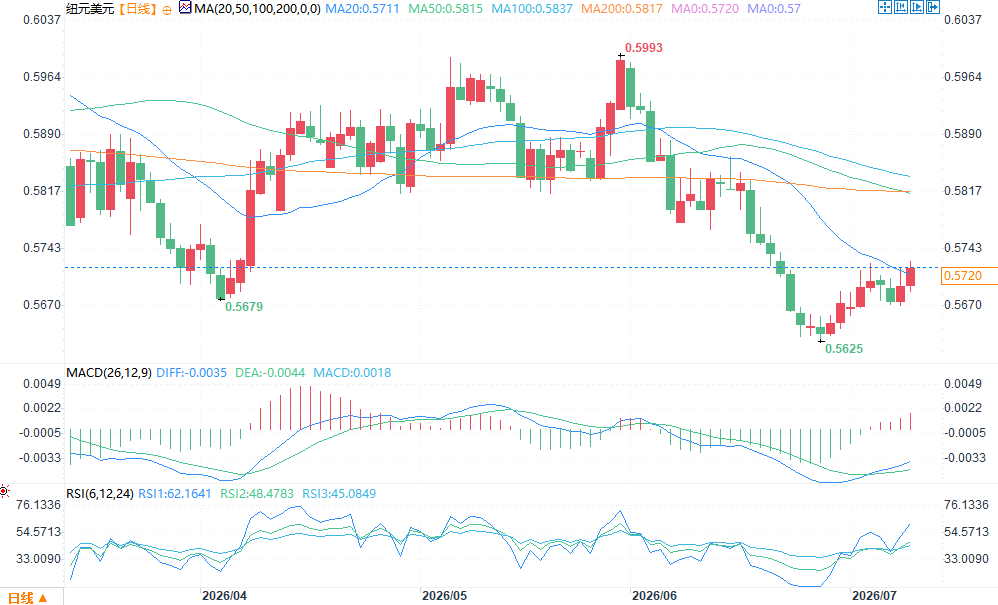
(NZD/USD daily chart, source: FX678)
At 11:29 Beijing time on July 9, the New Zealand dollar was trading at 0.5720/21 against the US dollar.
On Wednesday, the Reserve Bank of New Zealand raised its official cash rate by 25 basis points to 2.50%, the first rate hike since May 2023. The New Zealand dollar strengthened slightly against the US dollar following the announcement, becoming one of the better-performing currencies against the dollar that day.
However, Derek Halpenney, a foreign exchange analyst at MUFG, pointed out that the market should remain cautious about the sustainability of this trend – the overnight index swap market has largely priced in this rate hike and further tightening in the future, but subsequent buying of the New Zealand dollar may be limited.
Harpenney believes that the Reserve Bank of New Zealand's policy communication was generally in line with a "moderate pace of tightening," and the statement did not reveal any sense of urgency or surprisingly hawkish language. Although the minutes showed that two members believed the risks to inflation were skewed to the upside, most members considered the risks balanced. The New Zealand economy remains fragile, and the Reserve Bank of New Zealand is keenly aware of this—the two-year yield rose by only 4 basis points after the decision, suggesting limited further upside potential for the New Zealand dollar.
Market pricing and policy expectations: Interest rate hikes have been fully priced in.
Harpenney pointed out that the overnight index swap market had already priced in an 18-basis-point rate hike on the day of the decision and had also priced in a cumulative 85-basis-point rate hike over the next 12 months. This means that the Reserve Bank of New Zealand's 25-basis-point rate hike was not beyond market expectations, and the positive reaction of the New Zealand dollar stemmed more from the elimination of uncertainty than from a policy surprise.
Mitsubishi UFJ Financial Group's assessment of the Reserve Bank of New Zealand's (RBNZ) future policy path is slightly more moderate than market pricing. The agency anticipates only two additional rate hikes before March 2027—slightly below the level implied by the current overnight index swap curve. This assessment is based on an interpretation of the RBNZ's communication tone: the lack of urgency and unexpectedly hawkish language in the statement suggests the central bank prefers gradual tightening to aggressive rate hikes.
Reserve Bank of New Zealand's communication tone: moderate tightening, hawkish as expected.
Harpenney emphasized that the Reserve Bank of New Zealand's policy communication was "generally in line with a moderate pace of tightening."
This assessment is supported by two points: First, the meeting minutes show that although two members believed the risks to inflation were skewed to the upside, most members believed the risks were balanced—indicating that there was no strong hawkish consensus within the decision-making body; second, the statement contained "no sense of urgency or surprising hawkish language," which contrasts with the market's previous concerns about an aggressive tightening scenario.
This tone echoes Commerzbank's earlier assessment, which also pointed out that while the Reserve Bank of New Zealand's hawkish stance exceeded expectations, the weak economy would limit its actual room for tightening.
Economic Reality: Fragile Fundamentals Limit New Zealand Dollar's Upside
Halpenney points out that "the economy remains fragile, and the Reserve Bank of New Zealand seems to recognize this as well." This assessment is key to understanding the future trajectory of the New Zealand dollar.
Although the Reserve Bank of New Zealand (RBNZ) mentioned structural inflationary factors in its statement (such as low productivity growth potentially exacerbating price pressures), the New Zealand economy showed clear signs of slowing in the June quarter – weak performance in electronic card transactions, services, and manufacturing indices, and continued sluggish housing market activity. Against this backdrop, the RBNZ lacked the confidence to aggressively raise interest rates. The two-year yield rose only 4 basis points after the decision, a mild market reaction that confirmed Harpenney's assessment that further buying of the New Zealand dollar should be kept within a limited scope.
Outlook: The New Zealand dollar is finding short-term support, but its medium-term upside is limited.
Overall, the Reserve Bank of New Zealand's decision to raise interest rates by 25 basis points to 2.50% in July was in line with market expectations, and the positive reaction of the New Zealand dollar came more from the elimination of uncertainty than from a policy surprise.
Mitsubishi UFJ's assessment clearly points out the dual constraints facing the New Zealand dollar: from a policy perspective, the Reserve Bank of New Zealand's communication tone is dovish, lacking unexpected hawkish signals, making it difficult to drive market repricing; from a fundamental perspective, the New Zealand economy remains fragile, and the slight increase in the two-year yield indicates limited market confidence in further tightening.
Looking ahead, the New Zealand dollar may find short-term support around 0.5700, but further upside potential will be limited. The market's over-pricing of the OCR path (currently implying an 85 basis point rate hike over the next 12 months) may face corrective pressure in the face of weaker-than-expected economic data, potentially putting renewed pressure on the New Zealand dollar. Traders should be wary of the risk of a correction in expectations if they go long on the New Zealand dollar at current levels.
(NZD/USD daily chart, source: FX678)
At 11:29 Beijing time on July 9, the New Zealand dollar was trading at 0.5720/21 against the US dollar.
- Risk Warning and Disclaimer
- The market involves risk, and trading may not be suitable for all investors. This article is for reference only and does not constitute personal investment advice, nor does it take into account certain users’ specific investment objectives, financial situation, or other needs. Any investment decisions made based on this information are at your own risk.

